



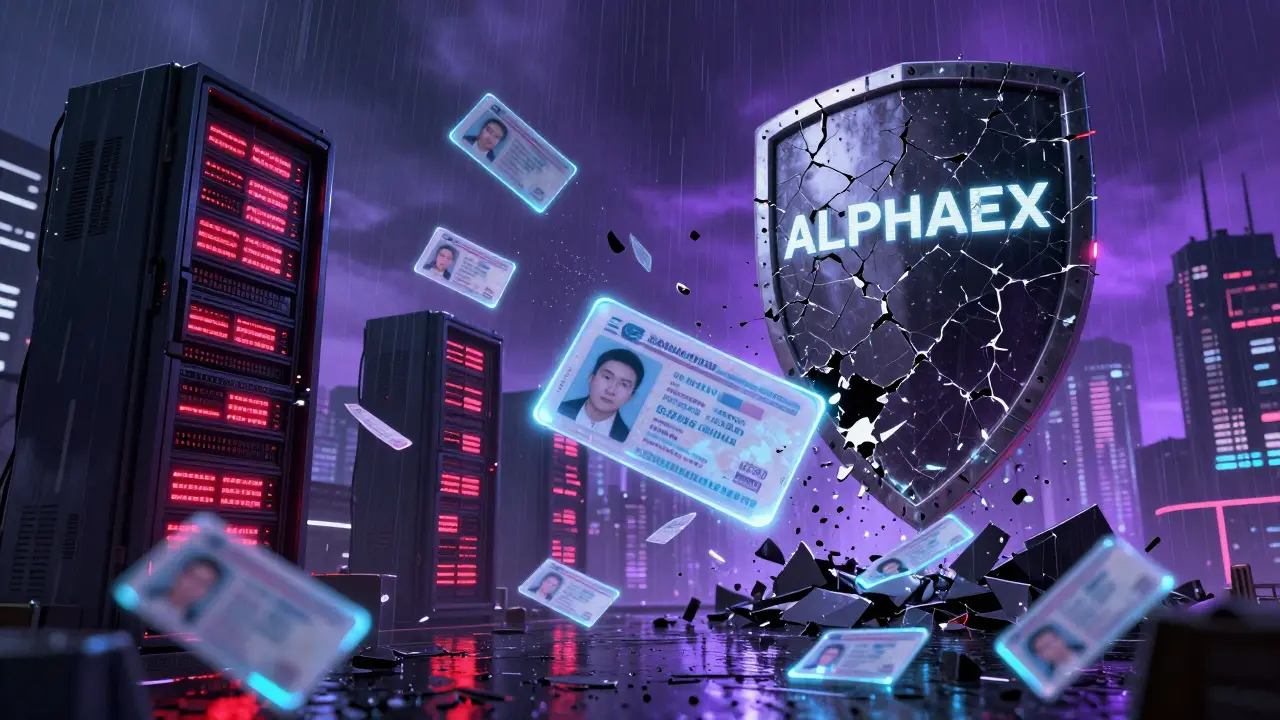
AlphaEx was once a name you might have seen on crypto forums or Reddit threads as a small exchange for trading Bitcoin and other digital assets. But today, it’s not a platform you should even consider. AlphaEx is defunct - not because it went out of business quietly, but because it suffered one of the worst security failures in recent crypto history. In early 2024, a misconfigured server exposed over 5,000 customer identity documents, including passports, driver’s licenses, and national ID cards. This wasn’t a small leak. This was a catastrophic breach that put real people at risk of identity theft, fraud, and targeted scams.
What Happened to AlphaEx?
The breach wasn’t caused by a hacker breaking in. It was caused by a simple, avoidable mistake: a server was left open to the public, and every document users uploaded for KYC verification - the legal requirement to prove who you are - was downloadable by anyone with a web browser. IDCARE, Australia’s identity and cyber support service, confirmed that 232 Australian citizens and 24 New Zealanders had their personal documents exposed. These weren’t just wallet addresses or email addresses. These were government-issued IDs. The kind of data criminals use to open bank accounts, apply for loans, or impersonate you online. What made it worse? AlphaEx didn’t notify users properly. IDCARE had to reach out directly to affected people, and even then, many weren’t reached. No public statement. No transparency. No apology. Just silence. Then, in March 2024, the domain alphaex.net reappeared - now claiming to be a “Bitcoin & Digital Asset Exchange powered by XDC Protocol.” But there’s no mention of the breach. No details on how they fixed the security flaws. No audit reports. No regulatory compliance info. This isn’t a revival. It’s a rebranding attempt by someone trying to cash in on the old name.Why This Breach Was So Dangerous
Crypto exchanges handle money, but they also handle your identity. That’s why security standards exist. The Cloud Security Alliance says exchanges must encrypt sensitive data, restrict access, and conduct regular audits. AlphaEx did none of that. Storing unencrypted ID documents is like leaving your house key under the mat - and then posting a photo of it online. When your passport or driver’s license is stolen, you’re not just at risk of losing crypto. You’re at risk of losing your entire financial identity. Cybercriminals use these documents to perform SIM swaps, where they take over your phone number, reset passwords for your bank and crypto accounts, and drain everything. Dr. Sarah Jamie Lewis, a cryptography researcher, says this kind of breach creates “compounded risks” - meaning the damage doesn’t stop at one platform. It spreads. Compare that to Coinbase, which uses nine layers of security including biometric logins, device tracking, and 24/7 monitoring. Or Kraken, which publishes its security audit reports publicly. AlphaEx didn’t even have one layer done right.How AlphaEx Compared to Other Exchanges
Top exchanges follow strict rules. They store over 95% of customer funds in cold storage - offline, air-gapped wallets that can’t be hacked remotely. They require two-factor authentication. They get audited at least twice a year by independent firms. They register with financial regulators. AlphaEx? No public records show it was registered with ASIC (Australia’s financial regulator). It didn’t appear on the official Digital Currency Exchange Register. It didn’t disclose its ownership. It didn’t publish any security policies. Its customer support was already slow before the breach - users reported verification taking over two weeks. That’s not just bad service. That’s a sign of poor internal operations, which often leads to security gaps. According to IDnow’s 2024 report, exchanges that don’t protect KYC documents see 3.7 times more account takeovers. AlphaEx’s breach wasn’t an accident - it was predictable. And now, it’s a textbook case in crypto security courses.
User Reactions and Community Response
People who used AlphaEx are still dealing with the fallout. One Reddit user, u/AusCryptoInvestor, shared how they got a call from IDCARE after the breach. They had to change every password, monitor their credit, and set up fraud alerts with Equifax and Experian. They spent 10 hours just trying to recover their identity. That’s not unusual. IDCARE says affected users typically spend 8 to 12 hours dealing with the aftermath. For some, it’s months of vigilance. Others have had their identities stolen and used to open credit cards or take out loans. That’s the real cost of using an insecure exchange. BitcoinTalk moderators added AlphaEx to their “Caution List” in March 2024. Trustpilot has no active reviews - only old complaints about slow support. No one is defending it. No one is recommending it. The entire crypto community agrees: AlphaEx is a warning sign, not a platform.What About the Current AlphaEx Website?
The website at alphaex.net is live. It looks professional. It mentions “cutting-edge security technologies.” But look closer. There’s no mention of the breach. No explanation of how they’ve fixed it. No audit reports. No regulatory licenses. No team bios. No contact address. The domain was registered on March 5, 2024 - right after the breach went public. That’s not a coincidence. That’s a red flag. Arkose Labs’ Crypto Exchange Safety Checklist says legitimate exchanges clearly display their security certifications, compliance status, and audit history. AlphaEx.net doesn’t. That means it’s either a scam or a reckless attempt to relaunch without accountability. Either way, don’t trust it.
What You Should Do If You Used AlphaEx
If you ever signed up for AlphaEx, here’s what you need to do right now:- Place a fraud alert with Equifax, Experian, or TransUnion (available in Australia and New Zealand). These alerts last 90 days and can be renewed.
- Change every password you used on AlphaEx - especially if you reused it on your email, bank, or other crypto accounts.
- Enable two-factor authentication on all your important accounts, using an authenticator app like Authy or Google Authenticator - not SMS.
- Monitor your credit reports and bank statements for unusual activity.
- Consider freezing your credit. It’s free in Australia and New Zealand and stops anyone from opening new accounts in your name.
The Bigger Picture: Why This Matters
AlphaEx didn’t fail in a vacuum. In 2023, $3.68 billion was stolen from crypto platforms worldwide. Nearly 40% of those incidents involved stolen user data - not just coins, but identities. Australia’s AUSTRAC responded by requiring all registered exchanges to conduct quarterly security audits starting July 2024. The EU’s MiCA regulation, effective December 2024, will make similar rules mandatory across Europe. AlphaEx failed every single one of these standards. And now, it’s become a case study in what happens when you ignore security. Users are moving to safer platforms. Binance, Coinbase, and Kraken gained over 12 million new users in Q1 2024. Smaller, unregulated exchanges like AlphaEx are disappearing - and for good reason.Final Verdict: Avoid AlphaEx at All Costs
There’s no scenario where using AlphaEx makes sense. The original exchange is gone. The new website is suspicious. The data is out there. The trust is gone. No amount of marketing can fix what AlphaEx broke. If you’re looking for a crypto exchange, choose one that:- Is registered with a financial regulator (like ASIC or FinCEN)
- Publishes its security audits
- Stores most funds in cold storage
- Uses multi-factor authentication and encryption
- Has a clear, public response to past security issues
Is AlphaEx still operating as a crypto exchange?
No, the original AlphaEx exchange shut down after a major security breach in early 2024 that exposed thousands of customer identity documents. While a website at alphaex.net currently exists, it has no connection to the original company, provides no proof of security improvements, and is widely considered a suspicious rebranding attempt. Do not use it.
What kind of data was leaked in the AlphaEx breach?
Over 5,000 identity documents were exposed, including Australian and New Zealand driver’s licenses, passports, proof of age cards, and national identity cards. These are highly sensitive documents that criminals can use for identity theft, SIM swaps, and fraudulent financial applications.
Was AlphaEx regulated or licensed?
No. AlphaEx did not appear on ASIC’s official Digital Currency Exchange Register, which is required for legal operation in Australia. It also showed no evidence of registration with any other financial authority. Its lack of regulatory compliance was one of many red flags before the breach.
Should I trust the current alphaex.net website?
No. The current alphaex.net site lacks transparency, provides no security audit reports, doesn’t mention the breach, and has no verifiable ownership details. Security experts and industry watchdogs classify it as a high-risk site that may be attempting to exploit the old brand’s name. Avoid it completely.
What should I do if I used AlphaEx in the past?
If you were a customer, immediately change all passwords used on AlphaEx, especially if reused elsewhere. Place fraud alerts with credit bureaus (Equifax, Experian, TransUnion), enable two-factor authentication on all important accounts, and monitor your financial statements for suspicious activity. Consider freezing your credit to prevent new accounts from being opened in your name.
How common are breaches like AlphaEx’s?
Exchanges that fail to protect KYC documents are among the most vulnerable. According to the Cloud Security Alliance, over 68% of breached exchanges had exposed customer identity information. AlphaEx’s case was extreme in scale, but the underlying failure - poor data handling - is sadly common in unregulated platforms.
Can AlphaEx ever recover its reputation?
Almost certainly not. Industry analysts agree that once identity documents are exposed at scale, user trust is permanently broken. Regaining credibility would require a complete ownership change, third-party security overhauls, and full transparency - none of which have occurred. The damage is irreversible.
Comments
13 Comments
Liza Tait-Bailey
So I just checked alphaex.net again and it's still up. Same sleek design, same empty about page. No audits, no team, no nothing. I swear if this was a crypto version of a sketchy gas station that says 'we fix anything!' I'd believe it less. Just delete the domain already.
Anthony Ventresque
I used AlphaEx back in 2022 just to trade a little BTC. Never had issues until the breach hit. I didn’t even know I was affected until my bank flagged a suspicious login attempt on my credit card. Turns out someone opened a loan in my name using my leaked driver’s license. Took me 6 months to fix. This isn’t just 'bad crypto' - it’s life damage.
Anna Gringhuis
Let’s be real - if you’re using an exchange that doesn’t register with ASIC or publish audits, you’re basically handing your ID to a stranger on the street and asking them to hold your cash. AlphaEx didn’t fail because of hackers. They failed because they were lazy, unprofessional, and didn’t care. And now? Someone’s rebranding it like it’s a new iPhone. Please.
Haley Hebert
My friend got caught in this and it was wild. She had to freeze her credit, change every password, set up alerts everywhere, and still gets phishing emails months later. She said the worst part wasn’t the money - it was the feeling that your identity isn’t yours anymore. Like someone else is living your life in the shadows. And AlphaEx just vanished. No apology. No help. Just silence. I don’t get how people still think 'crypto is wild' when this stuff is avoidable.
Jill McCollum
OMG I just saw the new alphaex.net and it's like they hired a high schooler to make a website in 2007. No SSL certificate? No contact info? No 'about us'? Bro, this is worse than a Nigerian prince email. I screenshot it and sent it to my crypto group. We all laughed. Then cried. Then made a meme.
Hailey Bug
If you’re still considering using any exchange without a public audit or regulatory registration, you’re not being bold - you’re being reckless. AlphaEx didn’t have one security layer. Not even basic encryption on KYC docs. That’s like leaving your house key in the lock and posting a video of it on TikTok. This breach was 100% preventable. And the fact that someone’s trying to reuse the name? That’s predatory.
Dustin Secrest
There’s a philosophical layer here that’s rarely discussed: when you entrust your identity to a platform, you’re not just giving them data - you’re surrendering a piece of your social contract. AlphaEx didn’t just mishandle documents; they violated the implicit trust between user and intermediary. In a world where digital identity is becoming our primary currency, this isn’t a technical failure - it’s an ethical collapse.
Josh V
People are still using sketchy exchanges?? Bro just use Coinbase already. It’s free. It’s safe. It’s got 2FA and cold storage and actual humans answering support tickets. Why are we still debating this? AlphaEx is dead. The new site is trash. Move on. Your identity is worth more than your FOMO
Pat G
Why does America let these fly-by-night crypto scams exist? In Germany they’d be in jail by now. No license? No audit? Exposing passports? This isn’t innovation - it’s criminal negligence. And now they’re just rebranding? Someone needs to shut this down. Not just warn people - actually make them pay.
Alexandra Heller
It’s not just AlphaEx. It’s the whole culture. People treat crypto like a casino where the house doesn’t care if you lose. They don’t want regulation because they think it’s 'censorship.' But when your ID is out there and someone opens a credit card in your name, who’s the real tyrant? The regulator who demands audits? Or the clown who left the server wide open? Wake up.
myrna stovel
If you used AlphaEx, please don’t panic - but do act. I’ve helped over 20 people through this exact situation. Start with the fraud alert. It takes 10 minutes. Then change your passwords - use a password manager. Don’t use SMS 2FA. Get Authy. And if you’re scared to do it alone, DM me. I’ve got a free checklist. You’re not alone in this.
Hannah Campbell
ALPHAEX IS BACK BABY 🤡💸 The new site looks like it was built by a bot that hates humans. No contact info? No team? No ethics? This isn't a comeback - it's a horror movie sequel nobody asked for. I'm reporting it to the FTC just for fun. Let's watch them ignore it like they ignore everything else
Bryan Muñoz
Guys... I think this was a government op all along. AlphaEx was never real. The breach? Fake. The 'new site'? A trap to catch crypto users. They want your IP, your device fingerprint, your habits. Then they sell it to the NSA or whoever. This isn't a scam - it's a psyop. I saw the domain registration date. March 5th. Right after the breach. Too clean. Too perfect. They're watching us right now.
Write a comment