




If you're trading, staking, or holding cryptocurrency in the UK, you're probably wondering: how much do I actually owe in taxes? The answer isn't simple, and it’s changed dramatically in the last two years. What used to be a gray area is now a tightly enforced system with real penalties for mistakes. The UK government isn’t just watching - it’s tracking every trade, every staking reward, and every gift of crypto you’ve made since 2014.
What Counts as a Taxable Event?
The UK doesn’t treat crypto like cash. HMRC calls it a “cryptoasset,” and it’s taxed based on what you do with it. Not just selling. Not just cashing out. Every time you trade one coin for another, spend crypto on a coffee, or send it to a friend, it’s a taxable disposal. Even if you don’t make a profit, you still have to report it.Here’s what triggers a tax event:
- Selling crypto for pounds (GBP)
- Exchanging Bitcoin for Ethereum
- Using crypto to buy goods or services
- Gifting crypto to anyone who isn’t your spouse or civil partner
- Receiving crypto as payment for work or services
That last one is key. If you’re a freelancer and get paid in USDT, that’s income. If you earn staking rewards from Cardano, that’s income. If you get an airdrop, that’s income. And income is taxed differently than capital gains.
Capital Gains Tax: The £3,000 Rule
For disposals like selling or swapping crypto, HMRC applies Capital Gains Tax (CGT). The big change? The annual tax-free allowance dropped from £6,000 in 2024 to just £3,000 in 2025 and 2026. That’s not a typo. You now have half the room you did two years ago.Here’s how it works:
- If your total net gains from all crypto disposals in a tax year (April 6 to April 5) are under £3,000 - you pay nothing.
- If you hit £3,001 or more - you pay CGT on the full amount over the threshold.
And the rates? They went up too.
- 18% if your total taxable income (including crypto gains) is £50,270 or less
- 24% if your total taxable income is over £50,270
Before October 2024, the rates were 10% and 20%. Now, higher earners pay 4 percentage points more - and the allowance is cut in half. That means someone who paid £500 in CGT last year might now owe £1,200 this year, even if they made the same trades.
Income Tax: Staking, Mining, and Payments
Crypto you earn is treated like salary. That means it gets added to your other income - wages, freelance work, pensions - and taxed at your marginal rate.Personal allowance: £12,570 (2024/2025). That’s the amount you can earn before income tax kicks in.
Here’s how income tax brackets apply to crypto earnings:
- 20% on income between £12,571 and £50,270
- 40% on income between £50,271 and £125,140
- 45% on income over £125,140
So if you earned £8,000 in staking rewards and your salary is £40,000, your total income is £48,000. The £8,000 gets taxed at 20% because it pushes you into the higher bracket. No deductions. No exceptions.
And yes - even if you didn’t sell the crypto, you still owe tax on the value of the reward when you received it. If you got 0.5 ETH worth £1,200 in January, you owe income tax on £1,200 - even if ETH later dropped to £800.
What You Must Track
HMRC doesn’t guess. They require full records for every transaction. If you’re audited and can’t prove your cost basis, they’ll assume the worst - that every sale was fully taxable at the highest rate.You need to record:
- Date you acquired the crypto
- How much you paid (in GBP) - including fees
- Date you disposed of it
- How much you received (in GBP) - including fees
- Type of disposal (sale, swap, gift, etc.)
That’s not optional. HMRC’s 2025 guidance says exchanges must report transaction data directly to them by January 2026. So if you think you can hide behind an offshore exchange - think again.
Cost Basis and the Same-Day Rule
Calculating profit isn’t as simple as “I bought at £500, sold at £800.” HMRC uses specific rules to match your buys and sells.Here’s the technical part:
- Same-day rule: If you buy and sell the same crypto on the same day, the sale is matched to that day’s purchase. Profit or loss is calculated on that pair.
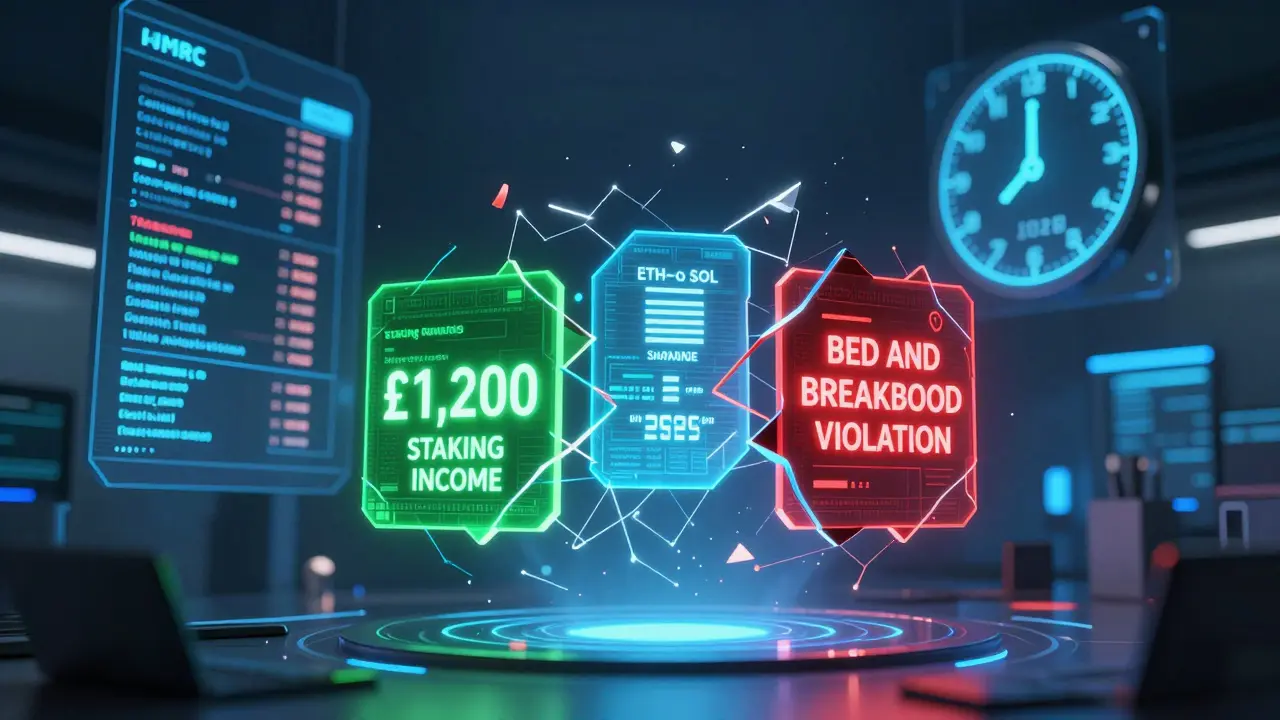
- Bed and breakfasting rule: If you sell crypto and buy it back within 30 days, HMRC treats it as one continuous position. You can’t reset your cost basis by selling and rebuying.
- Section 104 pool: For all other trades, you average your total cost across all holdings of the same crypto. If you bought 1 BTC for £40,000 and another for £45,000, your average cost is £42,500 per BTC.
These rules are why manual tracking is a nightmare. A single swap of ETH for SOL might involve 15 different purchases over 6 months. Without software, you’re doing math that would take a CPA hours.
Losses: Only for Gains, Not Income
If you lost money on crypto, you can use those losses to reduce your capital gains - but only capital gains.Example: You made £5,000 in gains from selling Bitcoin, but lost £2,000 on Solana. You only pay CGT on £3,000. You can carry forward unused losses indefinitely. So if you lose money this year, you can offset it against profits next year.
But here’s the catch: you can’t use crypto losses to reduce your income tax. If you earned £10,000 in staking rewards and lost £7,000 trading, you still pay income tax on the full £10,000. The loss doesn’t help.
What’s Changing in 2026?
The rules aren’t done evolving. Starting January 2026, all UK-based crypto exchanges - including Binance, Kraken, and Coinbase - must report every user transaction to HMRC. This isn’t voluntary. It’s mandatory under the FATF Travel Rule.That means:
- HMRC will know exactly when you bought, sold, or swapped crypto
- They’ll have your cost basis and proceeds
- If your self-reported tax return doesn’t match their data - you’ll get a letter
And there’s more. The Financial Conduct Authority approved crypto exchange-traded notes (ETNs) in October 2025. These could let you invest in crypto through a Stocks & Shares ISA - meaning gains inside the ISA are tax-free up to £20,000 per year. But this doesn’t change your current tax bill. It just gives you a new way to invest going forward.

Real-World Pain Points
People are struggling. One Reddit user spent 40 hours manually tracking 500 transactions across three exchanges. Another thought gifting £4,000 in ETH to their brother was tax-free - until HMRC sent a bill for £240 in CGT.Survey data shows:
- 87% of UK crypto investors find tracking transactions overwhelming
- 68% say calculating cost basis across multiple exchanges is their biggest headache
- Only 38% used tax software in 2023 - now it’s 62%
Software like Koinly, CoinLedger, and Blockpit now handle the math - but they cost money. And even then, they can’t fix bad data. If you forgot to log a transfer from a hardware wallet, the software won’t know.
What You Should Do Now
1. Export your transaction history from every exchange, wallet, and DeFi platform you’ve used since 2014. 2. Separate income from capital events. Track staking, airdrops, and payments separately from trades. 3. Use tax software. Manual tracking is no longer feasible. Tools like Koinly or CoinTracker can auto-import data and apply HMRC rules. 4. File by January 31. The deadline for the 2025/2026 tax year is January 31, 2027. Late filings mean penalties - and HMRC is cracking down. 5. Don’t gift crypto to friends. That’s a taxable event. Only spouses are exempt.The UK is no longer a crypto tax haven. It’s a tightly regulated system with real teeth. Ignorance won’t save you. Delaying won’t help. If you’re holding or trading crypto here - you’re in the system. And HMRC already has your data.
Do I pay tax if I just hold crypto and don’t sell?
No, holding crypto without selling, swapping, or spending it doesn’t trigger a tax event. You only owe tax when you dispose of it - meaning you sell it, trade it for another coin, use it to buy something, or gift it to someone who isn’t your spouse. Simply holding it in a wallet is tax-free.
What if I lost money on crypto? Can I get a refund?
You can’t get a refund for crypto losses, but you can use them to reduce your future capital gains tax. For example, if you lost £5,000 this year and make £8,000 next year, you only pay CGT on £3,000. Losses can be carried forward indefinitely, but they can’t be used to lower your income tax or get cash back.
Are airdrops and staking rewards taxed?
Yes. Airdrops and staking rewards are treated as income. You pay income tax on the pound value of the crypto when you receive it - even if you don’t sell it. If you get 10 ADA worth £300 in staking rewards, you owe income tax on £300. Later, if you sell that ADA, you may also owe capital gains tax on any profit above your cost basis.
Do I need to report crypto if I made under £3,000 in gains?
Technically, you don’t owe tax if your total gains are under £3,000. But HMRC still expects you to report all disposals if you’re required to file a Self-Assessment tax return. If you’re not already filing one, you don’t need to start just because of crypto - unless you have other income sources. But if you’re already filing, you must include all crypto transactions.
Can I avoid tax by using an offshore exchange?
No. Starting January 2026, all UK-based exchanges must report your data to HMRC. Even if you use an offshore exchange like Binance or KuCoin, HMRC can still get your transaction history through international agreements. Plus, if you’re a UK resident, you’re taxed on your worldwide income and gains. Moving your trades overseas doesn’t change your tax liability - it just makes record-keeping harder.
Comments
21 Comments
Mansoor ahamed
UK crypto tax rules are brutal. £3k allowance? That's like being taxed on every coffee with Bitcoin. I'm from India, and we still have gray zones. This is next-level enforcement.
Brad Zenner
I've been holding since 2021. Never sold. Never swapped. Just stacked. Still feels weird knowing HMRC has my wallet history. But honestly? I'm not worried.
Tony Phillips
I used to think crypto was tax-free until I got a letter from HMRC last year. Turned out I forgot about a 0.02 ETH airdrop from 2022. £4.50 in income tax. I paid it. Peace of mind is worth it.
YANG YUE
The system doesn't care if you're rich or poor. It cares if you moved the asset. That's the beauty of it. No moral judgment. Just math. You bought. You sold. You owe. No drama. Just reality.
Anna Lee
OMG I just realized I forgot to log 3 staking rewards from 2023 😱 I'm using Koinly now and it's a game changer. Seriously, if you're not using software, you're doing yourself a disservice. You got this!
Shana Brown
I used to gift ETH to friends thinking it was nice... until I got a bill for £180. Now I just send cash. Less drama. Less taxes. Less guilt. 🤷♀️
DarShawn Owens
I'm glad someone finally laid this out clearly. I was terrified of filing until I read this. Took me 3 days to export all my data. Now I feel calm. Knowledge is power.
Ananya Sharma
I hold only. No trades. No staking. Just Bitcoin in cold wallet. So far so good. HMRC can't tax what you don't touch.
Alicia Speas
While the rules are strict, they are also transparent. That is preferable to ambiguity. Compliance is not oppression. It is participation in a regulated financial system. The alternative is chaos.
Dheeraj Singh
You people are overreacting. £3k allowance? I made £15k last year and paid £1k. That's like 7% effective tax. You're whining about being taxed like normal humans? Get a job.
Mike Yobra
So HMRC is basically the crypto IRS. And we're all just... paying up? I guess that's what happens when you live in a country where the government knows what you ate for breakfast.
Kayla Thompson
This is why crypto will never go mainstream. You want people to use Bitcoin for coffee? Then you tax every damn latte. Brilliant. Just brilliant.
Brijendra Kumar
If you're still using Excel to track crypto you're an idiot. You're not saving money. You're risking an audit. Software isn't optional. It's survival. Stop pretending you're a crypto ninja.
Pradip Solanki
The bed and breakfast rule is a trap for the uninitiated. You think you're arbitraging but HMRC sees one long position. Section 104 pool is your only friend if you're not using software. Don't overcomplicate.
Alice Clancy
USA has no federal crypto tax law. We're still in the Wild West. UK is just being smart. You want to play in the big leagues? You pay the tax. Simple. No whining.
Shelley Dunbrook
The shift from £6k to £3k is significant, but it reflects the maturation of the market. We are no longer a fringe asset class. Taxation is a sign of legitimacy, not oppression.
Florence Pardo
I spent 42 hours last year tracking 800 transactions across 4 wallets and 3 exchanges. I cried. I screamed. I almost quit crypto. But then I got Koinly. It imported everything in 5 minutes. I now sleep. I recommend it to everyone. It's not a luxury. It's therapy.
Tammy Stevens
I'm a mom who staked 20 ADA last year. Got £60 in rewards. Paid £12 in tax. Felt weird at first. Then I realized: I'm part of the economy now. Not some rebel. Just a person. And that's okay.
Sam Harajly
The real issue isn't the tax rate. It's the lack of education. Most people don't know what a disposal is. Or that gifting counts. HMRC should offer free workshops. Not just penalties.
Aman Kulshreshtha
I'm from India. We don't have crypto tax yet. But I'm filing UK returns because I moved there last year. The system is rigid. But fair. If you're honest, you'll be fine. Just don't ignore it.
Leona Fowler
I used to think I could skip reporting if I didn't sell. Then I realized staking rewards are income. I owe £210. Paid it. No regrets. The peace of mind is worth more than the money.
Write a comment