


When you trade crypto, every trade costs something. Even if it’s just 0.1%, those fees add up fast-especially if you’re active. But what if you could cut those fees in half? That’s where exchange token fee discounts come in. They’re not magic. They’re a simple, powerful tool built into most major crypto exchanges to reward users who hold their native tokens. And if you use them right, you can save hundreds or even thousands of dollars a year.
How Exchange Token Fee Discounts Actually Work
Most crypto exchanges charge a fee every time you buy or sell. That’s usually between 0.1% and 0.5% of the trade value. On a $10,000 trade, that’s $10 to $50 gone right away. Now, imagine paying only $5 instead. That’s what exchange tokens can do. Here’s the basic setup: exchanges like Binance, KuCoin, and OKX issue their own tokens-BNB, KCS, OKB. If you hold these tokens in your account and choose to pay your trading fees in them, you get a discount. The discount isn’t random. It’s built into the platform’s rules. For example:- Binance’s BNB gives you up to 25% off trading fees
- OKX’s OKB can reduce fees by up to 20%
- KuCoin’s KCS offers discounts as high as 30%
- Gate.io’s GT token cuts fees down to 0.03% for makers and 0.036% for takers-nearly 80% off the base rate
Why Exchanges Built This System
It’s not generosity. It’s smart business. When exchanges launched their tokens, they needed funding. Selling tokens to users raised hundreds of millions-sometimes billions-without giving away equity. That money helped them build infrastructure, hire teams, and compete with bigger players. But the real win? Locking users in. If you’re saving 20% on every trade because you hold BNB, you’re less likely to switch to another exchange. That’s sticky revenue. And as more people use the token, demand goes up. That pushes the token’s price higher. Which makes users feel like they’re winning-saving on fees and watching their holdings grow. But here’s the catch: if the token crashes, your savings vanish. And if the exchange goes under? You lose everything. That’s what happened with FTX and FTT. The token wasn’t just a discount tool-it was tied to the exchange’s financial health. When FTX collapsed, FTT dropped 95%. People who held it for fee discounts ended up losing far more than they saved.Real Savings: How Much Can You Actually Save?
Let’s say you trade $50,000 a month. At a 0.2% fee, that’s $100 in fees. Now, switch to paying with BNB at a 25% discount. Your fee drops to $75. That’s $25 saved per month. $300 a year. Now scale that up. If you trade $200,000 a month, you’re saving $100 a month. $1,200 a year. And if you’re trading $1 million a month? You’re saving $4,000 a year just from the discount. Some users report saving over $10,000 annually. But those are usually professional traders with high volumes and disciplined token management. For most people, $200-$800 a year is realistic. The real kicker? The discount compounds. The more you trade, the more you save. The more you save, the more you can reinvest. And if the token price rises? You get a double win: lower fees and higher asset value.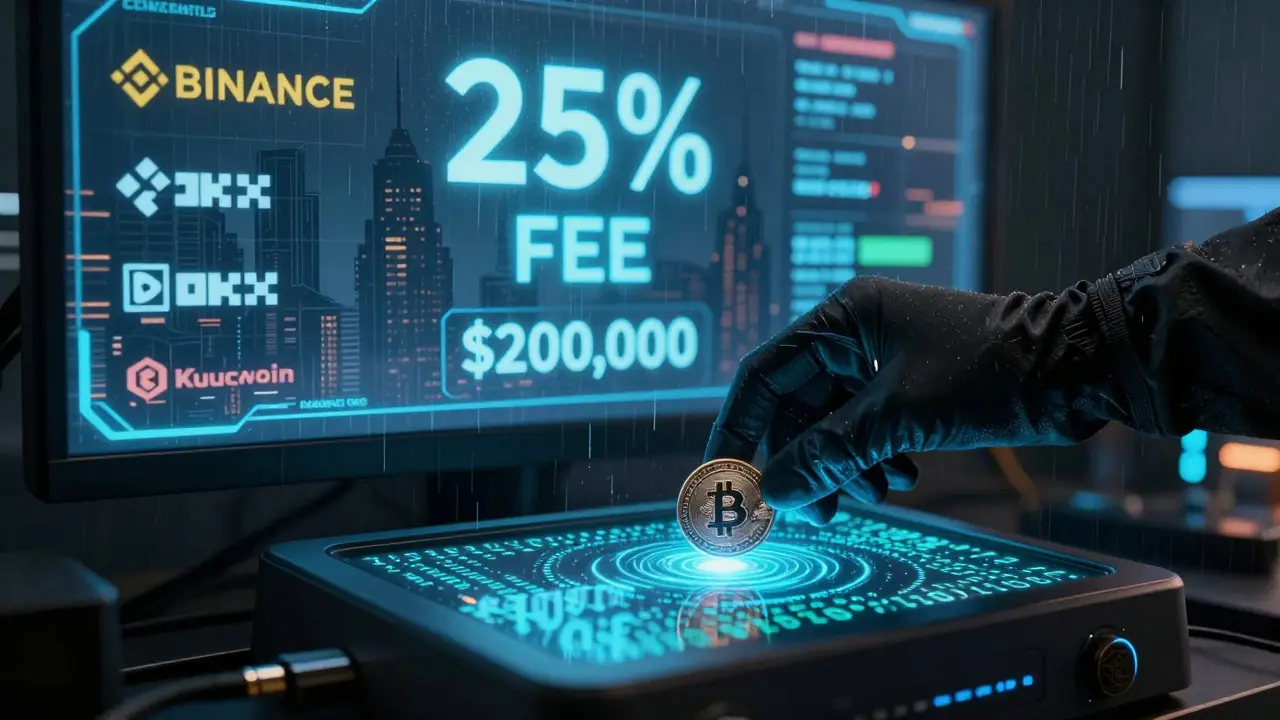
How to Start Using Exchange Token Discounts
It’s not complicated. Here’s how to do it in three steps:- Buy the exchange’s native token. Go to the spot market on your exchange and buy BNB, OKB, KCS, or GT. You don’t need to buy a lot-$50-$100 is often enough to unlock the discount.
- Enable fee payment in the token. Go to your account settings. Look for “Fee Payment” or “Discount Settings.” Toggle it to pay fees in the native token. Save your changes.
- Monitor your holdings. Some platforms require you to keep a minimum balance. If you sell your token, your discount disappears. Set a reminder to check your balance monthly.
When It’s Not Worth It
This isn’t for everyone. If you trade once a month and only $1,000 at a time, you’re saving maybe $1-$2 a month. Buying a $50 token just to get that discount? Not worth the risk. The token could drop 30% in a week, wiping out your savings and then some. Also, avoid this if you don’t understand volatility. Exchange tokens are risky. They’re tied to the exchange’s success. If the exchange gets hacked, faces regulatory trouble, or loses users, the token can crash hard. FTX is the clearest example-but it’s not the only one. Several smaller exchanges have vanished, taking their tokens with them. Professional traders treat these tokens like a tool, not an investment. They buy just enough to get the discount. They don’t hold long-term. They rebalance. If the token rises 50%, they sell half to lock in profit. If it drops 20%, they buy more to keep their discount active.Alternatives to Exchange Tokens
You don’t have to use exchange tokens to save on fees. Some platforms offer lower fees if you use their native blockchain. For example, trading on Binance Chain or Solana often has lower fees than on Ethereum-based exchanges. Others give discounts for using their debit cards or staking tokens. KuCoin lets you earn interest on your KCS while still using it for fee discounts. You can also avoid fees entirely by trading on peer-to-peer platforms or using decentralized exchanges (DEXs) like Uniswap. But DEXs have their own costs-gas fees on Ethereum can be $10-$50 per trade. On Optimism or Arbitrum, those drop to under $1. So sometimes, using a centralized exchange with a token discount is still cheaper.
What to Watch Out For
There are three big traps:- Hidden tier systems. Some exchanges say “up to 50% off” but only if you’re trading $1 million a month and holding $50,000 in tokens. Read the fine print.
- Dynamic changes. Exchanges can change discount rules with little notice. Binance cut its BNB discount from 50% to 25% in 2022. Users were caught off guard.
- Token devaluation. If your token drops 40%, your $1,000 discount is now worth $600. You’re still saving, but you’ve lost value elsewhere.
Future of Exchange Tokens
The trend is toward more utility. Binance’s BNB now pays for cloud services, travel bookings, and even insurance. OKB can be used for loans on OKX’s DeFi platform. Gate.io lets you use GT to pay for NFT minting fees. But regulation is catching up. The SEC has flagged exchange tokens as potential securities. That’s why platforms now emphasize “utility” over “investment.” They’re trying to avoid the FTX fate. The future belongs to exchanges that build real-world use cases for their tokens-not just trading discounts. But for now, the fee discount remains the most powerful reason to hold them.Final Thought: Is It Worth It?
If you trade regularly-weekly or more-and you understand crypto volatility, then yes. Exchange token fee discounts are one of the best ways to reduce your trading costs. They’re simple, transparent, and effective. But if you’re a casual trader, or you don’t want to manage another volatile asset, skip it. Stick with low-fee exchanges like Kraken or Bitstamp that don’t require token holdings. The math is clear: save on fees, and you keep more of your profits. But don’t let the discount blind you to the risk. Treat your exchange token like a tool. Not a treasure.Do I need to hold a lot of exchange tokens to get the discount?
No. Most exchanges offer the basic discount with as little as $50-$100 worth of the token. Higher holdings unlock bigger discounts, but you don’t need to buy in bulk to start saving.
Can I use multiple exchange tokens for discounts at once?
No. You can only pay fees in one native token at a time. Most platforms let you choose which token to use in your account settings, but you can’t combine them for a bigger discount.
Do fee discounts apply to margin and futures trading?
Usually, yes. Most exchanges extend the discount to all trading types-spot, margin, and futures. But always check the platform’s fee schedule. Some limit the discount to spot trades only.
What happens if the exchange token crashes?
You still get the discount-but your token holdings lose value. If you bought $1,000 worth of BNB for fee savings and it drops 50%, you’ve lost $500 even if you saved $300 in fees. The discount doesn’t protect you from price risk.
Are exchange token discounts taxed?
Yes. In most jurisdictions, using a token to pay fees is treated as a sale of that token. You may owe capital gains tax on any appreciation since you bought it. Keep records of your purchase price and the token’s value at the time you used it for fees.

Comments
25 Comments
Krista Hoefle
lol why are you even talking about this like it's a free lunch? exchange tokens are just exit liquidity for the devs. you think bnb's gonna save you when binance gets raided again?
Kip Metcalf
bro just use bnb. it's easy. you save money. you chill. life is good.
Jon Martín
THIS IS THE MOST IMPORTANT THING YOU'LL HEAR THIS YEAR IF YOU TRADE CRYPTO YOU'RE LEAVING MONEY ON THE TABLE IF YOU'RE NOT USING YOUR EXCHANGE TOKENS I MEAN COME ON
Mujibur Rahman
The utility of native tokens extends beyond mere fee discounts. In jurisdictions with regulatory scrutiny, the tokenomics must be structured to avoid classification as a security. Binance's BNB has evolved into a multi-chain utility token with staking, payments, and even fiat on-ramp integrations. This is strategic ecosystem lock-in, not altruism
Jennah Grant
I like how this post frames it as a tool, not an investment. That’s the key. I hold just enough KCS to get the 30% discount and rebalance quarterly. No gambling.
Dennis Mbuthia
You guys are so naive. The SEC is coming for these tokens. Binance is already under investigation. You think they're gonna let you keep your 'discount' when they shut them down? You're just funding a pyramid scheme with your trading volume.
Staci Armezzani
If you're trading under $10k/month, don't bother. The gas to buy the token and the risk of it dropping isn't worth $5/month. But if you're active? Totally worth it. I've saved over $1k this year with BNB.
Tracey Grammer-Porter
I started with $50 of GT and now I'm saving 80% on fees. I didn't even know it was possible until I saw someone mention it in a Discord. It's crazy how simple it is once you know where to look
Don Grissett
You think this is smart? You're trusting your savings to a private company that can change the rules tomorrow. I've seen 3 exchanges collapse. Their tokens went to zero. Your 'discount' becomes a $20k loss. Don't be a sheep
Brittany Slick
I used to think this was just a gimmick... until I saw my fee history. Before BNB: $120/month. After: $85. That’s $420 a year I didn’t have to give away. Now I buy a little every payday. It’s like a secret perk no one talks about.
Sherry Giles
This is all a psyop. The exchanges are printing tokens to pump their own stock prices. They know you'll buy them thinking you're saving money. But the real winners are the insiders who dumped before the crash. FTX didn't die. It was murdered.
Denise Paiva
The implicit assumption that fee discounts constitute economic utility is fallacious. The token’s value proposition is contingent upon centralized governance, which is inherently antithetical to the decentralization ethos of cryptocurrency. One is thus compelled to question whether such mechanisms are not merely extractive rent-seeking disguised as consumer benefit.
Valencia Adell
I used to be one of you. Then I lost $18k in OKB when OKX froze withdrawals. You think you're saving money? You're just giving them your money while they laugh all the way to the bank. Wake up.
Sarbjit Nahl
The economic logic is sound. But the philosophical contradiction remains: using a centralized token to reduce fees on a centralized platform negates the very premise of decentralization. One must ask: are we optimizing for cost or ideology?
Paul Johnson
You people are so dumb. You think you're smart for using BNB? You're just making it easier for them to track you. They know exactly how much you trade, how often, and how desperate you are to save a few bucks. You're not a trader. You're a data point.
Kelley Ramsey
I just bought $75 of KCS last week and turned on the discount. My fees dropped from 0.2% to 0.14%. I didn't even notice it at first... then I checked my statement. Holy crap. I'm doing this for life.
Jessie X
I used to ignore this until I started trading more. Now I keep a small balance in BNB and GT. It’s not an investment. It’s like having a loyalty card. Why not use it?
Natalie Kershaw
The real win is compound interest on your savings. Save $50/month on fees → reinvest it → earn more → save more. Over 5 years that’s like an extra $5k+ in your portfolio. It’s not flashy but it’s real
Jacob Clark
I JUST FOUND OUT ABOUT THIS AND I'M SO MAD I DIDN'T KNOW SOONER. I'VE BEEN PAYING $200 A MONTH IN FEES AND NOW I'M PAYING $150. I'M GOING TO BUY A LOT MORE BNB RIGHT NOW. THIS CHANGES EVERYTHING.
Danyelle Ostrye
I don't use any exchange tokens. I just use Kraken. Lower fees, no drama, no token risk. Why make it complicated?
Becky Chenier
It's fascinating how behavioral economics plays into this. The discount creates a sunk cost fallacy - you hold the token not because you believe in it, but because you don't want to lose the benefit. Clever design.
Katrina Recto
I hold GT because I trade on Gate.io daily. The discount is 78% off. I bought $200 worth. It’s now worth $350. So I saved $800 in fees and made $150 on the token. Win-win.
greg greg
I’ve been analyzing this for months. The discount tiers are intentionally designed to incentivize both volume and token accumulation, creating a feedback loop that locks users in. The exchange benefits from increased liquidity, lower customer acquisition costs, and higher token valuation-all while users believe they’re getting a deal. But the real cost isn’t the fee-it’s the opportunity cost of not diversifying. If you hold 80% of your trading capital in BNB because you’re scared to lose the discount, you’re not saving money-you’re exposing yourself to single-point failure. And when the exchange gets hacked or regulated out of existence, as happened with FTX, your 'savings' evaporate along with your holdings. The math looks good on paper, but the risk-reward profile is skewed toward the exchange, not the user. You’re not a customer. You’re a revenue stream with a loyalty card.
Andy Schichter
Oh wow. So we're supposed to be impressed that you're using a coupon code from a company that might vanish tomorrow? Congrats. You saved $300. You also lost $10k in FTT. We see you.
Emily Hipps
I love how this post doesn't sugarcoat it. I used to think exchange tokens were shady, but now I treat them like a utility bill-pay them, use them, don't fall in love with them. I keep mine under 5% of my portfolio. Smart, simple, safe.
Write a comment