



You lock up your crypto tokens, wait a few months, and check your balance. The number is higher, but is it the number you expected? If you’ve ever stared at a dashboard showing a '10% APY' only to see your actual earnings drift lower or higher than projected, you aren’t alone. The disconnect usually comes down to one thing: most people don’t understand the math behind staking rewards calculation.
We often treat staking like a savings account where the bank promises a fixed rate. But blockchain networks are not banks. They are decentralized systems with dynamic variables. To truly maximize your returns and avoid unpleasant surprises, you need to look past the marketing numbers and understand the mechanics of how those rewards are actually generated, distributed, and calculated.
The Core Formula: Why APY Isn't Just Simple Interest
At its simplest level, staking rewards are compensation for securing a network. In Proof-of-Stake (PoS) blockchains, validators lock up tokens to verify transactions. In return, the protocol mints new tokens or distributes transaction fees to them. This process is governed by mathematical formulas that determine the Annual Percentage Yield (APY).
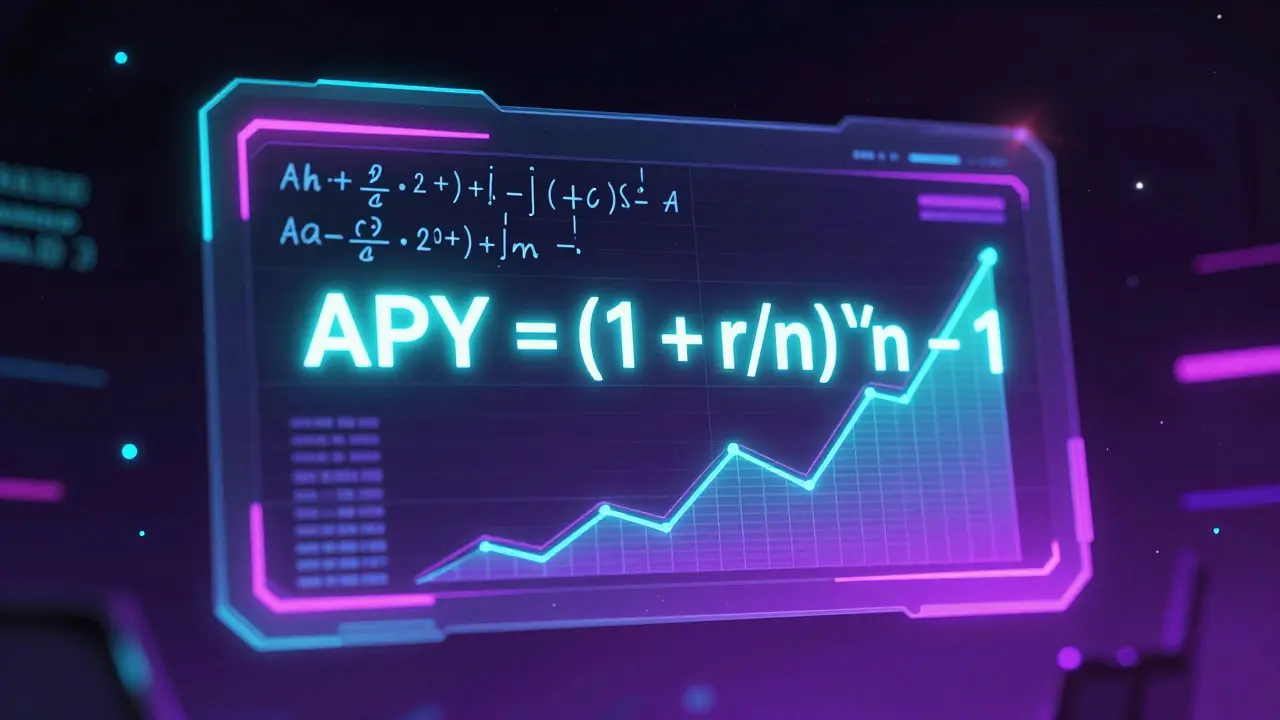
The standard formula used across most platforms looks like this:
APY = (1 + r/n)n − 1
Here’s what those letters mean in plain English:
- r: The periodic rate of return (the base reward rate per period).
- n: The number of compounding periods per year.
Let’s break this down with a real-world example. Imagine you stake on a network with a 5% annual base rate. If the rewards compound daily (365 times a year), your effective yield isn't exactly 5%. It’s slightly higher because you earn interest on your interest every single day. Using the formula, that 5% base rate becomes approximately 5.13% APY. It sounds small, but over millions of dollars in assets, that fraction makes a massive difference.
However, this formula assumes a static environment. In reality, Total Supply and Inflation Rate change constantly. As more people stake their tokens, the total amount of staked capital increases. On many networks, as the staking ratio goes up, the individual APY goes down to prevent excessive inflation. This inverse relationship is crucial: the more popular a chain becomes for staking, the lower your personal yield might drop unless the protocol adjusts its emission rates.
Ethereum’s Complex Reward Structure
No discussion on staking calculations is complete without looking at Ethereum. After its transition to Proof-of-Stake in September 2022, Ethereum became the largest staking ecosystem in the world. Its reward structure is not a single flat rate; it’s a multi-layered system.
Your total reward on Ethereum consists of three main components:
- Base Attestation Rewards: These are earned for being online and correctly validating blocks. Think of this as your salary for showing up to work.
- Block Proposal Rewards: When you are chosen to propose a new block, you get an extra bonus. This is performance-based pay.
- MEV-Boost Rewards: This stands for Maximum Extractable Value. Validators can optimize the order of transactions within a block to capture additional value from arbitrage opportunities. This can add significant upside, sometimes boosting yields by an extra 1-2%.
The challenge here is variability. Your uptime matters. If your validator node goes offline, you don’t just miss out on rewards; you risk being slashed (penalized). Furthermore, the total number of active validators affects everyone’s share. As of mid-2024, over 900,000 validators were active on Ethereum. With such high participation, the base APY has settled around 3-4%, depending on market conditions. Understanding that your return is diluted by the sheer volume of other participants is key to setting realistic expectations.
| Platform Type | Reward Calculation Method | Predictability | Key Risk Factor |
|---|---|---|---|
| Self-Validated (e.g., Ethereum) | Dynamic based on uptime & network size | Low (Variable) | Slashing penalties & technical downtime |
| Custodial Exchange (e.g., Coinbase) | Net APY after platform fees | Medium (Adjusted periodically) | Counterparty risk & withdrawal limits |
| Guaranteed Rate Services (e.g., Coinhouse) | Fixed rate paid by provider | High (Fixed) | Provider insolvency & lower max yield |

Guaranteed Rates vs. Variable Yields
Not all staking providers use the same calculation logic. Some platforms, like Coinhouse, have introduced a "Guaranteed Rate" methodology. Instead of passing through the fluctuating blockchain rewards directly, they absorb the variance and offer a fixed percentage, such as a guaranteed 9% on certain assets.
Why would a company do this? They likely stake at a higher aggregate level, negotiate better terms, or use sophisticated hedging strategies. For the user, this eliminates the anxiety of watching your APY drop from 8% to 6% overnight. However, there’s a trade-off. Guaranteed rates are often capped below the potential maximum yield of the native protocol. You are paying for predictability.
In contrast, traditional exchanges like Phemex or Binance typically offer variable rates that track closely with the underlying network’s performance minus their service fee. Their calculators allow you to input your amount and duration to get a projection, but these are estimates, not promises. If the network congestion spikes or the token price crashes, affecting the incentive structure, your realized yield may differ from the calculator’s output.
Hidden Variables That Eat Into Your Profits
When calculating your net profit, you must subtract costs that aren’t always obvious. Here are the silent killers of staking yields:
- Service Fees: Most custodial services charge between 5% and 20% of your rewards. If your gross APY is 5% and the fee is 10%, your net APY is 4.5%. Always ask: Is this fee taken from the principal or just the rewards?
- Tax Implications: In many jurisdictions, including Canada and the UK, staking rewards are treated as income at the time they are received. This means you owe tax on the fair market value of the tokens when they hit your wallet, even if you haven’t sold them. In Germany, holding crypto for over 10 years can make gains tax-free, but the rules for staking income are still evolving. In the US, recent court cases suggest some flexibility, but the IRS generally views staking rewards as taxable ordinary income.
- Opportunity Cost: Locked-up capital cannot be moved during a bull run. If the token price doubles while your funds are locked in a 6-month staking contract, you miss the chance to sell. Liquidity risk is a major factor in your overall return calculation.

Optimizing Your Staking Strategy
So, how do you apply this knowledge to earn more? First, diversify your understanding of protocols. Not all chains operate like Ethereum. Some newer Layer-1 blockchains offer much higher APYs (sometimes 10-20%) to attract initial liquidity. However, these high rates come with higher risk, including potential devaluation of the token itself. A 20% APY means nothing if the token price drops 50% in the same period.
Second, consider the duration. Research from firms like Figment.io suggests that extending staking durations can optimize returns due to reduced churn and better compounding effects. Short-term staking often incurs higher relative fees or lower tiered rates.
Third, monitor your validator’s performance if you are self-staking. Tools that track uptime and MEV extraction efficiency can help you choose the best delegation pools. If you are using a centralized exchange, check their historical payout consistency. Do they pay out daily, weekly, or monthly? More frequent compounding (higher 'n' in the formula) leads to higher final balances.
Finally, keep detailed records. Because staking rewards are complex and taxable events occur frequently, manual tracking is error-prone. Use dedicated portfolio trackers that integrate with blockchain APIs to log every reward receipt accurately. This ensures you’re ready for tax season and gives you a true picture of your annualized return versus the advertised APY.
Looking Ahead: The Future of Staking Calculations
The landscape is shifting. With the global staking market projected to grow from $18 billion in 2023 to over $83 billion by 2030, we are seeing increased institutional adoption. Banks and custody providers are entering the space, bringing stricter compliance and potentially more standardized calculation methods.
We also expect to see more integration of AI tools that dynamically adjust staking positions across multiple chains to optimize yield while managing risk. Cross-chain staking protocols will allow users to accumulate rewards from different networks simultaneously, further complicating the simple APY formula but offering greater diversification benefits.
For now, the rule remains: trust the math, not the marketing. Understand whether you are getting a variable yield tied to network health or a fixed rate backed by a provider’s balance sheet. Know your fees, know your taxes, and never stake more than you can afford to lock away.
Is staking rewards calculation the same as mining?
No. Mining uses Proof-of-Work, where rewards are fixed per block and depend on hardware power. Staking uses Proof-of-Stake, where rewards are calculated based on the amount of tokens locked, the total supply, and the network's inflation rate. Staking rewards are generally more variable and dependent on economic factors rather than computational power.
Why does my actual APY differ from the advertised rate?
Advertised rates are often estimates based on current network conditions. Actual APY changes due to fluctuations in the total amount of staked tokens (more stakers = lower individual yield), validator performance, transaction fee volatility, and platform service fees. Additionally, compounding frequency affects the final realized yield.
What is MEV-Boost and how does it affect my rewards?
MEV-Boost (Maximum Extractable Value) allows validators to include profitable transaction sequences (like arbitrage trades) in blocks they propose. This generates extra revenue beyond the standard block reward. If you delegate to a validator using MEV-Boost, your rewards may be higher, but it requires advanced infrastructure and carries specific risks related to centralization concerns.
Are staking rewards taxable in Canada?
Yes. In Canada, the Canada Revenue Agency (CRA) generally treats staking rewards as income at the time they are received. You must report the fair market value of the rewards in Canadian dollars on the day you receive them. Subsequent sales of those tokens may trigger capital gains tax.
Can I lose money while staking?
Yes. While you rarely lose the principal amount in simple staking, you can face 'slashing' penalties if you are a validator and act maliciously or go offline frequently. Additionally, if the token price drops significantly, the value of your staked assets decreases. There is also counterparty risk if you use a third-party custodian that fails or gets hacked.
How often are staking rewards compounded?
It depends on the platform. Self-custody staking on Ethereum compounds automatically with every epoch (roughly every 5-6 minutes) as rewards are added to your balance. Custodial platforms may compound daily, weekly, or monthly. More frequent compounding results in a higher effective APY due to the exponential growth formula.