
When you hear "crypto exchange," you probably think of buying Bitcoin, swapping Ethereum, or trading meme coins. But PiperX v3 isn’t like that. It doesn’t trade Bitcoin or Dogecoin. It trades something no other exchange touches: intellectual property. That’s right - songs, patents, books, and even TikTok trends, turned into blockchain tokens. Sounds futuristic? It is. But as of February 2026, PiperX v3 is still mostly a promise on paper.
What PiperX v3 Actually Does
PiperX v3 isn’t trying to compete with Uniswap or PancakeSwap. It doesn’t need millions in daily volume. It’s built for one thing: letting creators turn their IP into tradeable assets. Think of it like a stock market for songwriters, inventors, and digital artists - except instead of shares, they issue NFTs backed by copyright claims.
The platform runs on the Story Layer 1 blockchain, which uses AI agents as part of its consensus system. That’s not just a buzzword. These agents verify IP ownership, track usage rights, and even help match buyers with creators. The whole system is built around something called "CreativityProof," a patent-pending tech that rewards users not for staking coins, but for creating new IP - like writing a track, designing a logo, or filing a patent.
Traditional DEXs ask you to lock up ETH or SOL to earn rewards. PiperX asks you to create something original. If you write a song and tokenize it, the protocol tracks how often it’s used, shared, or sampled - and pays you accordingly. It’s a radical shift: from liquidity mining to creativity mining.
The Numbers Don’t Lie - It’s Not Live
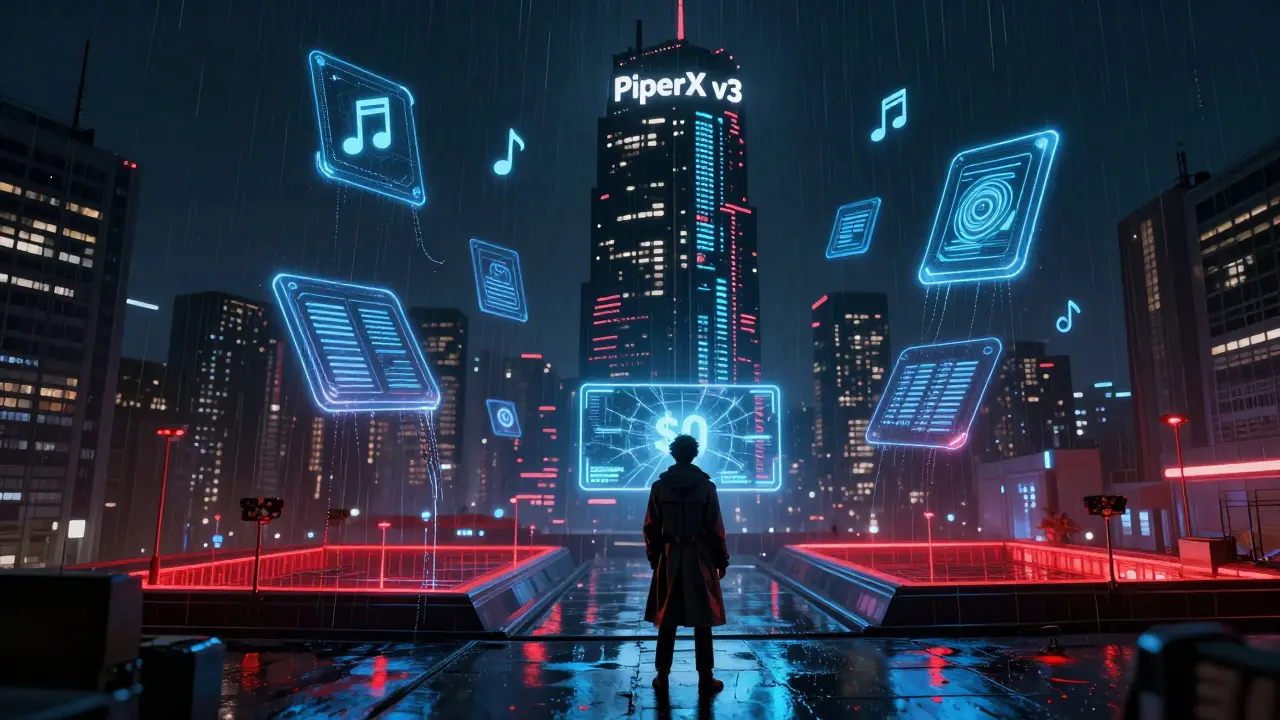
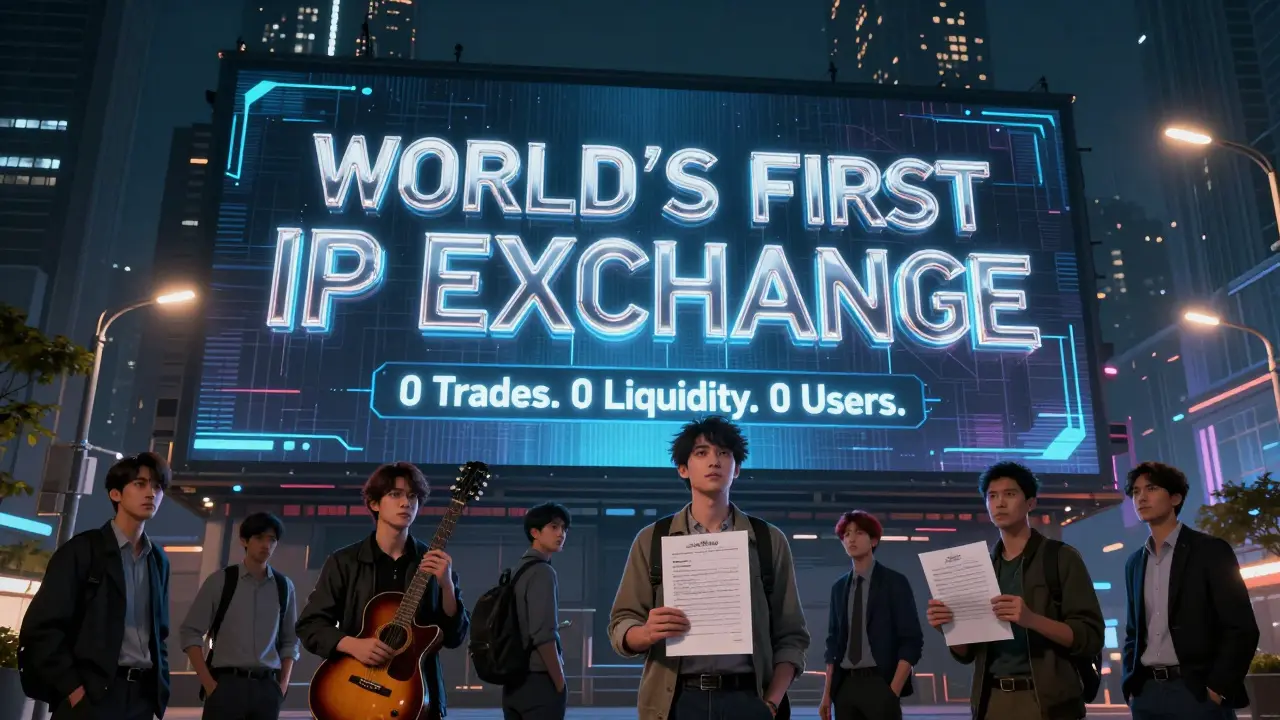
Here’s the harsh truth: as of February 2026, PiperX v3 has $0 total value locked (TVL). Zero. No trading volume. No mainnet activity. According to their own website, it’s been 0 days since mainnet launch. That’s not a beta. That’s not a testnet. That’s a platform stuck in development.
Compare that to Uniswap, which moves over $140 billion a month. Or even smaller DEXs like QuickSwap, which handles $1 billion daily. PiperX isn’t just behind - it’s not even on the same track. The team claims it’s targeting a Q1 2026 mainnet launch. But as of now, that date has passed without a single transaction recorded.
Why does this matter? Because without real trading, there’s no liquidity. Without liquidity, no one can buy or sell IP tokens. And without buyers and sellers, the whole idea collapses. It’s like opening a restaurant with no food, no staff, and no customers - and still advertising it as the best dining experience in town.
How It Works (If It Ever Launches)
If PiperX v3 ever goes live, here’s what you’d need to do:
- Get a Story Protocol-compatible wallet (like WalletConnect with Story SDK 2.3+)
- Tokenize your IP using their IP-NFT standard - this means legally proving you own the rights
- Create a liquidity pool for your asset (e.g., 50% your song NFT, 50% STY token)
- Configure your DeFAI agent to monitor usage and auto-distribute royalties
- Wait for someone to trade it - which, right now, no one has
That’s five steps just to get started. Compare that to Uniswap, where you can swap tokens in under a minute. PiperX requires understanding blockchain law, AI agents, and IP rights. It’s designed for lawyers and developers - not casual crypto users.

Why It’s Different - And Why That’s a Problem
Most DEXs thrive because they’re general-purpose. You can trade anything. PiperX only trades IP-backed tokens. That’s its strength - and its death sentence.
There are over 20,000 tokens on Ethereum alone. But how many are tied to real-world IP? Less than 100. And most of those are just NFTs of digital art - not actual copyright claims. PiperX needs creators to tokenize patents, music rights, or book licenses. But why would a musician give up control of their song’s rights to a blockchain protocol that doesn’t even exist yet?
Industry analysts agree. Gartner’s Q3 2025 report says blockchain-based IP tokenization makes up less than 0.01% of the $61 trillion global IP market. The SEC has already warned that IP-backed tokens might be classified as securities. That means legal risk, regulatory scrutiny, and potential lawsuits.
Even if creators wanted to join, they’d need to understand smart contracts, IP law, and DeFi mechanics. A 2025 survey by the Blockchain Research Institute found that 78% of independent artists had no idea how to tokenize their work. PiperX’s documentation is thorough - but it’s written for engineers, not musicians.
What People Are Saying (Or Not Saying)
There are no reviews on Trustpilot. No ratings on CoinGecko. No meaningful user feedback. The only voices come from testnet participants on Reddit and Discord.
One user, "CryptoCreator89," said it took them three hours to complete a single test swap. "I had to read six whitepapers and watch three tutorials just to understand how the agent decided my royalty split," they wrote.
Another, "NFT_Lawyer," pointed out the bigger issue: "As an IP attorney, I’m intrigued by the concept but concerned about legal recognition of on-chain IP claims. Courts don’t recognize blockchain records as proof of ownership. Not yet. Not anywhere."
Meanwhile, the Discord server has 1,247 members. Only 14% identify as artists, writers, or creators. The rest? Developers, blockchain researchers, and speculators.
The Real Challenge: The Chicken-and-Egg Problem
PiperX v3 is caught in the classic startup trap: you need users to create value, but you need value to attract users.
Creators won’t tokenize their IP unless there’s liquidity. But liquidity won’t come unless creators tokenize their IP. That’s why Dr. Elena Rodriguez from Messari called it a "chicken-and-egg problem that has stalled similar initiatives for five years."
Even if Story blockchain works perfectly, if no major IP holders - like music labels, publishers, or patent holders - join, PiperX will just be a fancy toy for crypto nerds.
Rumors suggest PiperX is talking to music publishers. But rumors aren’t contracts. And until one major entity - say, a label like Universal or Sony - publicly partners with PiperX, it’s all theoretical.
Who Is This For?
PiperX v3 isn’t for traders. It’s not for investors looking to flip coins. It’s not even for most DeFi users.
This is for one very specific group: blockchain-savvy creators who own valuable IP and are willing to bet their rights on an unproven system. That’s a tiny fraction of creators. And even among them, most are skeptical.
If you’re a songwriter with a viral TikTok hit? Maybe. But you’d need to trust that a blockchain protocol can protect your rights better than ASCAP or BMI - and that’s a huge leap.
If you’re a developer building tools for IP tokenization? Then PiperX’s API and agent documentation might interest you. But even then, you’re building on sand.
The Bottom Line
PiperX v3 is one of the most ambitious ideas in crypto. Turning intellectual property into liquid assets could unlock trillions. It’s not crazy. It’s visionary.
But vision without execution is just fantasy.
As of February 2026, PiperX v3 has no users, no trading, no liquidity, and no real-world adoption. It’s a whitepaper with a website. It’s a prototype with no product. It’s a solution to a problem that doesn’t yet exist in practice.
Until a single song, patent, or book is successfully traded on mainnet, PiperX v3 remains a fascinating idea - not a functional exchange.
Don’t invest. Don’t try to use it. Don’t even waste time testing it. Wait until there’s proof - not promises.
Is PiperX v3 a real crypto exchange I can use today?
No. As of February 2026, PiperX v3 has not launched on mainnet. It has $0 total value locked, $0 trading volume, and no recorded transactions. All activity is limited to testnet environments. You cannot buy, sell, or trade anything on it yet.
What makes PiperX v3 different from Uniswap or PancakeSwap?
PiperX v3 doesn’t trade cryptocurrencies. It’s built exclusively for tokenized intellectual property - like songs, patents, and digital art rights. While Uniswap handles thousands of crypto tokens, PiperX only supports assets tied to real-world IP, using a custom system called CreativityProof to reward creators based on usage, not liquidity provision.
Does PiperX v3 charge trading fees?
Yes, but not like traditional exchanges. PiperX uses a dynamic protocol fee between 0.15% and 0.3%, based on how liquid the IP asset is. Seventy percent of that fee goes to liquidity providers, and 30% goes to the protocol treasury. There are no fixed trading fees, but you’ll need to hold the native STY token to interact with the system.
Can I use MetaMask or Trust Wallet with PiperX v3?
Not directly. PiperX v3 requires integration with the Story blockchain, which uses its own wallet standard. While it supports EVM-compatible wallets, you must install the Story Protocol SDK v2.3 or higher and configure it to connect to Story’s network. Standard wallets like MetaMask won’t work without this setup.
Is PiperX v3 safe to use?
There’s no way to assess safety because the platform isn’t live. Its security depends entirely on Story blockchain’s unproven consensus mechanism, which uses AI agents to verify IP ownership - a first in blockchain history. No audits have been published, and there are no known incident reports - simply because no one has traded on it. Treat it as high-risk until mainnet launch with verified security reviews.
Will PiperX v3 ever become mainstream?
It depends on whether IP creators adopt blockchain. Right now, less than 0.01% of the global $61 trillion IP market is tokenized. Major institutions like the SEC warn that IP-backed tokens may be classified as securities. Without legal recognition, regulatory clarity, and adoption by big IP holders (like music labels or publishers), PiperX v3 will remain a niche experiment - not a mainstream platform.

Comments
19 Comments
Elana Vorspan
I love this idea so much 😊 Like, imagine your favorite song being traded like a stock and you get royalties every time it's used in a TikTok? That’s wild. I’m not even a techie but I’d totally tokenize my poetry if this ever launches. Keep going, PiperX 💫
Kenneth Genodiala
This is peak crypto delusion. You’re not trading IP-you’re trading vapor. The fact that anyone thinks a blockchain can enforce copyright law is laughable. Courts don’t recognize on-chain metadata. This isn’t innovation. It’s a Ponzi with a thesaurus.
Neeti Sharma
USA think they invent everything but blockchain IP? LOL. In India we have centuries of music and art not monetized by some app. This is just another white guy startup trying to steal culture and put it on a ledger. No thanks
Nadia Shalaby
I read the whole thing. Honestly? I’m torn. The concept is genius but the execution is… a dream. Like, I want to believe. But zero TVL? That’s not a beta. That’s a tombstone.
Fiona Monroe
The legal implications of tokenizing intellectual property are profound and, frankly, perilous. Without jurisdictional recognition of on-chain rights, this platform operates in a regulatory vacuum. I would strongly advise against any engagement until comprehensive legal frameworks are established and audited by recognized authorities.
Molley Spencer
CreativityProof? More like CreativityWishfulThinking. You need to be a blockchain lawyer just to upload a damn haiku. And the fact that 80% of the Discord is devs? That’s not a community. That’s a cult of people who think JSON is poetry.
John Fuller
No traction. No users. No point.
Maggie House
I tried to understand this and honestly? My brain hurt. But I love that someone’s trying to make art worth something beyond likes. I’m not techy but if someone explains it like I’m 5, I’d give it a shot. Maybe? 🤷♀️
maya keta
You think a blockchain can replace BMI? LOL. You need a degree in law and crypto just to upload a meme. And who’s gonna pay for this? The same 300 people who own Bored Apes? This isn’t innovation. It’s elitist cosplay.
Curtis Dunnett-Jones
I applaud the ambition. The concept of rewarding creators through usage rather than liquidity is revolutionary. However, the current state of implementation is inadequate. Without regulatory clarity and institutional adoption, this remains a theoretical construct. We must proceed with diligence, not haste.
bella gonzales
Ugh. Another one. I swear every week someone says 'this time it's different' and then disappears. I'm tired. I'm emotionally drained. I just want to listen to music without being sold a blockchain solution. Can we just… not?
Paul Reinhart
Let me tell you something. I’ve been in crypto since 2017. I’ve seen ICOs turn into ghost towns. I’ve watched DAOs dissolve into memes. But PiperX? This is different. Not because it’s better. But because it’s so painfully, beautifully, tragically sincere. It’s not trying to make money. It’s trying to give art a voice. And maybe… just maybe… that’s the only thing that matters. Even if it takes 10 years. Even if no one buys a single token. Even if the SEC shuts it down. I still believe in the dream. Because the world needs more dreamers. And fewer hustlers.
Phillip Marson
This isn't a platform. It's a therapy session for overeducated millennials who think their TikTok skit is a patent. You're not a creator-you're a spreadsheet jockey with a wallet. Go make a real song. Then come back.
Ifeanyi Uche
Africa has been sharing music and stories for thousands of years without blockchain. Why we need this? This is not progress. This is colonization with smart contracts. Your IP is not yours until the world accepts it. Not a ledger.
Danny Kim
So let me get this straight… you’re asking artists to lock their life’s work into a system that doesn’t exist… just so a bunch of devs can build a dashboard? That’s not innovation. That’s a hostage situation.
Cathy Sunshine
The only thing more delusional than this project is the people who think it'll work. You don't solve copyright law with AI agents. You solve it with courts. And lawyers. And paperwork. Not a blockchain that doesn't even have a live transaction. This isn't visionary. It's a cry for attention.
Dee Resin
I read the whole thing. Then I cried. Not because it’s bad. But because it’s beautiful. And I know it’ll die. And I hate that.
Brian Lemke
As someone who’s helped artists in Nigeria and Indonesia tokenize their folk music via decentralized grants, I can say this: the real barrier isn’t tech-it’s trust. People won’t give up rights until they see someone like them benefit. PiperX needs a real creator success story. Not a whitepaper. A song. A video. A payment. One. Then the rest will follow.
Colin Lethem
I made a test token of my poem. Took 3 hours. Got 0 trades. Got 1 DM from a guy asking if I’d sell my rights for 0.05 ETH. I laughed so hard I cried. Then I deleted it. This isn’t a platform. It’s a graveyard for idealists.
Write a comment