

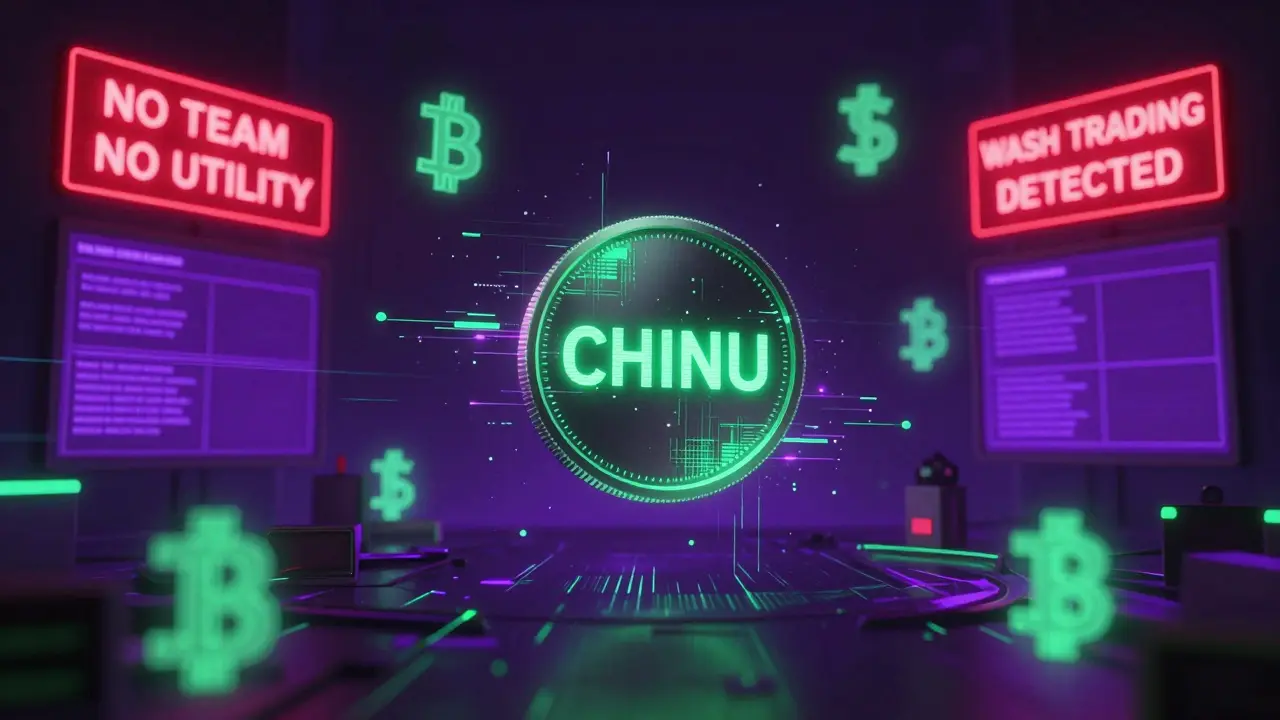
Chinu (CHINU) isn’t a cryptocurrency you buy because you believe in its future. It’s not a project with a team, a whitepaper, or a roadmap. It’s not even a serious experiment in decentralized finance. If you’re wondering what Chinu is, the honest answer is this: Chinu is a low-market-cap meme coin on the Solana blockchain that exists almost entirely because people are gambling on its price dropping lower - and hoping someone else will buy it before it vanishes.
What you can actually find about Chinu (CHINU)
Chinu’s contract address on Solana is FLrgwxXaX8q8ECF18weDf3PLAYorXST5orpY34d8jfbm. That’s it. That’s the only verifiable technical detail. No GitHub repo. No developer updates. No official website. No team members named. No documentation explaining how many tokens exist, how they were distributed, or what the token is even supposed to do.
It doesn’t power a decentralized app. It doesn’t pay transaction fees. It doesn’t stake. It doesn’t reward holders. It doesn’t have a utility. It’s just a token with a ticker symbol - CHINU - that got listed on Binance under the name ‘Chinu-sol’ because exchanges sometimes list anything with even a sliver of trading volume.
Some sites say its price was as high as $0.007987. Others say it’s currently around $0.000048. The numbers don’t match because nobody’s trading it seriously. The trading volume on CoinGecko was $40 in one day. On LiveCoinWatch, it was $173,600. That’s not a mistake - it’s a red flag. When data conflicts this badly across platforms, it usually means someone is artificially inflating volume through wash trading - buying and selling to themselves to make the coin look active.
Why the price is so low - and why that’s dangerous
Chinu trades at fractions of a cent. That’s not a bargain. It’s a trap.
People get lured in by the idea that if a coin is only $0.000048, then buying 10 million tokens costs just $480. If it goes up 10x, they’ll make $4,800. Sounds easy. But here’s the reality: Solana transaction fees are fixed at around $0.00025 per swap. That’s more than five times the value of one CHINU token. So if you buy 10,000 CHINU, your transaction fee eats up more than 20% of your investment before you even hold it.
And when you try to sell? Good luck. Liquidity is almost nonexistent. On Reddit, users report being stuck for hours trying to sell because there are no buyers. One user lost $350 after buying during a ‘dip’ - only to find the order couldn’t execute for three hours. When it finally did, the price had crashed 40%.
This isn’t investing. It’s playing Russian roulette with your wallet.
Who’s behind Chinu? No one knows - and that’s the norm
There’s no founder. No company. No team. No legal entity. No jurisdiction. No KYC. No compliance. That’s not unusual for meme coins - Dogecoin and Shiba Inu started the same way. But those had communities. They had memes. They had movement. Chinu has none of that.
There’s no official Telegram group with verified admins. There are no Twitter threads from developers. No Medium posts. No YouTube explainers. The only ‘community’ is a few anonymous Telegram groups with names like ‘CHINU 100x Pump’ and ‘CHINU Moon Mission’ - groups that disappear after a few weeks. One analytics site tracked CHINU’s main group dropping from 50 daily messages in August 2023 to just 8 in October - a classic sign of abandonment.
Experts like Delphi Digital and Messari classify tokens like this as having a 97% chance of dying within a year. Chinu isn’t an exception - it’s the rule.

How it compares to other meme coins
Let’s put this in perspective. Dogecoin trades at around $0.07. Shiba Inu trades at $0.0000075. Both have millions of holders. Both are listed on dozens of exchanges. Both have active communities, developer updates, and even charity initiatives.
Chinu? It’s ranked #2399 by market cap - meaning there are over 2,300 other cryptocurrencies with more value. Its 24-hour volume is less than 0.01% of Dogecoin’s. It doesn’t appear in any mainstream crypto analysis. No major analyst has written about it. No institutional fund holds it. No DeFi protocol integrates it.
Even among meme coins, Chinu is at the bottom. It doesn’t have the humor, the culture, or the momentum. It’s just a ticker symbol with a price so low it’s practically a joke.
The scam signals are everywhere
Here’s what you’ll see if you dig into user reports:
- ‘Whales’ control 78% of the supply - according to blockchain analysis firm Chainalysis. That means three wallets own most of the tokens and can dump them anytime.
- Telegram groups promise ‘100x returns’ - then vanish after the pump.
- Users report being unable to sell because the order book is empty.
- TradingView lists a completely different financial product - a BNP Paribas ETF - under the same ticker CHINU. That’s not a coincidence. It’s how scammers confuse people.
The U.S. Securities and Exchange Commission (SEC) has been cracking down on ultra-low-priced tokens since September 2023. They’ve already charged three projects under the Howey Test for selling unregistered securities. Chinu fits the profile perfectly: no utility, no team, no disclosure, just a price pump driven by hype.

Can you trade Chinu? Technically, yes. Should you? Absolutely not.
You can buy CHINU on Binance by connecting a Solana wallet like Phantom and swapping SOL for it. The process is simple - too simple. That’s the problem.
There’s no research needed. No analysis. No due diligence. You just click ‘swap’ and hope. But when you try to exit, you’ll find:
- The price slippage is massive - you might get 30% less than you expected.
- Your transaction might fail because the network can’t find a buyer.
- There’s zero customer support. No email. No help center. No response.
And if you do make a profit? Congratulations. You just got lucky. But you didn’t invest. You gambled. And the house always wins in the long run.
The bottom line
Chinu (CHINU) is not a cryptocurrency. It’s a speculative gamble wrapped in the illusion of opportunity. It has no team, no technology, no future, and no safety net. Its only value is the hope that someone else will pay more for it tomorrow - even though the odds are overwhelmingly against it.
If you’re looking for a crypto to invest in, there are thousands of projects with real teams, real code, and real use cases. Chinu isn’t one of them. It’s a ghost coin - visible only because someone’s still spinning the wheel, hoping for a win that will never come.
Don’t be the last one holding it.
Is Chinu (CHINU) a good investment?
No. Chinu has no team, no utility, no roadmap, and almost no liquidity. Its price is driven entirely by speculation and wash trading. Over 97% of tokens like this fail within a year. It’s not an investment - it’s gambling.
Where can I buy Chinu (CHINU)?
Chinu is listed on Binance under the symbol ‘Chinu-sol’. You can trade it using a Solana wallet like Phantom or Solflare by swapping SOL for CHINU. But be warned: liquidity is extremely low, and selling can be nearly impossible during price drops.
Why is Chinu’s price so low?
Its price is low because there’s no demand beyond speculative trading. It has no real use case, no community support, and no development. The low price attracts traders looking for ‘penny crypto’ pumps, but those pumps are almost always followed by crashes. The value is artificial and unsustainable.
Is Chinu a scam?
It’s not officially labeled a scam, but it has all the hallmarks: anonymous team, no documentation, fake volume, pump-and-dump patterns, and zero long-term utility. The SEC has warned about tokens like this, and crypto researchers classify them as extreme-risk assets. Treat it like a lottery ticket - not an asset.
Can I make money trading Chinu?
Maybe - if you’re lucky and exit at the exact right moment. But the odds are stacked against you. Most people who trade Chinu lose money because they can’t sell when the price drops. The few who profit are usually the ones who created the token or bought before the pump. For everyone else, it’s a loss.
Does Chinu have a whitepaper or roadmap?
No. There is no official whitepaper, no GitHub repository, no development updates, and no public roadmap. The project appears to have been launched with zero documentation - a common trait of abandoned meme coins.
Is Chinu on Solana or Ethereum?
Chinu is a Solana-based token. Its contract address (FLrgwxXaX8q8ECF18weDf3PLAYorXST5orpY34d8jfbm) follows the Solana format. It is not available on Ethereum or other blockchains.
Why do some sites show different prices for Chinu?
Because trading volume is manipulated. Some platforms report inflated volume from wash trading - where the same wallets buy and sell to each other to create fake demand. This causes price discrepancies between CoinGecko, CoinMarketCap, and LiveCoinWatch. The real price is likely the lowest one - because that’s what buyers are actually paying.