

You’ve likely seen the ticker COSMO pop up on a trading screen or heard it mentioned in a quick chat. It sounds familiar, right? It sounds exactly like Cosmos (ATOM), one of the most respected blockchains in the industry.
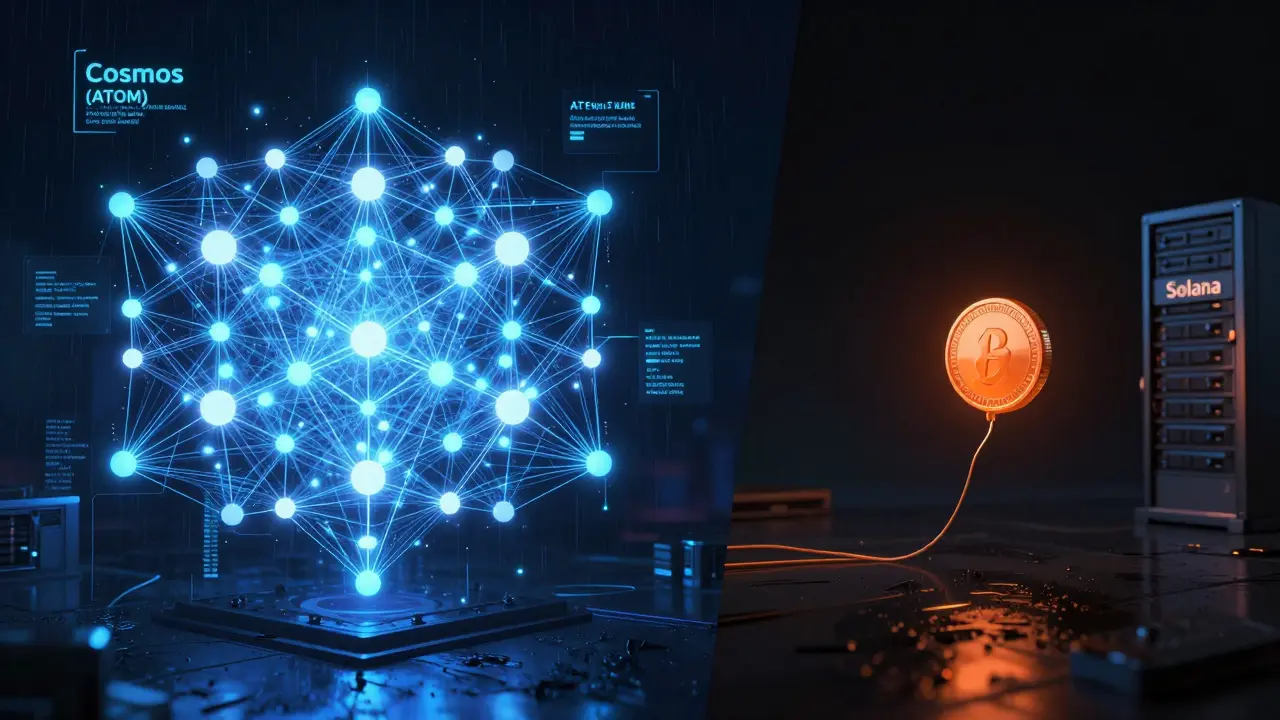
But here is the hard truth: Cosmo (COSMO) is not Cosmos. They are two completely different things. One is a major technological infrastructure powering billions of dollars in cross-chain activity. The other is a small, obscure token built on the Solana blockchain with almost no public documentation, utility, or community presence.
If you are looking to invest, understanding this difference isn’t just helpful-it’s critical for protecting your capital. Most people asking "What is Cosmo?" are actually trying to find information about Cosmos but have been misled by similar names. This guide clears up the confusion, explains what little we know about the actual COSMO token, and shows you how to spot these naming traps before they cost you money.
The Name Game: Why Confusion Is Dangerous
In the world of cryptocurrency, name similarity is often a feature, not a bug. Scammers and low-effort projects frequently choose names that sound like established giants. Think of "Bitcoin Cash" vs. "Bitcoin," or the dozens of tokens named after "Ethereum."
Cosmos (The 'Internet of Blockchains' ecosystem led by the ATOM token) is a well-documented, open-source project launched years ago. It has a whitepaper, a known team, active developers, and a massive ecosystem. Its native token is ATOM.
Cosmo (A lesser-known token operating on the Solana network), on the other hand, uses the ticker COSMO. While it shares a linguistic root, it operates on an entirely different technology stack. It lives on Solana, not its own independent blockchain. This distinction matters because it tells us immediately that COSMO does not control its own security, governance, or consensus mechanism. It relies entirely on Solana’s infrastructure.
When you see a coin with a name this close to a top-50 asset, your first instinct should be skepticism. Ask yourself: Why did they choose this name? Is it to build a brand, or to capture search traffic from people looking for something else?
Technical Reality: What Actually Is COSMO?
If we strip away the marketing fluff, what is left of the COSMO token? Based on available data from exchanges like CoinSwitch as of late 2025, COSMO is described simply as a "Web3 coin built on the fast and scalable Solana blockchain."
That description is incredibly vague. Here is what that means in practical terms:
- No Independent Blockchain: Unlike Cosmos, which runs its own network using the Tendermint BFT consensus mechanism, COSMO is just a file-a smart contract-living on Solana. It cannot vote on protocol changes. It cannot secure its own network. It exists only because Solana allows it to.
- Performance Inheritance: Because it sits on Solana, COSMO transactions benefit from Solana’s speed. Solana can process roughly 65,000 transactions per second (TPS) with fees often under $0.001. However, COSMO adds no new technical innovation to this. It doesn’t make Solana faster; it just rides along.
- Lack of Utility Documentation: A legitimate project usually has a clear use case. Does COSMO pay for storage? Does it govern a decentralized exchange? Does it offer staking rewards? Public records do not show any specific utility for COSMO. There is no whitepaper detailing its economic model, token supply cap, or distribution plan.
Compare this to Cosmos Hub, where ATOM holders actively participate in governance votes to upgrade the network and allocate funds to ecosystem grants. With COSMO, there is no evidence of such mechanisms. You are buying a digital receipt with no clear promise attached to it.

Head-to-Head: COSMO vs. ATOM
To understand the risk profile of COSMO, we have to look at what it is being compared against. The table below highlights the stark differences between the established Cosmos ecosystem and the obscure Cosmo token.
| Feature | Cosmos (ATOM) | Cosmo (COSMO) |
|---|---|---|
| Blockchain Type | Independent Layer-1 Blockchain | Token on Solana (Layer-1) |
| Consensus Mechanism | Tendermint BFT (Proof-of-Stake) | Inherits Solana’s Proof-of-History + PoS |
| Primary Utility | Governance, Security Staking, Interoperability (IBC) | Unclear / Not Documented |
| Market Presence | Top 50 Cryptocurrency (CoinMarketCap) | Negligible / Absent from Major Trackers |
| Community Size | 185,000+ Reddit members, 45k+ Discord users | No significant public community found |
| Development Activity | Active GitHub, Regular Upgrades (e.g., Nexus) | No public roadmap or code repository visible |
The gap here is enormous. ATOM is a foundational piece of internet infrastructure. COSMO appears to be a speculative asset with no underlying technological contribution. When you buy ATOM, you are betting on the growth of interoperable blockchains. When you buy COSMO, you are betting solely on price speculation driven by buyer demand, with no fundamental value anchor.
The Red Flags: Why Data Is Missing
In traditional finance, if a company had no website, no CEO listed, and no product description, you would walk away. In crypto, many investors ignore these signs because of the anonymity culture. But let’s look at the absence of evidence for COSMO as evidence itself.
1. No Institutional Support Major custodians like BitGo and Coinbase Prime support Cosmos (ATOM) because institutions need secure places to store large amounts of assets. These same firms do not list COSMO. If a token cannot be stored securely by institutional-grade providers, it signals a lack of maturity and audit trails.
2. Zero Community Engagement Crypto projects live or die by their communities. Cosmos has active subreddits, Telegram groups, and YouTube channels analyzing its tech. Search for COSMO, and you find silence. There are no developer discussions, no user reviews on Trustpilot, and no educational content. A project without a community is a project without a future, because there is no one to defend it, use it, or improve it.
3. Regulatory Blind Spot The SEC has scrutinized Cosmos’s governance model. This scrutiny, while challenging, proves that Cosmos is significant enough to matter to regulators. COSMO has attracted zero regulatory attention. This isn’t because it’s compliant; it’s because it’s too small to notice. Being invisible to regulators often means being invisible to liquidity providers, making it hard to sell your tokens when you want to exit.

How to Verify Any Crypto Token Before Buying
You don’t have to take my word for it. You can verify the legitimacy of any token, including COSMO, by following these three steps. This process works for any obscure coin you encounter.
- Check the Contract Address: Never buy based on a name alone. Names can be copied. Go to a block explorer like Solscan (for Solana tokens). Paste the contract address provided by the exchange. Look at the holder distribution. If one wallet holds 90% of the supply, it is a rug-pull waiting to happen. For COSMO, public data is scarce, which makes this step difficult-a red flag in itself.
- Search for the Whitepaper: Legitimate projects publish technical documents. Search Google for "[Token Name] whitepaper PDF." If you only find blog posts on random sites or nothing at all, the project lacks technical substance. Cosmos has multiple detailed papers on its architecture. COSMO has none.
- Analyze Social Sentiment: Go to Twitter, Reddit, and Discord. Are real people discussing the technology? Or are bots posting "To the moon!"? For Cosmos, you’ll find engineers discussing IBC packets. For COSMO, you’ll likely find silence or spam. Real adoption creates noise; fake projects create echo chambers.
Conclusion: Stick to Fundamentals
The crypto market is full of opportunities, but it is also filled with traps designed to look like opportunities. Cosmo (COSMO) is a prime example of a token that benefits from the reputation of a larger neighbor without offering comparable value. It runs on Solana, yes, but so do thousands of other tokens. Without unique utility, a strong team, or a vibrant community, it remains a high-risk speculative asset.
If you are interested in blockchain interoperability, high-speed transactions, and robust governance, Cosmos (ATOM) is the established choice. If you are drawn to COSMO because of its name similarity, pause and ask why. Usually, the answer isn’t technology-it’s hope. And hope is an expensive strategy in crypto.
Is Cosmo (COSMO) the same as Cosmos (ATOM)?
No, they are completely different. Cosmos (ATOM) is a major, independent blockchain network focused on interoperability. Cosmo (COSMO) is a smaller, less documented token that operates on the Solana blockchain. They share a similar name but have different technologies, teams, and market values.
Which blockchain is Cosmo (COSMO) built on?
Cosmo (COSMO) is built on the Solana blockchain. This means it utilizes Solana’s infrastructure for transaction processing and security, rather than having its own independent network like Cosmos or Ethereum.
Is Cosmo (COSMO) a safe investment?
Cosmo (COSMO) carries high risk due to its lack of transparency. It has no public whitepaper, limited community engagement, and unclear utility. Compared to established coins like ATOM or SOL, it offers fewer safeguards against volatility and potential scams. Always do your own research and consider the risks of investing in obscure tokens.
Why is there so little information about Cosmo (COSMO)?
The scarcity of information suggests that COSMO is a minor project with minimal development activity. Legitimate crypto projects typically publish roadmaps, team details, and technical docs. The absence of these for COSMO indicates it may not have a substantial long-term vision or active development team.
Can I stake Cosmo (COSMO) for rewards?
There is no public documentation confirming a staking mechanism for COSMO. Unlike ATOM, which has a well-defined proof-of-stake system, COSMO’s tokenomics are not clearly defined. Be wary of any platform claiming to offer high-yield staking for COSMO without verifiable smart contract audits.

Comments
19 Comments
Carl Hanzel
You people are so gullible it makes me sick. The article is obvious but you still fall for the narrative that ATOM is some holy grail while ignoring the raw speculative potential of obscure tokens. It’s not about utility, it’s about who gets out first and who holds the bag. I don’t care about whitepapers or governance votes when there is money to be made on the pump. Most of you are just looking for validation to buy the dip on dead projects.
Daniel J. Cox
Hey Carl, calm down a bit 😊 It’s actually really interesting how these naming similarities play out in different markets. In my experience with emerging tech in Asia, brand confusion is huge, but here in the US we tend to dig deeper into the code. It’s a cultural difference in how we trust digital assets. Solana ecosystem is vibrant though, isn’t it? 🌍
Emma Rémond
Daniel, your superficial observation misses the fundamental architectural disparity entirely. The ontological distinction between a sovereign Layer-1 blockchain utilizing Tendermint BFT consensus and a mere SPL token on Solana is not merely 'cultural'-it is technical bedrock. To equate the two is intellectually lazy. COSMO lacks the cryptographic proof of stake mechanisms that define Cosmos Hub’s security model. You are discussing aesthetics while I am discussing protocol-level integrity. The lack of institutional custody options for COSMO further cements its status as a sub-optimal asset class for any serious portfolio allocation strategy.
ELNORA JEFFERSON
This whole thread is exhausting. Why do we even need to discuss this? It’s clearly a scam token trying to ride the coattails of ATOM. Just ignore it and move on. I’m done reading about crypto failures. Ugh.
Carol @minaszilda
Let’s breathe together. Fear leads to bad decisions. Knowledge brings peace. Always verify before you invest. Trust your intuition but check the facts. Stay safe everyone. We are all learning here. No judgment needed. Just growth.
John Curry
The irony is palpable. We build systems designed to eliminate intermediaries, yet we remain enslaved by our own cognitive biases toward familiarity. Is COSMO truly worthless, or is it a mirror reflecting our collective desperation for easy gains? The silence of its developers speaks volumes, louder than any whitepaper could. Perhaps the true innovation lies not in the code, but in the human psychology exploited by such nomenclature. A tragic comedy played out on the blockchain stage.
Trent Erman1
Great points John! But let’s get practical. If you’re new to this, checking the contract address on Solscan is non-negotiable. Look at the holder distribution. If one wallet has 90%, run away. Fast. Don’t let philosophy stop you from protecting your capital. Do your homework, stay sharp, and keep building wealth responsibly. Let’s help each other avoid these traps! 💪
Fiona Ellis
I must interject, Trent, because your advice, while well-meaning, overlooks the nuanced reality of liquidity fragmentation. Have you considered the implications of MEV bots front-running these low-volume tokens? It is quite fascinating, isn’t it? 🤔 One might argue that the absence of documentation is itself a feature for those seeking anonymity. But then again, I rarely engage with such high-risk instruments personally. Just something to ponder! ✨
Nicole Woessner
honestly i think people overcomplicate this. if it sounds like a big name but has no info its probably sketchy. simple as that. i stick to what i know works. why risk it for nothing
Jon Milton
Nicole, you’re missing the forest for the trees. This isn’t just about ‘sketchy’ vibes; it’s about systemic deception. The entire industry is built on trustless verification, yet we allow branding to override due diligence. It’s aggressive negligence by exchanges listing these tokens without proper vetting. We need stricter regulations, not just individual caution. Fight back against the noise.
Sajjad Ghorbani Moghaddam
Hey Jon, maybe chill out a bit. Everyone learns at their own pace. No need to attack the system right now. Just share your knowledge gently. People respond better to kindness than aggression. Let’s keep it friendly here.
Rebecca Shoniker
Sajjad; your passive-aggressive tone is noted; however; it does not change the fact that regulatory arbitrage is rampant. The SEC’s silence on COSMO is not compliance; it is neglect. We must demand accountability. The jargon-heavy nature of these discussions often masks the simple truth: if it’s not indexed by major custodians; it is trash. Period. End of story. Do not confuse obscurity with privacy.
Jay Sharma
Wake up sheeple. COSMO is a honeypot controlled by the same entities behind the Solana validator cartel. They want you to buy so they can dump on the retail masses. Check the transaction hashes yourself. It’s all rigged. The government uses these tokens to track your spending habits. Don’t be fooled by the ‘open source’ lie. Nothing is free.
Scott Miller
Jay, you’re paranoid. Stop spreading fear. There are real opportunities here if you have the guts to take them. I’ve made more money on meme coins than ATOM ever gave me. Be aggressive. Take risks. Winners take all. Don’t let conspiracy theories stop you from getting rich. Crush it!
Abby Martin
Scott, your reckless optimism is morally bankrupt. Encouraging gambling under the guise of ‘opportunity’ is unethical. These tokens exploit vulnerable individuals. I refuse to engage with such toxic positivity. The community deserves better than hype-driven speculation. Stand for integrity, not greed. It’s that simple.
Mélanie Boulay
While I appreciate the passion displayed by both Scott and Abby, it is important to remember that the cryptocurrency market operates within a complex web of global financial regulations which vary significantly from jurisdiction to jurisdiction, thereby creating a situation where what may appear to be reckless speculation in one country might be viewed as legitimate entrepreneurial risk-taking in another, thus necessitating a more nuanced approach to investment strategies that takes into account not only the technical merits of the underlying blockchain technology but also the broader socio-economic context in which these digital assets exist and evolve over time.
Maurice Flynn
Mélanie, you’re overthinking it. Just look at the chart. If it goes up, it goes up. No need for long paragraphs. Keep it simple. Stay relaxed. The market will tell you the truth eventually. Just watch and wait. Peace.
nancy jarecki
Maurice, your simplistic view is insulting to anyone with basic financial literacy. The chart is manipulated. Order book spoofing is rampant. You are naive if you believe price action reflects value. I prefer to analyze the smart contract code directly. Most of these ‘Solana gems’ are rug pulls waiting to happen. Stick to blue chips or stay out. Your ignorance is not bliss; it is liability.
Robert Hundley
Whoa Nancy, lighten up! Life’s too short to be so negative. I see potential everywhere. Even if COSMO fails, the lessons learned are valuable. Let’s celebrate the innovation, not just criticize. High five! 🙌 Keep smiling and keep exploring. The future is bright!
Write a comment