

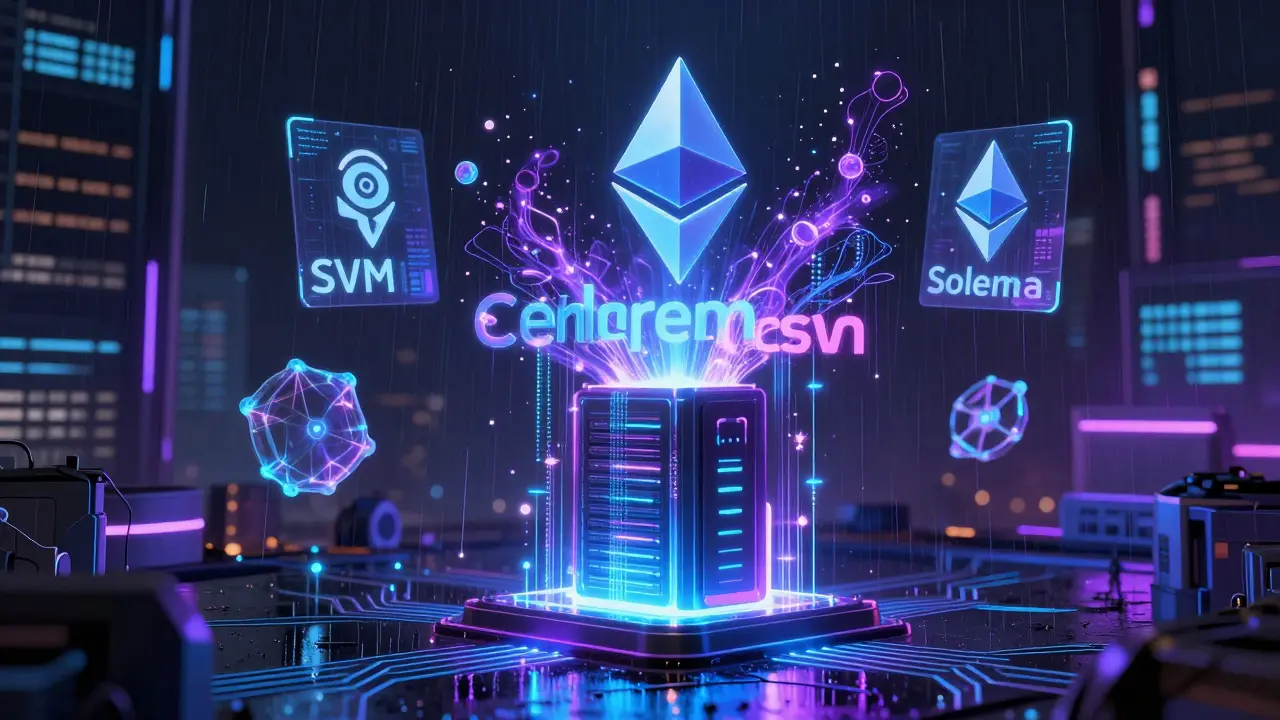
Eclipse (ES) is not another altcoin chasing hype. It’s a Layer 2 blockchain built to solve Ethereum’s biggest problem: slow, expensive transactions - but it doesn’t use the same tools everyone else does. Instead of copying the Ethereum Virtual Machine (EVM), Eclipse uses the Solana Virtual Machine (SVM). That’s unusual. And it’s intentional.
What Makes Eclipse Different?
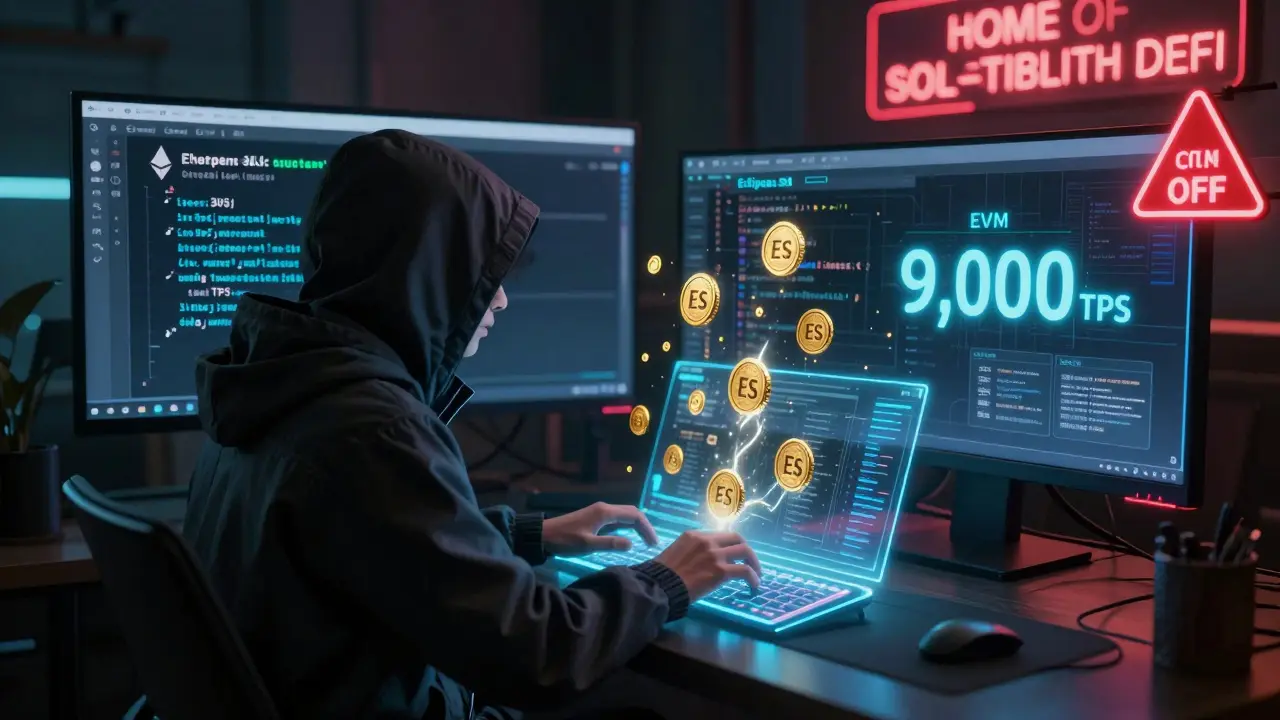
Most Ethereum Layer 2s, like Arbitrum or Optimism, are built to be EVM-compatible. That means developers can reuse their Solidity code, and wallets like MetaMask work out of the box. Eclipse flips that. It runs on SVM, the same engine that powers Solana. That gives it speed - real speed. In live tests, Eclipse handles nearly 9,000 transactions per second. Compare that to Ethereum’s mainnet, which struggles to hit 30 TPS, or even Polygon zkEVM, which maxes out around 2,000 TPS. Eclipse isn’t just faster. It’s in a different league.But speed alone doesn’t make a blockchain. Security does. That’s where Eclipse’s design gets clever. While it executes transactions using SVM, it settles them on Ethereum. That means every transaction is backed by Ethereum’s $450 billion market cap and its battle-tested security. It doesn’t try to replace Ethereum. It enhances it.
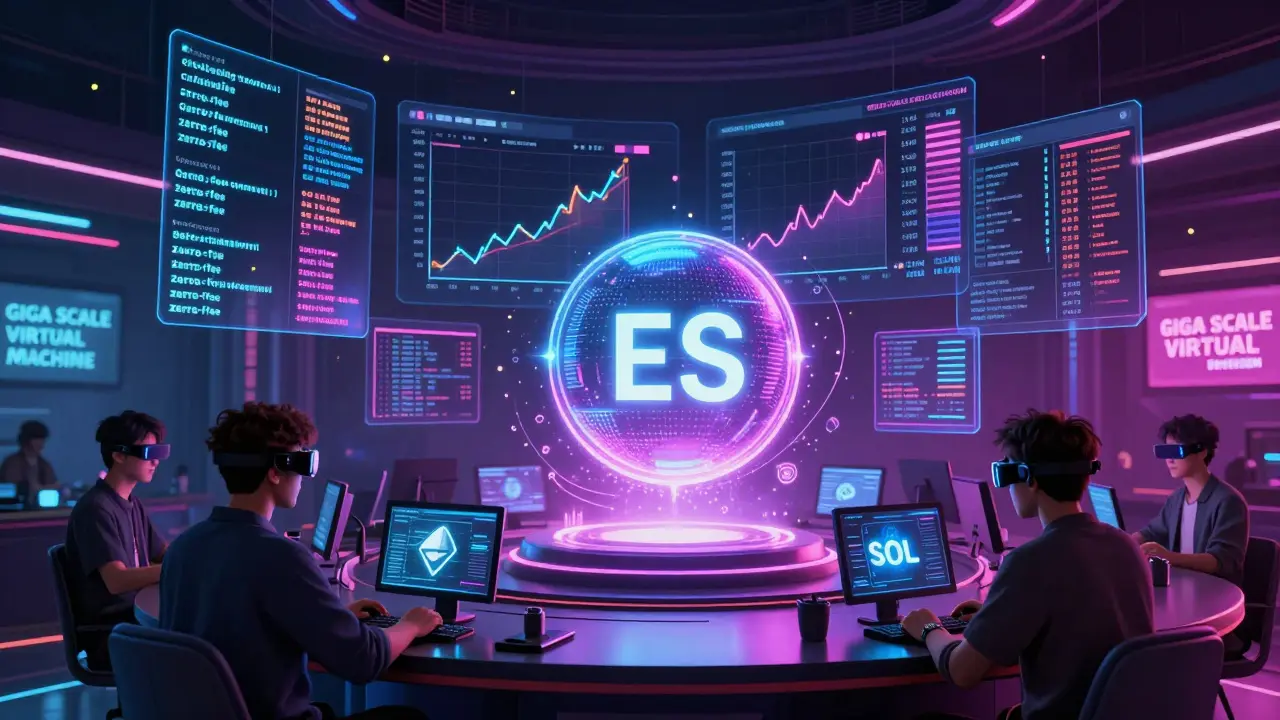
And it doesn’t stop there. Eclipse posts transaction data to Celestia, a dedicated data availability layer. This keeps costs low and ensures data can’t be hidden or altered. The result? A system that combines Solana’s performance, Ethereum’s security, and Celestia’s data reliability. The team calls it a "Giga Scale Virtual Machine." It’s not marketing fluff - it’s architecture.
How Does ES, the Token, Work?
The ES token is the fuel for the Eclipse network. It’s used to pay for gas - the fee you pay to send transactions or run smart contracts. Unlike some L2s that use ETH for gas, Eclipse uses ES. This means you need to hold ES tokens to interact with the chain. Some users get confused because CoinMarketCap lists ETH as the gas token, but Eclipse’s own documentation is clear: ES is the native gas token via its paymaster system.There are 1 billion ES tokens in total. As of July 2025, about 132.64 million are in circulation. The rest are locked in private sales, team allocations, and ecosystem development funds. The token’s price hovered around $0.09 in mid-2025, with a market cap of just over $11 million. That’s small compared to top L2 tokens like ARB or OP, which trade in the billions. But Eclipse is new. And it’s growing.
Trading volume is healthy - over $16 million in 24 hours - which suggests real usage. There are over 1.3 million active wallets, according to SwissBorg. And the token has 1,370 holders. That’s not mass adoption yet, but it’s more than just speculation.
Who Built Eclipse?
Eclipse was founded by Vijay Chetty, a crypto veteran who’s worked at Ripple, dYdX, and Uniswap. That’s not a random resume. These are companies that have shaped DeFi and trading infrastructure. Chetty’s experience tells you Eclipse wasn’t built by amateurs. He’s seen how Ethereum’s scaling problems hurt users and developers. His goal? To make Ethereum usable again - not by patching it, but by rebuilding its execution layer with better tech.The project raised $65 million across funding rounds, including NFT sales and venture capital. That’s serious money for a Layer 2 launched in early 2025. Most L2s take years to raise that much. Eclipse did it in months. That tells you investors see potential - even if the market isn’t fully convinced yet.
Who Is Eclipse For?
Eclipse isn’t for everyone. If you’re an Ethereum developer used to Solidity and MetaMask, you’ll hit a wall. SVM runs on Rust, not Solidity. Migrating a DeFi protocol from EVM to SVM isn’t a simple update - it’s a rewrite. One developer on Ethereum Stack Exchange said it added three weeks to their timeline. That’s a real cost.But if you’re a Solana developer? Or if you’re building high-frequency DeFi apps, gaming platforms, or trading bots that need fast, cheap transactions? Eclipse is a dream. Users on Reddit report doing 50 swaps in under two seconds with near-zero fees. That’s the kind of experience Ethereum mainnet can’t deliver.
It’s also ideal for users who want to move between SOL and ETH ecosystems without switching chains. Eclipse lets you hold both, trade between them, and earn yield on both - all in one place. That’s why they call it the "Home of SOL-ETH DeFi." It’s not just a Layer 2. It’s a bridge.
What Are the Downsides?
No project is perfect. Eclipse has three big challenges.First, developer adoption. EVM tooling is mature. You’ve got Hardhat, Foundry, Remix, dozens of tutorials, and a million Stack Overflow answers. SVM tooling? Still young. Eclipse’s documentation scores 3.8/5 on ReadTheDocs - decent, but not great. And there’s no easy way to convert Solidity code to Rust. You need to learn a new language.
Second, wallet support. MetaMask doesn’t natively support Eclipse. You have to manually add the network, configure custom RPCs, and import ES tokens. That’s a barrier for non-technical users. Wallets like Phantom and Solflare work better, but they’re not as common on Ethereum.
Third, competition. Arbitrum, Optimism, and Polygon aren’t standing still. They’re all building faster L2s. Eclipse’s 9,000 TPS is impressive, but if Arbitrum hits 8,000 TPS next year with full EVM compatibility, Eclipse’s edge shrinks fast. And with over $35 billion locked in L2s overall, Eclipse’s $11 million market cap is tiny.
What’s Next for Eclipse?
The roadmap is aggressive. In Q3 2025, Eclipse plans to launch native cross-chain messaging between Ethereum and Solana. That means you could send ETH to a Solana wallet directly through Eclipse - no bridges, no wrapping, no slippage. That’s huge.By Q4 2025, they aim to integrate with Ledger and Trezor hardware wallets. That’s critical for security-conscious users.
In Q1 2026, they plan to upgrade ES to a governance token. That means holders could vote on protocol changes - a sign of decentralization. If that happens, and if adoption grows, ES could become more than just a gas token. It could become a stake in the network’s future.
Analysts are split. Delphi Digital gives Eclipse a 3.5/5 rating - praising the tech but warning about slow ecosystem growth. Bernstein thinks the price might hit $0.10-$0.12 by year-end. Delphi sees $0.15-$0.25. The difference? Adoption. If 100 new DeFi apps launch on Eclipse by November, the price could jump. If not, it might stall.
Should You Care About Eclipse?
If you’re just holding ETH and BTC? Maybe not. Eclipse won’t change your portfolio.If you’re a developer, trader, or DeFi power user tired of paying $20 in gas to swap tokens? Then yes. Eclipse offers something no other Ethereum L2 does: Solana-level speed on Ethereum’s security. It’s not the only solution. But it’s the only one that bridges two worlds.
It’s risky. It’s early. It’s unproven at scale. But it’s also one of the few Layer 2s that isn’t just iterating - it’s reinventing. If it works, it could redefine what’s possible on Ethereum. If it fails, it’ll be a footnote in crypto history.
Right now, it’s a bet on speed. On innovation. On the idea that Ethereum doesn’t need to be fixed - it needs a better engine. And Eclipse is trying to build it.
Is Eclipse (ES) a good investment?
Eclipse is not a guaranteed investment. It’s a high-risk, high-reward project. The token price is volatile, the market cap is small, and adoption is still early. If Ethereum Layer 2s keep growing and Eclipse captures even 1% of that growth, ES could see significant upside. But if it fails to attract developers or faces regulatory hurdles, the price could drop. Only invest what you can afford to lose.
Can I use MetaMask with Eclipse?
You can use MetaMask with Eclipse, but not directly. You need to manually add the Eclipse network by entering its RPC URL, chain ID, and native token symbol (ES). It’s not plug-and-play like Ethereum or Polygon. Many users find this confusing. Wallets like Phantom or Solflare work better out of the box because they’re built for SVM chains.
Does Eclipse use ETH for gas?
No. Eclipse uses its own token, ES, as the gas token. Some sources incorrectly list ETH as the gas token, but Eclipse’s official documentation confirms ES is paid for transactions via its native paymaster system. You must hold ES tokens to interact with the network.
How is Eclipse different from Arbitrum or Optimism?
Arbitrum and Optimism are EVM-compatible, meaning they run code written in Solidity. Eclipse uses the Solana Virtual Machine (SVM), which runs Rust-based code. This gives Eclipse much higher transaction speeds - nearly 9,000 TPS vs. 30-50 TPS for EVM L2s in production. But it also means developers need to learn new tools. Eclipse is faster, but less compatible with existing Ethereum apps.
Is Eclipse safe to use?
Eclipse settles transactions on Ethereum, which means it inherits Ethereum’s security. It also uses Celestia for data availability, preventing data manipulation. The code is open-source and audited. However, as a new network, it hasn’t been battle-tested like older chains. There’s always risk in early-stage protocols. Use trusted wallets, avoid sharing private keys, and start with small amounts.
Where can I buy ES tokens?
ES tokens are available on major exchanges like KuCoin, Gate.io, and Bitget as of mid-2025. You can also trade them on decentralized exchanges on the Eclipse network itself, such as EclipseSwap. Always verify the token contract address before buying - scams with similar names exist.

Comments
15 Comments
Janet Combs
so like... eclipse just stole solana's engine and slapped it on ethereum? that's either genius or a trainwreck. i tried adding the network to metamask and my phone almost caught fire. but the gas fees? zero. like, i did 20 swaps before my coffee got cold. 🤯
Charles Freitas
another 'disruptor' that thinks replacing the EVM is a feature, not a bug. you don't fix a car by replacing the engine with a jet turbine and calling it 'innovation'. you just end up stranded in the desert with no mechanic who speaks rust. lol.
vaibhav pushilkar
if you're a dev, just learn rust. it's not hard. eclipse is the future. stop whining about metamask.
Dan Dellechiaie
yo, i've seen this movie before. 2021 called, it wants its 'new vm' hype back. svm on eth? cool. now explain why your tvl is 0.03% of arbitrum's. and why your docs are still missing the 'how to not lose your funds' section.
Sheila Ayu
Wait-so you're telling me… this thing… doesn't use ETH for gas?!!!?!!? That's… that’s… not just different-it's… ANARCHY!!! And now you want me to learn RUST?!?!?!?!?!?!?!? I barely know how to use a wallet!!!
Ellen Sales
i mean, i get why people are mad about the svm thing. but honestly? i just want to swap tokens without paying $15 in gas and waiting 4 minutes. eclipse does that. and yeah, my wallet setup looks like a hacker movie, but my trades are instant. so… i’ll take the chaos.
Shubham Singh
The claim of '9,000 TPS' is statistically meaningless without context. What is the average transaction size? What is the latency variance? Have you tested under Byzantine fault conditions? The documentation's 3.8/5 rating is not a feature-it is a red flag.
Lloyd Yang
i remember when people said the same thing about sidechains. 'oh, it's too different!' then we got rollups. now we got svm on eth? i'm not saying it'll work-but i'm saying i'm watching. i've got 500 ES tokens in my wallet and i'm not selling. not because i think it'll moon-but because i want to see if someone actually built something that doesn't suck. and honestly? this feels… different. like, the team actually knows what they're doing. not just shilling a token. they've been in the trenches. i respect that.
Jordan Renaud
it's not about being right or wrong. it's about whether the world needs a faster, cheaper way to move value between two ecosystems. if we keep building walls between solana and ethereum, we're just delaying the inevitable. eclipse isn't trying to win. it's trying to connect. and maybe that's more important than being compatible.
Radha Reddy
I appreciate the technical depth of this explanation. However, the tokenomics and wallet integration challenges remain significant barriers for institutional adoption. I would recommend prioritizing formal audits and institutional-grade API documentation before further marketing efforts.
Cathy Bounchareune
i love how this is basically solana’s speed with ethereum’s safety. like… imagine if your car had a ferrari engine but a tesla’s crash protection. that’s wild. and the celestia thing? genius. i’ve been waiting for someone to stop trying to copy-paste and just… build something new.
Sarah Glaser
The architectural decision to leverage SVM is a bold departure from the EVM monoculture. While this may hinder short-term adoption, it may ultimately catalyze a paradigm shift in blockchain interoperability. The integration of Celestia for data availability is particularly noteworthy as it addresses a critical bottleneck in L2 scalability.
Ashley Lewis
This is the kind of overhyped, under-engineered project that gives crypto a bad name. 11 million market cap? Please. The only thing 'giga scale' here is the delusion.
Luke Steven
i’m not a dev. i just want to buy sushi with crypto without crying. eclipse lets me do that. the wallet setup is annoying, sure. but once it’s done? it’s like magic. i don’t care if it’s rust or solidity. i care that my swaps don’t cost my rent.
SHEFFIN ANTONY
So you're telling me... this thing is basically Solana pretending to be Ethereum? And people are excited? I'm just waiting for the first major exploit where they realize 'Oh wait, we're using Solana's consensus model on Ethereum's settlement layer'... and then everything melts down. lol.
Write a comment