

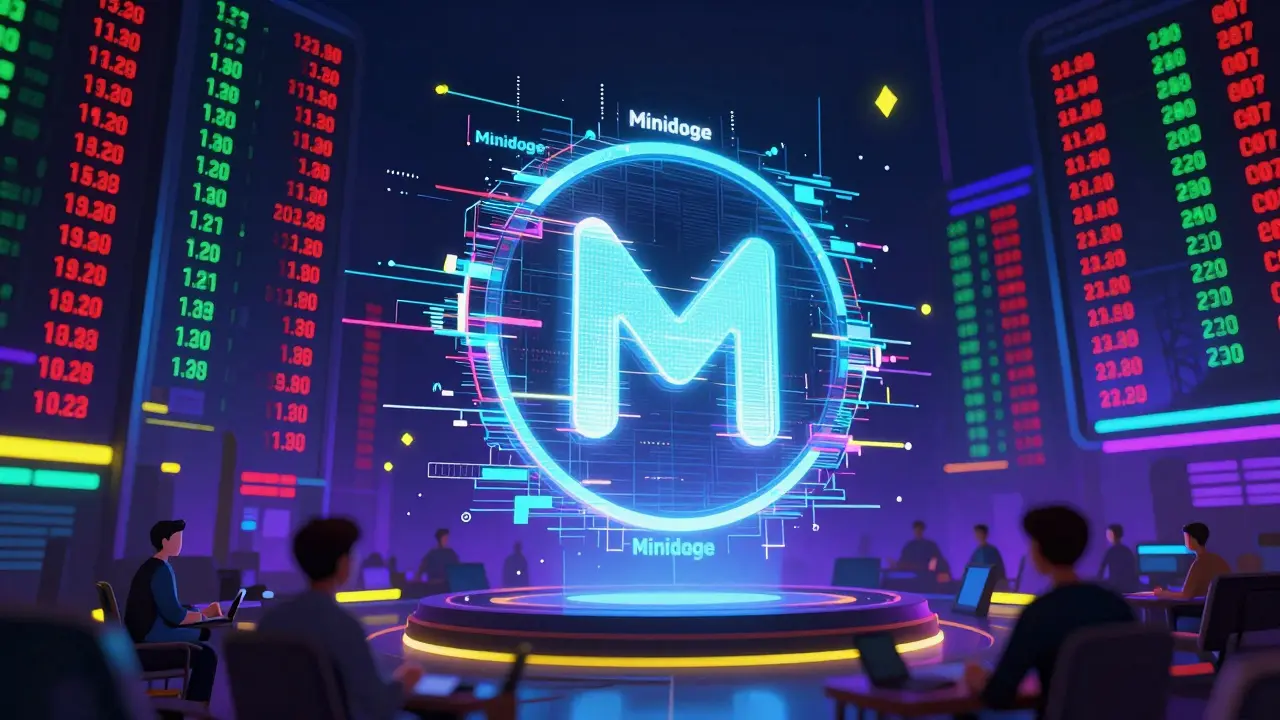
Have you ever seen a cryptocurrency name that sounds like a joke but promises serious returns? Minidoge is a speculative cryptocurrency token positioned as an extension of the Dogecoin ecosystem, often marketed with play-to-earn gaming features and community-driven governance. It’s the kind of project that pops up on social media feeds, usually accompanied by hype about "the next big thing" or connections to famous figures. But before you click buy, you need to know what you’re actually dealing with. This isn’t Bitcoin. It isn’t even standard Ethereum. It’s a fragmented, high-risk asset with confusing data and massive red flags.
The short answer? Minidoge is a meme-inspired token with multiple versions across different blockchains, extremely low liquidity, and wildly inconsistent pricing. If you are looking for stable growth, this is not it. If you are curious about how these tokens work-or why they are so dangerous-keep reading. We will break down the tokenomics, the wild price discrepancies, and the real risks involved in trading MINIDOGE.
The Origin Story: More Than Just a Meme?
Minidoge emerged from the broader Dogecoin original meme-based cryptocurrency created in 2013, known for its Shiba Inu mascot and strong community support ecosystem. The idea was simple: create a "child" token that inherits the cultural cachet of Dogecoin. On December 7, 2024, Elon Musk CEO of Tesla and SpaceX, influential figure in cryptocurrency markets shared an image on social media depicting "DogeFather" carrying "DogeSon." This wasn’t a technical endorsement, but it was enough to spike visibility. For meme coins, attention is currency. Musk’s post gave Minidoge a credibility boost it didn’t technically earn through code or utility.
The project positions itself as more than just a joke. According to Coinbase, MINIDOGE powers MiniPets a blockchain-based play-to-earn adventure game where players raise virtual pets and explore DOGEWorld to earn tokens. In this model, users engage with a game called MiniPets, exploring a world called DOGEWorld. The promise is that playing earns you tokens. This "play-to-earn" narrative is common in crypto gaming, but execution is rarely as smooth as the marketing suggests. Bill Spata is listed as the CEO of MiniDoge, but beyond that leadership detail, the team remains largely anonymous-a classic trait of high-risk meme projects.
Tokenomics: A Web of Contradictions
If you want to understand Minidoge, you have to look at its supply. And here is where things get messy. There is no single, agreed-upon number for how many MINIDOGE tokens exist. Different sources report vastly different figures:
- Coinbase: Reports a total supply of 1 quadrillion (1,000,000,000,000,000) tokens.
- CoinGecko: Lists a circulating supply of 1 billion tradable tokens.
- Bybit: Indicates a circulating supply of 700 trillion tokens as of August 2025.
- CoinMarketCap: Shows a total supply of 999.95 million tokens.
Why such huge gaps? You might be looking at different versions of the token on different blockchains, or you might be seeing outdated data. Some reports suggest there are multiple distinct tokens using the same ticker symbol. This fragmentation is a major risk. If you buy MINIDOGE on one exchange, it might not be the same asset as MINIDOGE on another. Always check the contract address before buying.
To combat inflation, the token uses two mechanisms: autoboost and burning. Autoboost converts some MINIDOGE into Binance Coin (BNB) to add liquidity to trading pools. Burning means sending tokens to a wallet with no private key, permanently removing them from circulation. The claim is that 100% of buyback tokens are burned after every trade. In theory, this creates scarcity. In practice, with a supply in the trillions or quadrillions, burning a few tokens rarely moves the needle significantly.
Price Chaos: Why Data Doesn't Match Reality
Let’s talk numbers. If you check the price of MINIDOGE today, you will likely see conflicting information. This isn’t just minor fluctuation; it’s extreme discrepancy:
| Platform | Reported Price (USD) | Market Cap Estimate | Note |
|---|---|---|---|
| Coinbase | $0.0000000012 | $0.00 | All-time high was $0.00000043 in March 2022 (-100% drop) |
| CoinGecko | $0.0000102 | BTC 0.2008 | Rank #9098; 24h volume only $179 |
| Bybit | $0.00000026 | $183.42 Million | Data from Aug 2025; rank #345 |
| CoinMarketCap | $0.00002236 | $99.87 Thousand | Zero 24-hour trading volume reported |
Look at that table. One source says the market cap is zero. Another says it’s over $183 million. How is this possible? It usually means one of three things: severe market manipulation, data reporting errors, or the existence of multiple unrelated tokens sharing the same name. The most active trading pair, according to CoinGecko, is MINIDOGE/SOL on Raydium a decentralized exchange built on the Solana blockchain, with a 24-hour volume of just $1.76. That is less than two dollars of trading activity. When volume drops 97.5% in a single day, liquidity has effectively vanished. You might find yourself unable to sell your tokens even if you wanted to.
Where Can You Actually Trade It?
You won’t find MINIDOGE on most major centralized exchanges like Coinbase Pro or Kraken for direct fiat trading. Instead, it lives primarily on decentralized exchanges (DEXs). Raydium is the most popular venue, followed by limited options on Binance via Web3 wallets. Bybit allows trading after identity verification, but availability changes frequently. Crypto.com currently does not list MINIDOGE for trading. This fragmentation makes entry difficult for beginners. You need a self-custody wallet, knowledge of gas fees, and the ability to verify contract addresses manually.
The Governance and Ecosystem Claims
Minidoge claims to have a decentralized autonomous organization (DAO) structure. Token holders can vote on decisions, theoretically giving the community control. They also partnered with the Treasure token to launch DogeEx, a DEX for DOGE tokens. While these features sound sophisticated, adoption metrics tell a different story. With near-zero trading volumes and inconsistent data, the DAO appears inactive or symbolic rather than functional. Community building is part of their roadmap, but without active participation, governance is just a buzzword.
Is There a Hardware Miner?
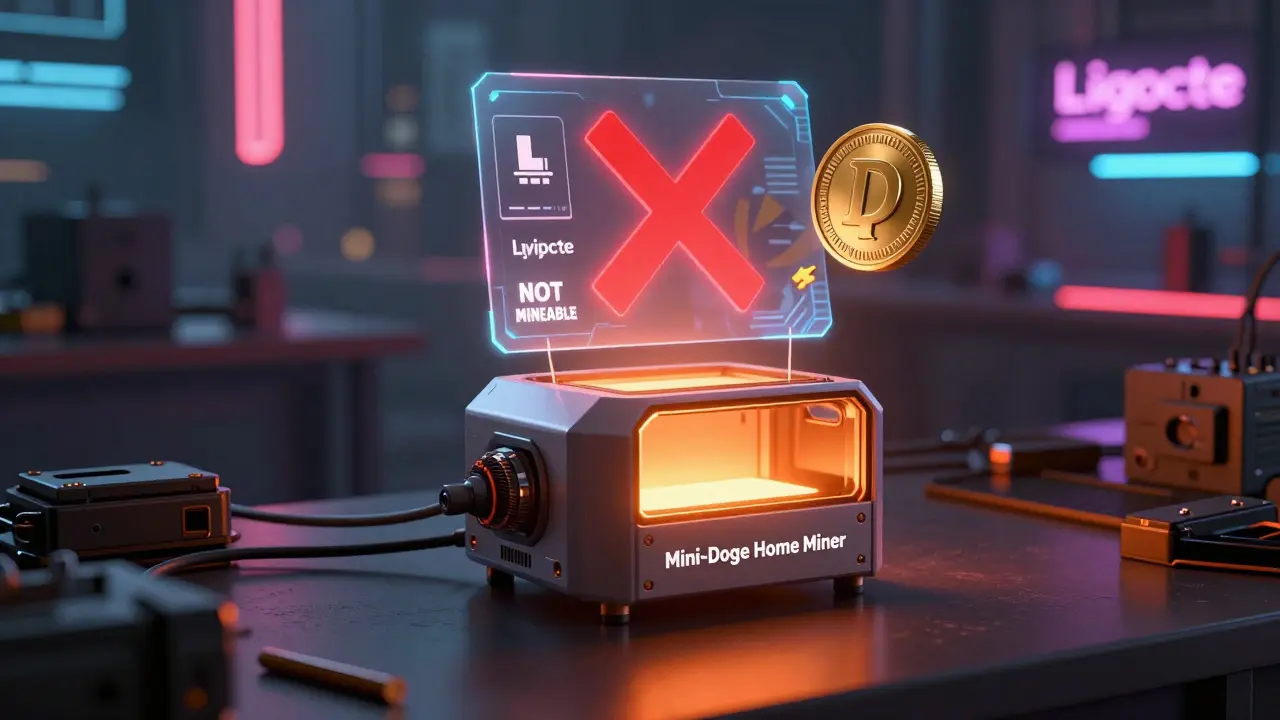
Here is another layer of confusion. Goldshell produces a device called the Mini-Doge Home Miner a hardware mining device using the Scrypt algorithm with 185 Mh/s hashrate. It mines using the Scrypt algorithm, achieving 185 megahashes per second at 233 watts. However, this miner is generally associated with Litecoin or Dogecoin, not necessarily the MINIDOGE token itself. The naming similarity is likely coincidental or a marketing tactic. Do not assume buying a miner will generate MINIDOGE tokens unless the manufacturer explicitly states otherwise. Most modern meme tokens are not mineable via proof-of-work.
Risk Assessment: Should You Buy?
Let’s be direct. Minidoge carries extreme risk. Here is why:
- Liquidity Crisis: With daily volumes under $200 on some platforms, selling large amounts could crash the price instantly.
- Data Inconsistency: Conflicting supply and price data make valuation impossible.
- Meme Dependency: Value relies entirely on social media hype, not utility or revenue.
- Fraud Potential: Multiple tokens with similar names increase the risk of buying a scam version.
- No Institutional Backing: Unlike established cryptos, there is no enterprise adoption or regulatory clarity.
If you decide to proceed, treat it as entertainment money-funds you are willing to lose completely. Never invest more than you can afford to burn. Use a separate wallet, verify the contract address twice, and avoid leveraging or borrowing to buy.
Alternatives to Consider
If you like the Dogecoin vibe but want safer exposure, consider sticking with Dogecoin itself. It has higher liquidity, clearer data, and broader acceptance. For play-to-earn gaming, look into established titles like Axie Infinity or StepN, which have transparent tokenomics and active user bases. These projects still carry risk, but they offer verifiable metrics and larger communities.
Is Minidoge a legitimate cryptocurrency?
Minidoge exists as a token on several blockchains, but its legitimacy is questionable due to extreme data inconsistencies, near-zero liquidity, and lack of clear utility. It functions primarily as a speculative meme asset rather than a functional currency.
Why do different websites show different prices for MINIDOGE?
Price discrepancies arise because multiple tokens may share the MINIDOGE ticker, data aggregators pull from different exchanges with varying liquidity, and some platforms report outdated or manipulated data. Always verify the specific contract address before trading.
Can I mine MINIDOGE with a GPU?
No. While Goldshell sells a "Mini-Doge" miner, it typically mines Scrypt-based coins like Litecoin or Dogecoin. The MINIDOGE token itself is not designed for proof-of-work mining and cannot be mined with consumer hardware.
Is Elon Musk endorsing Minidoge?
Musk posted an image referencing "DogeSon" in December 2024, which boosted visibility. However, he has not officially endorsed the token, invested in it, or confirmed any partnership. Social media mentions should not be interpreted as financial advice.
Where is the safest place to buy MINIDOGE?
There is no "safe" place to buy MINIDOGE due to its high risk. If you proceed, use reputable decentralized exchanges like Raydium, connect via a secure self-custody wallet, and double-check the token contract address against official project announcements to avoid scams.
Comments
24 Comments
beti macedo
I truly believe that there is a light at the end of the tunnel for those who look closely enough. The community spirit is what matters most in this journey. We must stay positive and keep our hearts open to new possibilities. It is not just about the numbers on the screen. It is about the connection we share with others. I have seen many projects rise from the ashes. This one feels different to me. The play-to-earn aspect is very promising for the future. We should support each other through thick and thin. Do not let the noise distract you from the vision. Keep believing in the dream.
Bianca Vilas Boas Lourenço
Oh wow, another meme coin article 😒. I am literally so tired of reading about these digital confetti pieces. You people are actually buying this? 🙄 It is giving major desperation vibes. Like, do you not have anything better to do with your time? 💔 The fact that the price varies by billions is just sad. It is like watching a train wreck in slow motion. And here I thought I was smart for staying away. Maybe I should start a support group for delusional investors. 🚩🚩🚩
Yash Lodha
The inconsistencies in the data are not mere errors but deliberate obfuscations designed to hide the true nature of the asset. Consider the possibility that multiple entities are manipulating the ledger to create an illusion of activity. The supply discrepancies suggest a coordinated effort to confuse retail investors. One must question why legitimate exchanges would list such fragmented assets without rigorous verification. The silence from regulatory bodies is deafening and suspicious. Are they complicit or simply overwhelmed by the sheer volume of scams? The answer likely lies in the shadows where power brokers operate unseen. We are being herded into a slaughterhouse disguised as a marketplace. Trust no one, especially those who profit from your confusion. The system is rigged against the individual.
Jesse Alston
Hey everyone! 👋 Just wanted to add some helpful context here. The contract address is crucial because many fake tokens use similar names. Always double-check on Etherscan or Solscan before swapping. 🛡️ It is easy to make a mistake when you are excited. Also, remember that low liquidity means high slippage. If you buy $100 worth, you might only get $80 back if you sell immediately. 😅 Stay safe out there!
Sarah C
I appreciate the detailed breakdown provided in the post. It helps clarify the risks involved for those of us who are cautious. Collaboration in understanding these complex systems is key to making informed decisions. Let us continue to share knowledge and support each other in navigating this space. Your insights are valuable to the community.
Kimberly Herbstritt
Actually, I think you are all missing the point. Meme coins are not about utility; they are about culture. The volatility is a feature, not a bug. People want excitement, not stability. Dogecoin succeeded because it was fun, not because it was efficient. Minidoge follows that same playbook. Stop trying to apply traditional financial metrics to internet jokes. It is like judging a clown by their accounting skills. Embrace the chaos.
Sharada Vakkund
Welcome to the discussion! Everyone has a unique perspective to share. Let us learn from each other's experiences with crypto investments. Whether you are bullish or bearish, your voice matters here. How has your journey been so far? Feel free to ask questions or offer advice. We are all in this together.
Sudarshan Anbazhagan
It is quite evident that the lack of transparency is a significant issue here. The varying supply numbers across different platforms indicate a fundamental flaw in the project structure. One cannot trust an asset that does not have a clear definition of its own existence. The burning mechanism is likely insufficient to counteract the massive inflation potential. Investors should be wary of such ambiguous propositions. The market will eventually correct itself, but until then, caution is advised. Do not rush into decisions based on hype alone.
John Gonzalez Bentham
U guys are all wrong about the risks. The real risk is missing out on the next big thing. Look at early Bitcoin adopters. They were laughed at too. Now they are rich. Minidoge could be the same. Dont listen to the FUD merchants. They just want to keep you poor. Buy the dip always works. Trust me on this one.
Ellie Riddell
Sarcasm aside, the reality is stark. A token with zero volume is essentially worthless paper. The philosophical implication of investing in nothingness is intriguing, though. Are we betting on hope or math? Probably neither. Just vibes. But vibes dont pay rent. Interesting times indeed.
Destiny Kilby
I understand the allure of quick gains. However, the data presented here is concerning. The lack of consistent pricing is a major red flag. It suggests that the market is not functioning properly. One should proceed with extreme caution. The emotional toll of losing money is significant. Please consider safer alternatives.
Jerry CUNNINGHAM SR
Respectfully, the analysis in the post is thorough and accurate. The fragmentation of the token across blockchains creates unnecessary complexity. This is not a feature for the average investor. It is a barrier to entry that serves no purpose other than obscurity. We should advocate for clearer standards in the industry. Transparency benefits everyone involved. Let us keep the conversation constructive and focused on facts.
Shelby Cantu
Stay strong! Every challenge is an opportunity to learn. Focus on your goals and ignore the noise. You got this!
Tobias Gjerlufsen
You are all idiots for even considering this garbage. The liquidity is non-existent. The team is anonymous. The utility is a joke. Why do people fall for these scams every single time? It is pathetic. Wake up sheeple. Sell now before you lose everything. Pathetic.
Ruben Michel
The pretension of calling this a 'currency' is laughable. It is a speculative instrument with no intrinsic value. The tokenomics are a disaster waiting to happen. Only the uninformed would touch this asset. True wealth comes from tangible assets and proven technology. Not from dog memes.
Gavin Wonnacott
I don't care about your feelings. This is a scam. Period. The developers are draining liquidity while you debate semantics. Get out now. Don't come crying to me when you are broke. It is simple economics. Supply exceeds demand by orders of magnitude. Basic math.
Samara McCallum
Maybe the chaos is the point. Life is unpredictable. Why should our investments be boring? I find comfort in uncertainty. It keeps me alive. Plus the drama is entertaining. Who cares about the price? The story is what matters. And the story is wild right now.
Sheldon Friesen
Let's look at this objectively. The risks are high. The rewards are uncertain. Is it worth it? Probably not. But if you do invest, keep it small. Use stop-losses. Protect your capital. That is how you survive in this game. Smart moves win. 📉📈
Tricia Alach
I think the philosophy behind meme coins is interesting. They represent pure sentiment. No whitepapers no tech just vibes. Maybe that is the future. Pure emotion driven markets. Sounds crazy but why not? Lets see where it goes.
Jan Gilmore
I know everything about this. The contract is rug-pull ready. The team has vanished. The socials are bots. It is over before it started. Listen to me because I am right. Always.
Caique Muniz
Whatever. Boring article. Too much text. Nobody reads this stuff. Just buy or sell. Stop whining about risks. If you cant handle the heat get out of the kitchen. Lmao.
Bradley Geldenhuys
Optimism is key! But also aggression. Fight for your gains. The market is a battlefield. Be fierce. Be bold. Don't let anyone tell you what to do. Trust your gut. Even if it screams danger sometimes. Risk is reward. Go hard or go home.
robert Whitehead
This is morally bankrupt. Promising returns with no substance is fraud. The creators are thieves. You are victims. Wake up. Do not enable this behavior. Boycott these scams. Demand accountability. Justice must prevail.
Mike S
Dramatic fail. Total disaster. Zero utility. Pure trash. I can't believe people still talk about this. It is embarrassing. Save yourselves. Run away fast. Don't look back. It is gone. Dead. Buried. Rest in peace.
Write a comment