



You’ve likely seen Tregrity USD pop up on a price aggregator or a generic "how-to-buy" guide. The ticker is USD.I, and it claims to be a next-generation stablecoin pegged to the US dollar. On paper, it sounds like just another entry in the crowded field of digital cash alternatives. But when you look closer at the data, the picture changes dramatically.
Tregrity USD is not a mainstream asset. It is an obscure token deployed on the BNB Smart Chain (a blockchain platform developed by Binance that supports smart contracts and decentralized applications). While major players like Tether (USDT) and Circle’s USD Coin (USDC) dominate the market with billions in verified reserves, Tregrity USD operates in the shadows. There is almost no real trading volume, no transparent issuer, and significant contradictions in its public data. Before you consider interacting with this token, you need to understand exactly what it is-and more importantly, what it isn’t.
The Basics: What Is Tregrity USD?
Tregrity USD (USD.I) presents itself as a privacy-focused, multi-chain stablecoin. According to its promotional materials and listings on sites like CoinCarp, it aims to offer accessibility and cross-chain operability. Technically, it exists as a BEP-20 token (a technical standard used for implementing smart contracts on the BNB Smart Chain, similar to ERC-20 on Ethereum).
Here are the hard facts derived from its smart contract:
- Blockchain: BNB Smart Chain (BSC)
- Contract Address: 0xa0Af324cC24ad0060bcE52dE359aFfD6deCb5cF2
- Maximum Supply: 12,000,000,000 (12 billion) tokens
- Decimals: 6 (standard for many stablecoins)
- Website: usditoken.io
The project claims these tokens will be backed 1:1 by US dollars or equivalent reserve assets. However, unlike established stablecoins, there is no public audit trail, no named banking partners, and no monthly attestation reports to prove those reserves actually exist. The website reads like a marketing brochure rather than a financial disclosure document. It promises features like privacy layers and DeFi integrations but lacks specific details, roadmaps, or verifiable team information.
The Data Problem: Why the Numbers Don’t Add Up
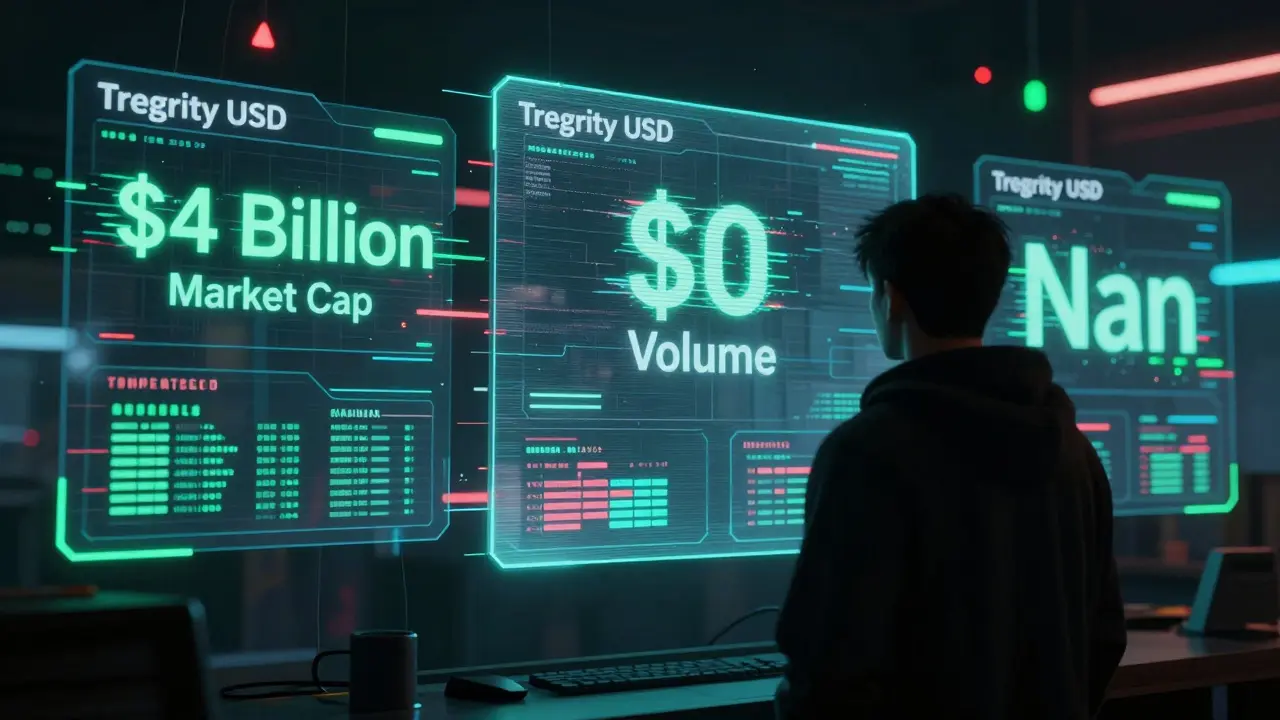
If you search for the price of USD.I, you’ll encounter a confusing mess of contradictory information. This is a major red flag. In legitimate markets, prices are determined by actual trades between buyers and sellers. For Tregrity USD, the "price" appears to be auto-generated by algorithms assuming a $1 peg, rather than reflecting real market activity.
| Platform | Reported Price | Market Cap | 24h Volume | Circulating Supply |
|---|---|---|---|---|
| Binance (Price Widget) | $1.000092 (or NaN) | $0 | $0 | 0 |
| FN-PLAN | $1.00106 | $4.06 Billion | $0 | 0 (Contradiction) |
| Coinbase | $0.9996 | N/A | $0.00 | N/A |
| Crypto.com | $0.9996 | N/A | N/A | N/A |
| CoinCarp | No Data | No Data | No Data | No Data |
Look closely at FN-PLAN’s data. It lists a market cap of over $4 billion but a circulating supply of zero. Mathematically, this is impossible. A market cap is calculated by multiplying the current price by the number of coins in circulation. If there are zero coins in circulation, the market cap must be zero. This discrepancy suggests that the data is placeholder text generated by automated scripts, not real economic indicators.
CoinCarp, one of the few aggregators honest enough to admit it, states clearly that they have no price data because Tregrity USD has not been listed on any recognized cryptocurrency exchanges. When you see a "price" on other platforms, it is likely a theoretical value based on the assumption that the token equals one US dollar, not a price anyone is actually paying.
On-Chain Reality: Who Actually Holds USD.I?
To understand if a crypto asset is real, you need to look at the blockchain itself. Using tools like BscScan (a block explorer and analytics platform for the BNB Smart Chain) and Nansen (an on-chain analytics platform that tracks wallet activities and token flows), we can see the true state of Tregrity USD.
The results are stark. The token has an extremely low number of holders-likely only tens of addresses, not thousands or millions. There is no evidence of heavy usage. Compare this to Tether (USDT) (the largest stablecoin by market capitalization, issued by Tether Limited) or USD Coin (USDC) (a fully reserved dollar-backed digital currency issued by Circle). Those tokens move billions of dollars daily across thousands of wallets, lending protocols, and exchanges.
Tregrity USD shows none of this activity. There are no large liquidity pools on decentralized exchanges like PancakeSwap. No major DeFi protocols accept it as collateral. No centralized exchange lists it for spot trading. Essentially, the token sits idle on the blockchain, moving only when manually transferred between a handful of known addresses. This lack of organic demand indicates that the token has failed to gain traction in the broader crypto ecosystem.
Red Flags: Transparency and Security
In the world of finance, transparency is trust. For stablecoins, it is non-negotiable. You need to know who holds your money and how you can get it back. Tregrity USD fails on both counts.
Unknown Issuer
Who is behind Tregrity? The official website does not name the founders, executives, or the legal corporate entity. There are no LinkedIn profiles, no office addresses, and no regulatory licenses displayed. Contrast this with Circle Internet Financial (the company behind USDC, which publishes monthly attestations from Grant Thornton). Circle is a registered money transmitter in multiple US states and provides full corporate details. Without knowing who you are dealing with, you have no recourse if something goes wrong.
No Audits
Smart contracts are code. Code can have bugs, or worse, malicious functions that allow developers to freeze funds or mint unlimited tokens. Reputable projects hire firms like CertiK, Trail of Bits, or OpenZeppelin to audit their code. Tregrity USD has no published security audits. The source code on BscScan is either unverified or generic, offering no proof that the contract doesn’t contain hidden risks. This is a critical vulnerability for any asset claiming to hold user value.
Regulatory Vacuum
Major regulators, including the US Department of the Treasury and the European Union under MiCA regulations, are cracking down on opaque stablecoins. Tregrity USD appears to operate outside these frameworks. There is no mention of KYC (Know Your Customer) or AML (Anti-Money Laundering) compliance policies. This places users at significant legal and financial risk, as the token could be delisted or frozen without warning.

How Would You Even Buy It?
You might find guides on smaller platforms like WEEX claiming to show you "How to buy Tregrity USD." These guides often follow a generic template: buy USDT, send it to MetaMask, connect to a decentralized exchange, and swap. However, this advice is misleading for USD.I.
Because there is no active liquidity pool, you cannot simply swap USDT for USD.I on PancakeSwap or Uniswap. There is no order book to execute your trade. To acquire Tregrity USD, you would essentially need to find an existing holder willing to transfer it to you directly via an over-the-counter (OTC) arrangement. This is highly impractical for retail investors and carries immense counterparty risk. You are relying entirely on the goodwill of an anonymous stranger to send you a token that has no clear exit strategy.
Conclusion: Proceed With Extreme Caution
Tregrity USD (USD.I) checks all the boxes of a high-risk, low-utility asset. It has a massive declared supply but negligible actual circulation. It claims a dollar peg but offers no proof of reserves. It promises innovation but delivers no working product or community adoption. The data surrounding it is fragmented, contradictory, and largely auto-generated.
If you are looking for a stable store of value in crypto, stick to established options like USDT, USDC, or DAI. These assets have deep liquidity, transparent issuers, and regulatory oversight. Tregrity USD currently serves no clear function in the market and poses unnecessary risks to your capital. In crypto, if something looks too vague to be true, it usually is.
Is Tregrity USD (USD.I) a safe investment?
No, Tregrity USD is not considered a safe investment. It lacks transparent reserves, has no identifiable issuer, and shows virtually no trading volume or liquidity. The absence of security audits and regulatory compliance makes it highly risky compared to established stablecoins like USDC or USDT.
Why is the market cap of Tregrity USD inconsistent across websites?
The inconsistencies arise because most data aggregators use automated formulas to estimate prices and market caps. Since there is no real trading activity, some sites assume a $1 peg and calculate a theoretical market cap, while others correctly report zero volume and supply. These figures do not reflect actual market value.
Can I buy Tregrity USD on Binance or Coinbase?
You cannot actively trade Tregrity USD on Binance or Coinbase. While these platforms may display informational price pages for USD.I, they do not list it in their active order books. There are no spot trading pairs available, meaning you cannot buy or sell it through these exchanges.
What blockchain is Tregrity USD built on?
Tregrity USD is deployed on the BNB Smart Chain (BSC) as a BEP-20 token. Its smart contract address is 0xa0Af324cC24ad0060bcE52dE359aFfD6deCb5cF2. While the project claims future multi-chain expansion, currently it only exists on BSC.
Does Tregrity USD have any security audits?
There are no publicly available security audit reports for Tregrity USD from reputable firms like CertiK or OpenZeppelin. This lack of verification means users cannot confirm if the smart contract contains vulnerabilities or malicious functions, adding to the overall risk profile.