

You might have seen Vertex Protocol mentioned in crypto Twitter or heard whispers about its ambitious hybrid trading model. But what exactly is it? Is it just another governance token, or does it offer something unique for traders looking to escape centralized exchanges? If you are trying to figure out if VRTX is worth your attention-or why its price has moved the way it has-you need to understand how this protocol actually works under the hood.
Vertex Protocol is a decentralized exchange (DEX) that combines a traditional central limit orderbook with automated market maker (AMM) liquidity, all while integrating a money market for lending and borrowing. Think of it as an attempt to bring the user experience of a centralized exchange like Binance onto the blockchain, specifically on the Arbitrum network. The native token, VRTX, isn't just there for speculation; it powers governance, staking, and fee discounts across this unified ecosystem.
The Core Problem Vertex Solves
Most early decentralized exchanges had a major flaw: they were fragmented. You’d use one platform for spot trading, another for perpetual futures, and yet another to lend out your idle assets. Moving funds between them was slow, expensive, and risky. Worse, your collateral didn’t work everywhere. If you deposited ETH on a spot DEX, you couldn’t easily use it to back a leveraged trade on a futures platform without withdrawing and redepositing.
Vertex aimed to fix this by creating a "synchronous" environment. In plain English, this means everything happens in real-time within a single risk engine. You can hold a position in Bitcoin perps, trade Ethereum spot, and earn interest on your USDC-all using the same collateral pool. This concept, known as cross-margining, allows for much higher capital efficiency. Instead of locking up $10,000 to cover three different positions, you might only need $3,000 because the protocol recognizes that gains in one area can offset losses in another.
How VRTX Fits Into the Ecosystem
The VRTX token serves as the backbone of this system. It’s an ERC-20 token deployed primarily on Arbitrum, though it exists on other EVM-compatible chains like Base and Blast. But holding VRTX isn't just about owning a piece of the pie; it unlocks specific utilities that change how you interact with the platform.
First, it grants governance rights. Holders can vote on critical protocol parameters, such as which new assets get listed or how fees are distributed. Second, it enables staking. By staking VRTX, users receive xVRTX, a liquid staking token. Unlike standard staking where your tokens are locked and useless, xVRTX remains transferable. It represents your claim on the protocol's revenue and voting power. If you stake 100 VRTX, you get roughly 100 xVRTX, which you can then use to boost your rewards or provide insurance to the protocol.
There’s also voVRTX, or "vote-escrowed" VRTX. This is a non-transferable token that acts as a scorecard for your commitment level. The longer you lock your tokens and the more actively you participate, the higher your voVRTX balance. This boosts your share of rewards and governance influence, rewarding long-term believers over short-term flippers.
| Token Type | Transferable? | Primary Function | Reward Mechanism |
|---|---|---|---|
| VRTX | Yes | Base asset for staking and fees | Fee discounts when used directly |
| xVRTX | Yes | Liquid representation of staked VRTX | Accrues protocol revenue and emissions |
| voVRTX | No | Governance weight and reward multiplier | Boosts yield based on lock duration/activity |
Technical Architecture: Hybrid Orderbook Meets AMM
Why call it a "hybrid" DEX? Traditional AMMs, like Uniswap, rely on liquidity pools. They’re great for simple swaps but struggle with complex derivatives and efficient pricing for large trades. Central Limit Orderbooks (CLOB), like those on Coinbase, match buyers and sellers directly but require high liquidity to function well.
Vertex uses a CLOB for matching orders, giving traders precise control over entry and exit prices. However, to ensure there’s always enough liquidity, it integrates AMM mechanisms behind the scenes. If no human counterparty is available to take your trade, the smart contract acts as the market maker. This setup aims to offer the low slippage of a centralized exchange with the self-custody security of DeFi. Because it runs on Arbitrum, transaction costs are significantly lower than on Ethereum mainnet, making frequent trading feasible for retail users.
Market Performance and The Ink Migration
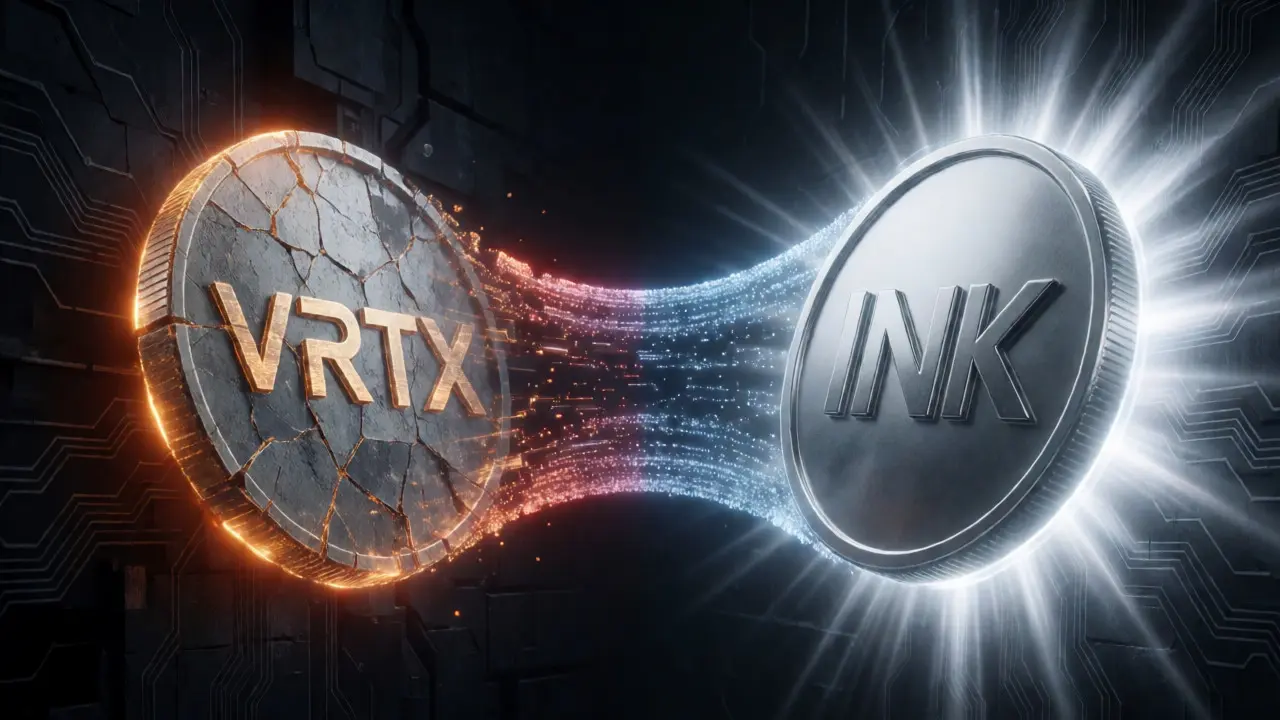
If you look at VRTX’s chart since its launch in November 2023, you’ll notice a steep decline. Reports indicate the token lost approximately 98% of its value from its debut highs. Why did this happen? Partly due to broader crypto market conditions, but also due to specific strategic shifts. In mid-2025, the team announced a major pivot: migrating the protocol to a new layer-2 network called Ink, backed by Kraken.
This move involves sunsetting the original VRTX token structure. Existing holders were eligible for an airdrop of the new INK token, with 1% of Ink’s genesis supply reserved for the Vertex community. Treasury and unvested VRTX tokens were burned, effectively resetting the economic model. For many investors, this felt like a capitulation-a sign that the initial tokenomics didn’t sustain demand. However, for others, it represented a chance to reset and align incentives with a larger ecosystem player.
As of late 2026, VRTX operates largely as a legacy asset transitioning into the new framework. Its circulating supply estimates vary between data providers, with some citing around 160 million and others reporting over 500 million, highlighting the complexities of tracking vesting schedules. The remaining locked tokens continue to unlock through 2029, which could introduce sell pressure if not matched by renewed utility demand.
Pros and Cons of Using Vertex
Should you care about Vertex today? That depends on what you’re looking for. Here is a balanced view:
- Capital Efficiency: The cross-margining feature is genuinely useful for active traders who want to maximize their leverage without juggling multiple accounts.
- User Experience: The interface mimics centralized exchanges, reducing the learning curve for newcomers moving away from CeFi.
- Innovation Risk: The migration to Ink suggests the original vision faced hurdles. While the technology persists, the token identity has shifted, creating uncertainty for long-term holders.
- Liquidity Depth: While improving, it still trails giants like dYdX or GMX in total volume, meaning large trades might still face some slippage compared to top-tier competitors.
Final Verdict
Vertex Protocol tried to solve a real problem: fragmentation in DeFi. Its hybrid orderbook approach and integrated money market offered a compelling alternative to siloed platforms. However, the journey of the VRTX token reflects the volatility and iterative nature of crypto infrastructure. The shift to Ink marks a new chapter, prioritizing stability and integration with the Kraken ecosystem over pure decentralization ideals.
If you are already holding VRTX, check your eligibility for the INK airdrop and monitor how the new token performs on the Ink chain. If you are a trader looking for efficient derivatives trading, keep an eye on Vertex’s successor protocols-they may offer better tools even if the original token has faded.
Is Vertex Protocol safe to use?
Like all DeFi protocols, Vertex carries smart contract risks. While it has undergone audits, no code is perfect. Users should start with small amounts and ensure they are interacting with the official website to avoid phishing scams.
What is the difference between VRTX and xVRTX?
VRTX is the base token you buy or earn. xVRTX is what you receive when you stake VRTX. xVRTX accrues rewards and retains voting power, whereas unstaked VRTX does not generate passive income automatically.
Why did VRTX price drop so significantly?
The drop resulted from a combination of general bearish market trends, competition from other derivatives DEXs, and the announcement of the migration to the Ink network, which led to the sunset of the original VRTX economic model.
Can I still trade on Vertex?
Yes, the underlying trading technology continues to operate, particularly as it migrates to the Ink layer-2. Check the current status of the front-end application to see which markets are currently active and accepting deposits.
Which wallets support VRTX?
Since VRTX is an ERC-20 token on Arbitrum, any wallet that supports Ethereum and Arbitrum networks will work. MetaMask, Rabby, and Trust Wallet are popular choices.