

You’ve probably heard of Zero-Knowledge Proofs (ZKPs) in the context of cryptocurrency. They’re the magic trick that lets you prove you have enough money to buy something without showing your bank balance or revealing who you are. But if you think ZKPs are just for hiding crypto transactions, you’re missing the bigger picture. This cryptographic technology is quietly revolutionizing industries far removed from blockchain, from how we vote to how artificial intelligence learns.
The core promise of a ZKP is simple but powerful: one party can prove to another that a statement is true without revealing any information beyond the fact that the statement is indeed true. It’s like proving you know the password to a door without actually speaking the password out loud. As computational power increases and algorithms become more efficient, this capability is moving from theoretical computer science into practical, everyday tools.
Reinventing Digital Identity Verification
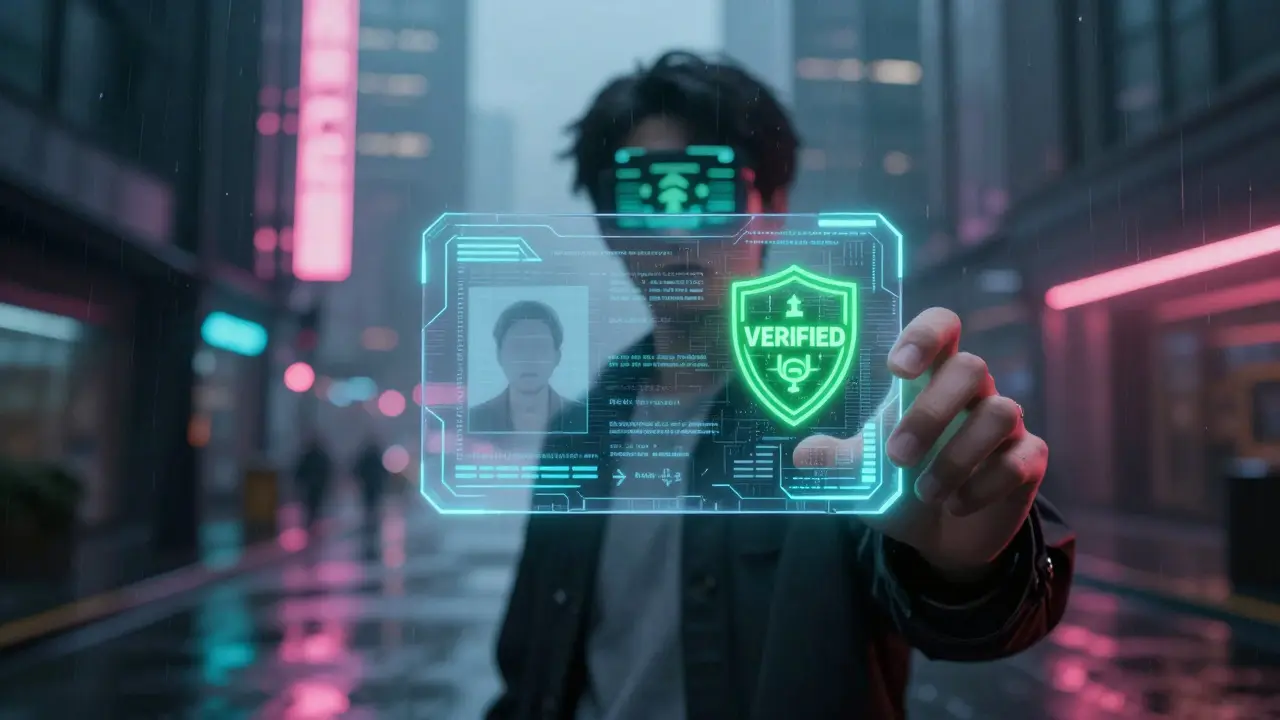
Think about how often you share sensitive personal data just to prove a basic fact. Want to order a drink? You hand over your driver’s license, which contains your name, address, birth date, and photo, just to prove you are over 21. The bartender doesn’t need your home address; they just need to know you meet the age requirement. This is where Decentralized Identity systems powered by ZKPs change the game.
With ZKP-based identity protocols, you can generate a cryptographic proof that you are over 21 without disclosing your actual birth date. In 2022, the United States alone reported over 1.1 million cases of identity theft, costing consumers more than $43 billion. Much of this fraud stems from the unnecessary hoarding of personal data by organizations. By using ZKPs, companies no longer need to store your passport number or social security number. They only need to verify the validity of the claim you present.
This approach is particularly valuable for compliance. Financial institutions must adhere to Know Your Customer (KYC) regulations. Traditionally, this means collecting and storing massive amounts of personal data, creating a honeypot for hackers. With ZKPs, a user can prove they are not on a sanctions list or that they reside in an allowed jurisdiction without revealing their specific location or identity details. The institution gets the compliance check it needs; the user keeps their privacy intact.
Enterprise Security and Authentication
In the corporate world, access control is a constant battle between security and convenience. Employees need access to various systems, but giving everyone broad permissions is risky. Restricting access too tightly slows down productivity. ZKPs offer a middle ground through anonymous authentication.
Imagine a hospital network. Doctors need access to patient records, but not all doctors need access to all records. Currently, hospitals maintain detailed logs of who accessed what and when, storing vast amounts of metadata. Using ZKPs, a doctor can prove they have the necessary clearance level for a specific department without revealing their exact identity to the system administrator every time they log in. This reduces the risk of insider threats and limits the exposure of employee directories.
Furthermore, enterprises can use ZKPs to verify vendor credentials. A supplier can prove they meet certain environmental or safety standards without exposing their proprietary manufacturing processes or supply chain secrets. This allows for secure business partnerships where trust is established mathematically rather than through invasive audits that compromise competitive advantages.

Supply Chain Transparency Without Trade Secrets
Consumers today care about where their products come from. They want to know if coffee is fair-trade, if diamonds are conflict-free, or if electronics contain recycled materials. However, companies are reluctant to share full supply chain data because it reveals their suppliers, pricing structures, and logistics strategies-information competitors would love to steal.
ZKPs solve this dilemma by enabling verifiable transparency. A manufacturer can generate a proof that a product meets specific ethical sourcing criteria without revealing the names of the suppliers or the exact routes taken. For example, a fashion brand can prove that its cotton is organic by verifying certificates from trusted authorities, without exposing which farms provided the cotton. This builds consumer trust while protecting business intelligence.
This application extends to food safety as well. In the event of a contamination issue, companies can trace the source of the problem using private ledgers verified by ZKPs, ensuring that only relevant parties see the sensitive data while regulators can verify that proper tracking measures were in place.
Secure Electronic Voting Systems
Democracy relies on two conflicting principles: votes must be secret to prevent coercion, but the election result must be public and verifiable to ensure integrity. Traditional paper ballots struggle with scalability and counting errors, while digital voting systems have historically been vulnerable to hacking and manipulation.
ZKPs provide a cryptographic solution to this paradox. Voters can cast a ballot that is encrypted, and the system can produce a proof that the vote was counted correctly without linking the vote back to the voter. This ensures that no one can sell their vote (since they cannot prove how they voted) and no one can alter the results without detection. Governments and organizations are increasingly exploring these systems to enhance electoral integrity, especially in large-scale elections where manual counting is impractical.

Privacy-Preserving Machine Learning
Artificial intelligence thrives on data, but much of the most valuable data is sensitive. Healthcare records, financial histories, and genetic information are prime targets for machine learning models, yet sharing them violates privacy laws like HIPAA and GDPR. This has created a bottleneck in AI development.
Zero-Knowledge Virtual Machines (zkVMs) are changing this landscape. These specialized environments allow computations to be performed on encrypted data. A company can train a machine learning model on data held by multiple other entities without ever seeing the raw data. The zkVM generates a proof that the computation was performed correctly according to the agreed-upon algorithm. This enables collaborative AI research in healthcare, where hospitals can jointly train diagnostic models without sharing patient records, accelerating medical breakthroughs while maintaining strict privacy standards.
| Application Area | Primary Benefit | Key Challenge |
|---|---|---|
| Identity Verification | Reduces identity theft risk | User education and adoption |
| Enterprise Security | Minimizes data breach impact | Integration with legacy systems |
| Supply Chain | Verifies ethics without secrets | Standardization across industries |
| Voting Systems | Ensures integrity and secrecy | Public trust and usability |
| Machine Learning | Enables collaborative AI | Computational overhead |
Implementation Challenges and Future Outlook
Despite the potential, adopting ZKPs is not without hurdles. The primary challenge remains computational intensity. Generating and verifying proofs requires significant processing power, although advancements in hardware and algorithms like zk-SNARKs (Zero-Knowledge Succinct Non-Interactive Arguments of Knowledge) are rapidly improving efficiency. Another challenge is integration. Legacy enterprise systems were not built with cryptography in mind, requiring careful planning and sometimes custom development to bridge the gap.
However, the trajectory is clear. As libraries and frameworks mature, the barrier to entry lowers. Developers are building domain-specific languages that make it easier to create ZKP-enabled applications without deep cryptographic expertise. We are moving towards a future where privacy is not an afterthought but a default feature of digital interactions, enabled by the mathematical certainty of zero-knowledge proofs.
What is the difference between ZKPs and encryption?
Encryption hides data so that only authorized parties can read it. Zero-Knowledge Proofs allow you to prove a statement about data is true without revealing the data itself. Encryption protects the content; ZKPs protect the process of verification.
Are ZKPs secure against quantum computers?
Many current ZKP schemes rely on elliptic curve cryptography, which may be vulnerable to quantum attacks. However, researchers are actively developing post-quantum ZKP protocols that will remain secure even in a quantum computing era.
How do ZKPs help with GDPR compliance?
GDPR emphasizes data minimization-the principle that you should only collect what is necessary. ZKPs enable businesses to verify compliance or user attributes without storing excessive personal data, aligning perfectly with data minimization requirements.
What are zk-SNARKs?
zk-SNARKs are a specific type of ZKP that are succinct (small proof size), non-interactive (no back-and-forth communication needed), and computationally efficient to verify. They are widely used in blockchain scaling and privacy solutions.
Can ZKPs be used outside of blockchain?
Absolutely. While blockchain popularized ZKPs, the underlying mathematics applies to any digital interaction requiring verification without disclosure, including cloud computing, identity management, and secure multi-party computation.