


The short answer is that for 99% of people, 12 words are plenty. However, the debate isn't just about numbers-it's about the trade-off between theoretical math and human error. If you're deciding which one to use for your new wallet, you need to understand where the actual risks live.
The Basics: What is a Seed Phrase?
Before we split hairs over the length, let's get the terminology straight. A seed phrase is a human-readable representation of a cryptographic master key. Instead of forcing you to write down a terrifying string of 64 random characters, the BIP39 standard converts that raw data into words from a specific list of 2,048 options.
Think of it as a translation layer. Your wallet generates a random number (entropy), and BIP39 turns that number into a phrase you can actually write on a piece of paper. Whether you use 12 or 24 words, the goal is the same: to give you a way to recover your private keys on any compatible device if your current one disappears.
The Math: 128-bit vs 256-bit Entropy
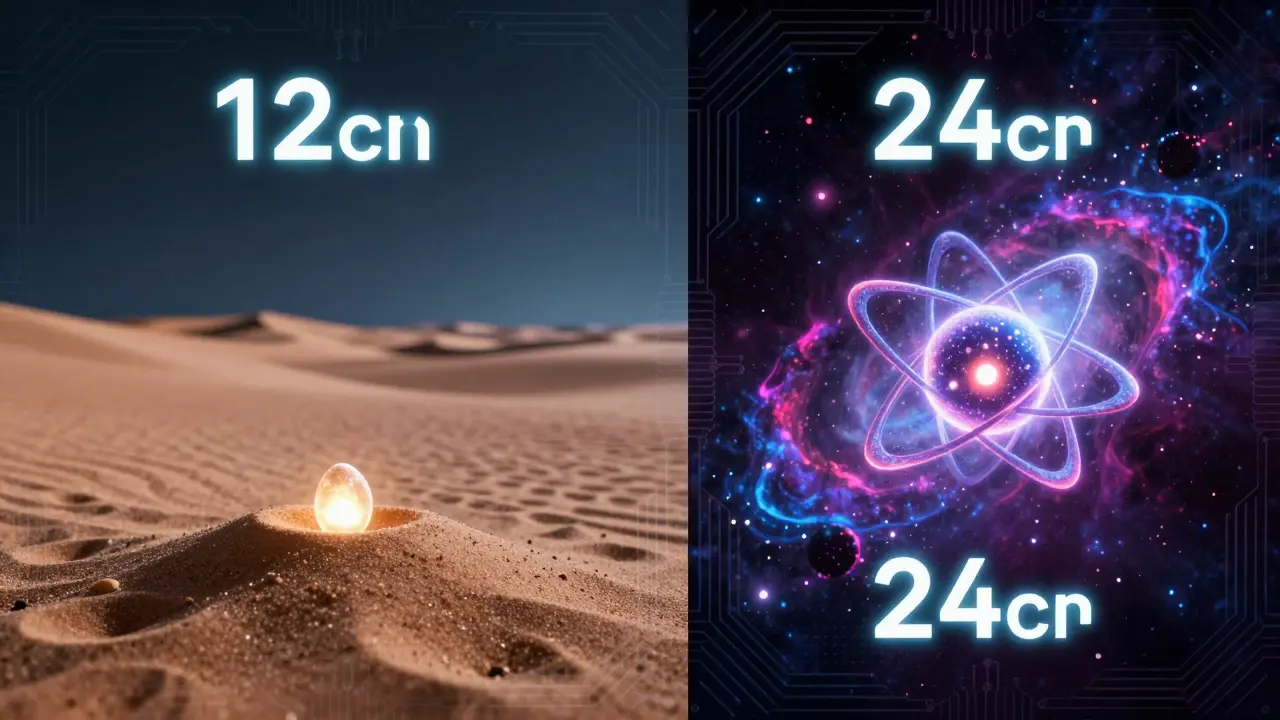
This is where the technical debate happens. A 12-word phrase provides 128 bits of security. A 24-word phrase provides 256 bits. On paper, 256 is double 128, which sounds like it's twice as secure. But in cryptography, doubling the bits doesn't just double the security; it increases it exponentially.
To put this in perspective, guessing a 12-word phrase is like trying to find one specific grain of sand among all the sand on Earth. Now, imagine trying to find one specific atom in the entire observable universe-that's closer to the difficulty of guessing a 24-word phrase.
However, Bitcoin's underlying security (the secp256k1 elliptic curve) is designed around a 128-bit security ceiling. This means that even if you have a 24-word seed, the actual "lock" on your Bitcoin address can't be stronger than 128 bits. As crypto pioneer Adam Back pointed out, since the underlying private key would be broken at the same point as a 12-word seed, the extra words don't actually add a practical layer of protection against a brute-force attack.
| Feature | 12-Word Seed | 24-Word Seed |
|---|---|---|
| Total Entropy | 128 bits | 256 bits |
| Total Data (with checksum) | 132 bits | 264 bits |
| Possible Combinations | ~3.4 × 1038 | ~1.2 × 1077 |
| Primary Benefit | Faster backup, lower error rate | Maximum theoretical security |
| Primary Risk | Higher collision risk (theoretical) | Higher user transcription error |
The Human Element: Where the Real Danger Lies
If 12 words are mathematically "enough," why do some wallets still push 24? The answer lies in imperfect entropy. If the software generating your seed is slightly flawed or uses a bad random number generator, a 256-bit seed (24 words) provides a safety net. Even if the generator is "unfair," you'll likely still have enough security to keep your funds safe. With 12 words, there's less room for error in the generation process.
But here's the flip side: humans are terrible at copying lists of words. Every extra word you have to write down is another opportunity to make a mistake. If you misspell one word or swap the order of two, you could lose everything.
Real-world data backs this up. In community discussions on Reddit, users have reported losing funds specifically because they misrecorded a long 24-word phrase during a stressful situation. In fact, some studies show that 12-word backups are completed significantly faster and with far fewer verification errors than 24-word ones. If you are more likely to lose your coins because of a typo than because a supercomputer guessed your phrase, then 12 words are objectively safer for you.
Comparing the Risks: Brute Force vs. Phishing
It's easy to obsess over whether a hacker can guess your seed, but that's almost never how people lose money. Whether you have 12 or 24 words, you are equally vulnerable to the two most common attacks: phishing and physical theft.
If a scammer tricks you into typing your seed into a fake website, it doesn't matter if your phrase was 12 words or 124 words-they have it. Data from security databases shows that phishing attacks have nearly identical success rates regardless of the seed length.
The same goes for physical security. A 24-word phrase written on a piece of paper in a desk drawer is vastly less secure than a 12-word phrase etched into stainless steel and locked in a bank vault. The storage method is the real variable, not the length of the phrase.

Which One Should You Choose?
Deciding between the two usually comes down to your persona and your balance.
The Casual User: If you're holding a few thousand dollars and want a setup that is easy to manage and back up, stick with 12 words. The risk of a transcription error is much higher than the risk of a cryptographic attack.
The Whale/Institutional User: If you're managing millions of dollars, the "perceived security" and the extra entropy headroom of 24 words are worth the extra effort. At this level, you're likely using a professional backup service or a multi-signature setup anyway, so the extra time spent writing words isn't a burden.
The Paranoid Optimizer: If you don't trust the random number generator of your device, go for 24 words. This gives you a buffer against poor software implementations.
For most people, the "sweet spot" is 12 words. It matches the security strength of the Bitcoin network and minimizes the chance that you'll accidentally lock yourself out of your own money.
Advanced Alternatives: Beyond Fixed Lengths
If the choice between 12 and 24 feels too limiting, some modern wallets are moving toward more flexible systems. Shamir's Secret Sharing (SSS) is one such method. Instead of one long phrase, it splits the recovery key into multiple parts. You might have five different shares, and any three of them can be used to recover the wallet.
This removes the "single point of failure" problem. You don't have to worry about one person losing a piece of paper or one house fire destroying your only backup. While this is more complex to set up, it's the gold standard for high-value storage because it balances security with practical redundancy.
Can I change my 12-word seed to a 24-word seed later?
No, you cannot simply "extend" an existing seed. To move from 12 to 24 words, you would need to generate a brand new 24-word seed on your wallet and then manually send all your funds from the old 12-word addresses to the new 24-word addresses. This involves paying network transaction fees.
Is a 12-word phrase easier to hack?
Theoretically, yes, because there are fewer combinations. Practically, no. 128 bits of entropy is still astronomically large. Current computing power cannot brute-force a 12-word seed within any reasonable timeframe. You are far more likely to be hacked via a phishing link than by someone guessing your words.
What happens if I lose one word of my 24-word phrase?
If you are missing a single word but have the other 23, it is possible to recover the wallet using brute-force software, as there are only 2,048 possibilities for that missing word. However, if you lose three or more words, recovery becomes nearly impossible without an incredibly powerful computer and a lot of luck.
Does a 24-word seed make my wallet slower?
Not at all. The seed phrase is only used during the initial setup or during a recovery process. Once the wallet is open and the private keys are loaded into the device's memory, the length of the original seed has zero impact on transaction speed or performance.
Should I store my seed phrase in a password manager?
Generally, no. The point of a hardware wallet is to keep the keys offline. Putting your seed phrase in a cloud-connected password manager defeats that purpose. If your computer is compromised, the hacker can find your seed. The safest method is a physical backup-preferably etched in metal-stored in a secure, fireproof location.