


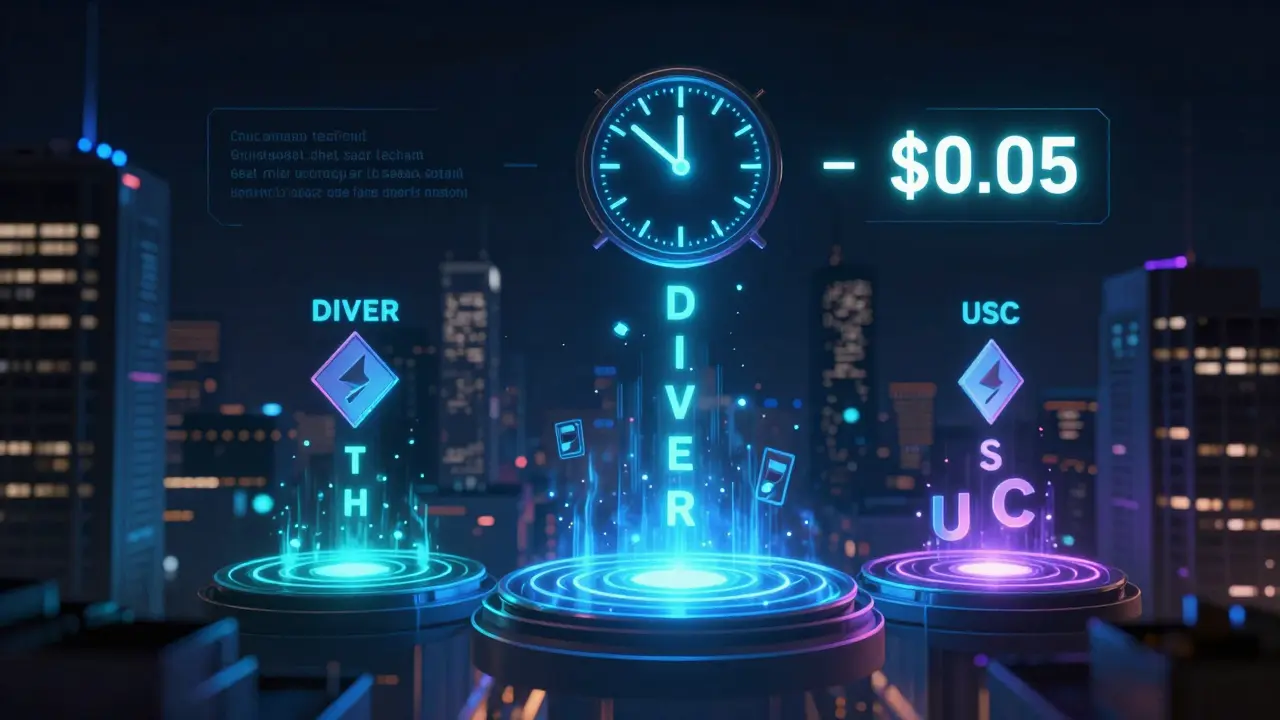
There’s a lot of talk about Divergence and its DIVER token, but if you’re looking for a traditional airdrop - like free tokens handed out to wallet holders - you won’t find one. Divergence didn’t run a typical airdrop. Instead, it used something more structured: a Dutch auction for its Initial DEX Offering (IDO). That means tokens weren’t given away for free. They were sold, at a price that dropped over time until all 20 million DIVER tokens were claimed.
The auction started at $0.10 per token, with a floor price of $0.05. That’s not a giveaway. That’s a market test. Over 7.75 million in value was raised during the sale. The team wanted to avoid the chaos of early hype and pump-and-dump cycles. By using a Dutch auction, they let the market decide the real price - no whales front-running, no bots sniping. It was designed to be fair, open, and scalable.
After the IDO, DIVER tokens hit SushiSwap. That’s where most of the liquidity went. If you wanted to buy or sell DIVER right after launch, SushiSwap was the only place to do it. The team kept the rest of the sale proceeds to fund future listings on bigger exchanges and to add more liquidity later. Today, DIVER trades around $0.010686 - way below the original auction price. That’s not unusual for early DeFi projects. Many drop 80-90% after launch before finding stability.
So if there’s no airdrop, how do you get DIVER tokens? The answer is participation.
How Divergence Rewards Its Community
Divergence doesn’t give out tokens randomly. It pays people who actually use the platform. Think of it like a loyalty program - but built on blockchain.If you provide liquidity to Divergence’s synthetic options markets, you earn DIVER rewards. That means locking up assets like ETH, WBTC, or stablecoins to help other users trade volatility. The more liquidity you add, the more rewards you get. It’s not a one-time bonus. It’s ongoing. The system is designed so that long-term contributors get the biggest share.
You can also earn DIVER by trading. Divergence lets users buy synthetic binary options on DeFi assets - think of it like betting on whether ETH will go up or down in the next 24 hours. Every trade you make adds to the platform’s activity, and the protocol rewards active traders with a portion of the DIVER token supply.
Holding DIVER gives you governance power. You can vote on upgrades, fee structures, and new asset listings. The more tokens you hold, the more weight your vote carries. This isn’t just a token - it’s a stake in the future of the protocol.
Why This Isn’t an Airdrop - And Why It Matters
Most airdrops are lazy. They dump tokens on wallets that did nothing but join a Discord server. Those tokens usually get sold immediately. The price crashes. The project loses momentum.Divergence chose a different path. They didn’t want to attract speculators. They wanted builders, traders, and liquidity providers - people who care about the platform working long-term. By tying rewards to real activity, they create a stronger, more resilient ecosystem.
Compare this to other DeFi projects that gave away 10% of their supply to early Twitter followers. Within days, those tokens flooded exchanges. The price collapsed. The community burned out.
Divergence’s model is harder - but it’s smarter. You don’t get tokens for signing up. You get them for doing something valuable. That’s why the team didn’t call it an airdrop. They called it a reward system.

What You Can Do Right Now
If you want DIVER tokens today, here’s what actually works:- Go to the Divergence Protocol website and connect your wallet.
- Deposit assets into one of the liquidity pools for synthetic options. You can use ETH, USDC, or other supported tokens.
- Start trading binary options on DeFi assets like AAVE, UNI, or LINK.
- Hold DIVER tokens to vote on governance proposals.
There’s no claim button. No waiting list. No snapshot. You don’t need to follow them on X or retweet anything. Just use the platform. The rewards come automatically.
Don’t be fooled by third-party sites claiming to offer “DIVER airdrops.” Those are scams. Divergence has never asked for private keys, wallet passwords, or gas fees to claim tokens. If someone asks you to pay to receive DIVER, it’s a fake.
Security and Risks to Consider
Divergence is built on smart contracts - and that’s both its strength and its risk. There’s no central company to call if something goes wrong. If a contract has a bug, your funds could be at risk. That’s why you should never deposit more than you’re willing to lose.Also, synthetic options are complex. Betting on price movements in DeFi can lead to big losses if you don’t understand how volatility works. A 10% swing in ETH could wipe out your position if you’re leveraged.
Always check the official Divergence documentation before depositing anything. Look for audits from reputable firms like CertiK or Hacken. The team has published audit reports - make sure you’ve read them.

Where Divergence Is Headed
The team has said they’re working on listings on major exchanges like Coinbase and Kraken. That could bring more users, more liquidity, and higher trading volume. But there’s no confirmed date yet.They’re also expanding the types of assets you can trade. Right now, it’s mostly Ethereum-based tokens. In the future, they plan to add Solana, Polygon, and even Bitcoin Layer-2 assets. If that happens, the demand for DIVER could rise - especially if more people start using it to hedge their portfolios.
The real test for Divergence isn’t whether the token price goes up. It’s whether people keep using it six months from now. If traders are still hedging their DeFi positions with Divergence’s options, and liquidity providers are still earning rewards - then this project has legs.
Final Thoughts
Forget the idea of free DIVER tokens. There isn’t one. But there’s a better path: earn them by using the platform. If you’re active in DeFi, if you trade, if you provide liquidity - then Divergence is one of the few protocols that actually rewards you for it. No gimmicks. No hype. Just real utility.Don’t chase airdrops. Build something instead. That’s what Divergence is doing. And if you join them, you might just build something valuable too.


Comments
19 Comments
Tanvi Atal
No airdrop? Big deal. I'm out.
Sony Sebastian
This 'Dutch auction' is just a fancy way of saying they pumped and dumped. The 80% drop proves it. Real DeFi doesn't need this theatrics.
Brian Lemke
Honestly? This is one of the cleanest models I've seen in DeFi. No free tokens means no flippers. Real users, real utility. That’s rare. You’re not getting rich overnight, but you’re building something that might last. 🌱
Megan Lavery
I love this approach. No drama, no scams. Just use the product and get rewarded. It feels… honest. Like actual work for actual value. 💪
Cory Derby
It's important to recognize that token distribution mechanisms are foundational to protocol sustainability. By aligning incentives with active participation rather than speculative entry, Divergence mitigates the systemic risks inherent in airdrop-driven liquidity pools. This is not merely a financial strategy-it's a governance innovation.
Colin Lethem
Lmao people still think airdrops are free money. Bro, if you wanna get DIVER, go provide liquidity. It's not hard. Just connect your wallet and trade. Stop waiting for handouts.
lori sims
I’m so tired of projects pretending they’re 'fair' while still locking up 70% of supply for the team. This feels better, sure-but where’s the proof that the team won’t dump their vested tokens later? 🤔
Deborah Robinson
Yesss! Finally a project that doesn’t treat users like ATMs 🙌 I’ve been in DeFi since 2021 and this is the first time I actually feel like my trades matter. Keep it up! 🚀
Mary Scott
This is all a front. They’re just hiding the real token dump behind 'liquidity provision.' I’ve seen this before. The team owns 40% and will cash out after the first 1000 people deposit. You’re being played.
Shannon Holliday
I tried it! Deposited ETH into the pool and made a couple trades. Got my first DIVER reward in 3 days. Not much, but it’s real. Feels good to earn it. 😊
Jeremy buttoncollector
The Dutch auction paradigm is an emergent property of mechanism design within permissionless environments. By decoupling distribution from pre-mined allocation, DIVER enacts a Schelling point for value discovery. The 0.010686 price is merely a transient equilibrium-wait for the next liquidity inflection.
Arya Dev
Ugh. Another 'community rewards' scam. They’re just trying to get you to do their work for free. Then they’ll raise the fees, change the rules, and laugh while you lose everything. I’ve been there. Don’t fall for it.
Leslie Cox
Let’s be real: if you’re not trading synthetic options on ETH volatility, you’re not even in the game. This isn’t for beginners. It’s for those who understand that DeFi isn’t about speculation-it’s about market structure. If you can’t handle that, stay in Coinbase.
Derek Sasser
I read the audit reports. CertiK and Hacken both gave clean bills. The contract logic is solid. The team’s been transparent with updates. This isn’t a rug. It’s a slow burn-but it’s real.
Nadia Shalaby
I’ve been holding DIVER since day one. Didn’t trade it. Just voted. It’s been quiet, but the community is growing. Slowly. Quietly. That’s how real projects win.
Fiona Monroe
The governance model exhibits a clear alignment of stakeholder incentives. By requiring active participation for token acquisition, Divergence avoids the moral hazard associated with passive distribution. This is a textbook example of mechanism design in decentralized finance. Well-executed.
Molley Spencer
They call it 'rewards' but it’s just a liquidity trap. You’re forced to provide capital just to earn the token that’s worth 90% less than the auction price. Classic. The team’s sitting on millions. You’re just their ATM.
John Fuller
No airdrop. Fine. I’m not here for free stuff.
Lucy Simmonds
Wait wait wait-so if I deposit my life savings into this and it gets hacked? I’m SOL? And they’re just gonna say 'smart contracts are risky'? That’s not a feature. That’s a bug. And they’re not even telling you that. This is dangerous.
Write a comment