



Imagine handing your house keys to a stranger and asking them to keep them safe. That is essentially what happens when you use a centralized service without proper encryption protocols. In the world of cryptocurrency, where transactions are irreversible and funds can vanish in seconds, this scenario is terrifying. This is why end-to-end encryption (E2EE) has become the gold standard for digital asset protection. But how does it actually work under the hood, and does it really make your wallet unhackable?
Most people think encryption just means "scrambling data." While that’s part of it, E2EE for crypto wallets is a specific architectural choice. It ensures that your sensitive data-specifically your private keys-is encrypted on your device before it ever leaves your hardware. Even if hackers intercept the data or breach the cloud server storing your backup, they only see gibberish. Only you, with your password or biometric key, hold the ability to decrypt it.
How End-to-End Encryption Works in Crypto Wallets
To understand why E2EE is so effective, we need to look at the four-stage lifecycle of your data within a modern non-custodial wallet. This process relies heavily on asymmetric cryptography, also known as public-key cryptography.
- Local Key Generation: When you create a new wallet, the application generates your private key and recovery phrase directly on your device. These cryptographic credentials never leave your secure environment during creation. This prevents any third-party server from knowing your seed phrase from the start.
- Local Encryption via KDF: Your wallet uses a Key Derivation Function (KDF), such as PBKDF2 or Argon2, to convert your human-readable password into a strong encryption key. This derived key encrypts your private key locally. If someone steals your encrypted file but doesn’t have your password, the data remains unreadable.
- Secure Encrypted Storage: The encrypted data is then stored either locally on your device’s secure enclave or remotely in cloud services like iCloud or Google Drive. Crucially, the data remains encrypted throughout this storage phase. The cloud provider sees a blob of ciphertext, not your financial assets.
- Local Decryption: When you want to send a transaction, the wallet prompts you for your password. It derives the decryption key locally, unlocks the private key in memory, signs the transaction, and then discards the key. The decrypted private key never travels over the internet.
This flow ensures that even the company developing the wallet software cannot access your funds unless they have physical access to your unlocked device and your password.
E2EE vs. Custodial Wallets: The Security Trade-off
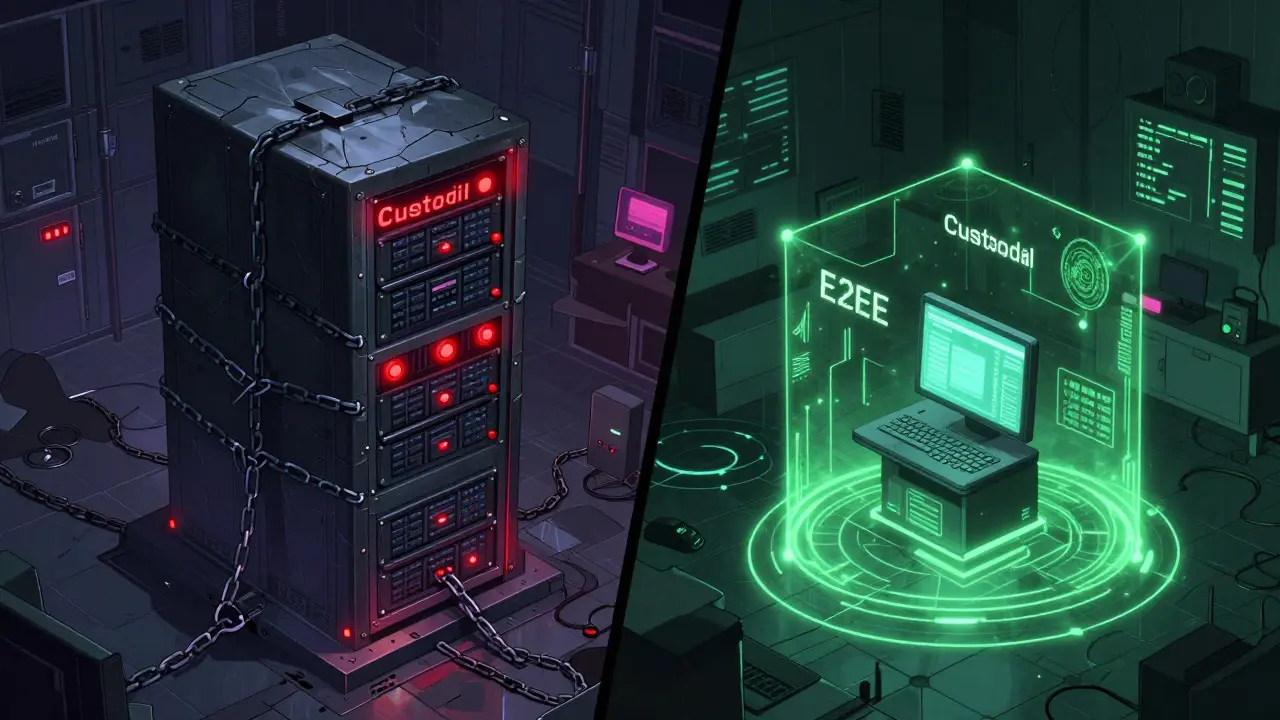
Not all wallets use end-to-end encryption in the same way. To grasp the value, you must compare E2EE-enabled non-custodial wallets against traditional custodial solutions.
| Feature | Custodial Wallet (e.g., Exchange) | Non-Custodial with E2EE (e.g., MetaMask) |
|---|---|---|
| Private Key Control | Held by the exchange/company | Held exclusively by the user |
| Encryption Responsibility | Provider manages server-side encryption | User manages local encryption/password |
| Single Point of Failure | High risk (server breaches affect many users) | Low risk (only your device matters) |
| Password Recovery | Email/ID verification resets password | Lost password = Lost funds (unless backed up) |
| Privacy Level | Low (KYC required, provider sees balances) | High (No KYC, provider sees nothing) |
In a custodial model, like an account on Binance or Coinbase, the platform holds your keys. They use enterprise-grade encryption to protect their databases, but you are trusting their security team. If their servers are breached, thousands of accounts can be compromised simultaneously. With E2EE non-custodial wallets, there is no central database of keys to steal. Each user’s data is siloed and encrypted individually.
However, this freedom comes with a heavy burden. In a custodial system, forgetting your password is annoying; you click "Forgot Password" and reset it via email. In an E2EE non-custodial wallet, forgetting your password means permanent loss of access. There is no admin who can override the encryption. This is the core trade-off: absolute control versus convenience.
The Role of Asymmetric Cryptography
End-to-end encryption in wallets relies on the mathematical principles of asymmetric encryption. This involves two keys: a public key and a private key. Think of the public key as a mailbox slot anyone can drop mail into, and the private key as the unique lock only you possess to open the box.
When you interact with the blockchain, you share your public address (derived from your public key) openly. Anyone can send crypto to that address. However, to move those funds out, you need the corresponding private key. E2EE ensures that this private key is always wrapped in a layer of symmetric encryption (like AES-256) using your password as the wrapper.
Advanced implementations also include integrity verification. Digital signatures and hash functions ensure that the encrypted data hasn’t been tampered with during storage or transmission. If a hacker modifies even one bit of your encrypted backup file, the wallet will detect the mismatch and refuse to load, preventing corrupted or malicious data from executing.
Real-World Applications Beyond Wallets
You likely already use end-to-end encryption daily without realizing it. Messaging apps like Signal, WhatsApp, and Telegram use E2EE to protect text messages and media. Email providers like ProtonMail and Tutanota apply similar protocols to keep correspondence private from their own servers. File storage services like Tresorit use E2EE to secure documents in the cloud.
The technology is proven and scalable. Its adoption in crypto wallets follows the same logic: trust no one but yourself. By bringing these communication-security standards to financial tools, developers have created an environment where your wealth is protected by mathematics rather than corporate promises.

User Experience Challenges and Solutions
Despite its security benefits, E2EE introduces friction. Users must manage recovery phrases (usually 12 or 24 words) and strong passwords. Common pitfalls include writing down seed phrases on paper that gets lost, taking photos of them that get uploaded to insecure clouds, or choosing weak passwords like "password123."
To mitigate these risks, modern wallets are integrating better UX features:
- Social Recovery: Allows trusted friends or family members to help recover access if you lose your keys, without giving them control over your funds.
- Hardware Integration: Pairing software wallets with hardware devices like Ledger or Trezor keeps private keys offline, adding a physical layer to the E2EE process.
- Biometric Unlocking: Using FaceID or fingerprint scanners to derive decryption keys quickly, balancing speed with security.
Education remains critical. Users must understand that their password is the master key. Without it, the encryption becomes a prison for their assets.
Future Trends: MPC and Zero-Knowledge Proofs
The landscape of wallet security is evolving. Traditional single-key E2EE is being supplemented by Multi-Party Computation (MPC). In MPC, a private key is split into shards distributed across different parties or devices. No single shard reveals the full key, eliminating the single point of failure entirely.
Additionally, Zero-Knowledge Proofs (ZKPs) are emerging. These allow users to prove they have sufficient funds or valid signatures without revealing the underlying private key or transaction details publicly. This enhances privacy while maintaining the integrity of the E2EE framework.
As decentralized finance (DeFi) grows, the demand for robust, user-friendly encryption will drive further innovation. The goal is clear: make security invisible to the user while remaining impenetrable to attackers.
Is end-to-end encryption enough to protect my crypto wallet?
E2EE protects your data from external breaches and unauthorized access to storage. However, it does not protect against phishing scams, malware on your device, or user error like losing your password. You still need to practice good hygiene: use strong passwords, verify URLs, and keep your recovery phrase offline.
What happens if I forget my wallet password?
In a true E2EE non-custodial wallet, forgetting your password usually means losing access to your funds permanently. Unlike email accounts, there is no "forgot password" button because the wallet provider never knows your password. You must rely on your backup recovery phrase to restore access on a new device or reinstall the app.
Do hardware wallets use end-to-end encryption?
Yes, hardware wallets like Ledger and Trezor utilize E2EE principles. They generate and store private keys securely inside a dedicated chip. Transactions are signed internally, and only the signed result is sent to your computer. The private key never leaves the device, ensuring maximum isolation from potential malware.
Can the wallet developer see my private key?
If the wallet is properly implemented with client-side E2EE, the developer should never see your private key. The encryption happens on your device before any data is sent to their servers for backup. Reputable open-source wallets allow you to audit the code to verify this claim.
Is cloud backup for crypto wallets safe with E2EE?
Yes, provided the encryption is done locally before upload. Services like iCloud or Google Drive store the encrypted file. Since they don't have your password-derived key, they cannot decrypt the contents. The risk lies only if your password is weak or if the cloud account itself is compromised without two-factor authentication.
Comments
23 Comments
Ed Wallace
The analogy of handing your keys to a stranger is spot on, but I think it misses the nuance of trust in the software layer itself. When we talk about E2EE, we are essentially betting that the client-side code hasn't been compromised before it ever reaches our devices. It’s a beautiful mathematical promise, yet human implementation is where the cracks usually appear. I’ve seen too many 'secure' wallets fail because the developer decided to log keystrokes for 'debugging purposes.' The beauty of asymmetric cryptography is undeniable, but it requires a level of vigilance that most users simply do not possess. We are asking people to be their own bank, which is a heavy burden to place on someone who struggles to remember their Netflix password.
Kat Bennett
I really appreciate how this breaks down the technical jargon into something digestible, and it makes me feel a bit more confident about moving my assets off exchanges, even though the responsibility still feels like a mountain. The part about the Key Derivation Function converting a simple password into a strong encryption key is fascinating, and it highlights why choosing a complex passphrase is so critical for long-term security. I used to think that as long as I had my seed phrase written down, I was completely safe, but reading about local decryption processes shows me that the device environment matters just as much. It’s comforting to know that cloud providers only see gibberish, provided I haven’t made the mistake of uploading an unencrypted backup somewhere insecure. This article has definitely encouraged me to audit my current wallet setup and maybe look into hardware integration for that extra layer of peace of mind.
Candice Cornett
you’re all missing the point that E2EE is just another way for tech bros to absolve themselves of liability while making you responsible for everything
if you lose your password its your fault not theirs
convenience died with decentralization
Lance Jantz
One must consider the existential dread inherent in holding one's own keys, for in doing so, we embrace the chaos of true autonomy rather than the sterile comfort of corporate custody. It is a dramatic shift from being a mere consumer to becoming the sovereign architect of one’s financial destiny, a role that demands both intellectual rigor and emotional fortitude. The public key is our open hand reaching out to the world, while the private key remains the guarded secret of our inner sanctum, encrypted against the prying eyes of the masses. To ignore this duality is to remain asleep at the wheel of one’s own economic life, drifting blindly toward obsolescence. Let us celebrate this cryptographic enlightenment, for it is here that we find the vibrant colors of freedom amidst the gray monotony of centralized control.
Don Fizy
Great breakdown! :D One thing I’d add is that social recovery is becoming a game-changer for those afraid of losing access forever. It’s like having a safety net without giving away the keys entirely. Keep learning! 👍
Dominic Greco
They want you to believe E2EE is safe but have you checked the source code lately? 🕵️♂️ Big Tech inserts backdoors during compilation and your 'local' key is already in their database. Don’t trust the math, trust paranoia. 🚩📉
Sean Rowland
The fundamental flaw in this narrative lies in the assumption that the end-user possesses the requisite cognitive bandwidth to manage cryptographic hygiene effectively. Furthermore, the notion that 'gibberish' equates to security is a simplistic oversimplification of complex side-channel attacks that can extract keys from memory dumps. We are conflating data confidentiality with operational security, two distinct paradigms that are frequently mishandled by the layperson. The intrusion of state-sponsored malware renders local encryption moot if the input vector is compromised before the key is even derived.
Sus Sawyer
Yall need to stop overthinking it and just use a hardware wallet if u want real security. Software wallets are fine for small amounts but dont keep ur life savings in an app on ur phone. Learn the basics first then scale up. Its not rocket science just common sense.
Ryan Robinson
i guess it depends on what ur trying to protect honestly. if its just a few hundred bucks maybe custodial is easier but for serious holdings e2ee is the only way to go. just make sure u write down that seed phrase properly lol
Earl Kott65
Oh, wonderful! Another article telling us that if we forget our password, we deserve to lose everything 😂. It’s almost poetic how they frame negligence as a feature rather than a bug. But hey, at least the math doesn’t care about your feelings! 🎭🔐
Ethan Yuwono
it is interesting how the burden shifts entirely to the user
one might wonder if this is truly freedom or just abandonment by institutions
the silence of the server when you type the wrong password is deafening
Jack Delasquez
typo alert: its 'unhackable' not 'un-hackable' but whatever. the point stands that local encryption is better than trusting some random exchange in cyprus. just dont click phishing links ok?
Harman Singh
my wallet got hacked anyway so whats the point of all this encryption stuff. i did everything right but still lost money. why bother reading these articles if nothing works. feeling drained just thinking about it.
Qolbina Islami
THIS IS WHY WE NEED STRONGER GOVERNMENT REGULATION ON THESE CRYPTO COMPANIES!!! THEY ARE STEALING FROM THE PEOPLE!!! E2EE IS A SCAM TO HIDE ILLEGAL ACTIVITIES!!! WAKE UP AMERICA!!! 🔥🇺🇸🔥
SUBHAM CHOUDHURY
Good read. MPC technology mentioned at the end is very promising for future scalability. We should support innovations that reduce single points of failure. Keep pushing forward!
Joy Kwant
It is morally reprehensible that companies design systems where ordinary people lose their life savings due to a minor error. This lack of empathy in system design reflects a broader societal decay. Who benefits when the little guy gets locked out? Probably the elites who hold the master keys to the banking system.
amy miranda
The author clearly enjoys using big words to explain simple concepts, but fails to address the sheer laziness required to maintain such high-security standards. Most people will inevitably choose convenience over security, rendering all this theoretical protection useless. It is a dramatic failure of user experience design that places the blame on the victim. Grammatically, the post is sound, but intellectually, it is bankrupt.
Subhash Kashyap Dm
you fools think aes-256 is secure against quantum computing?
post-quantum cryptography is the only real solution
current e2ee implementations are obsolete before they are even deployed
wake up sheeple
Billy Cunningham
Short answer: yes it works. Long answer: read the docs. 🤷♂️
Joshua Hofford
This is a fantastic explanation of how we can take back control of our finances! It’s inspiring to see technology evolving to protect individual sovereignty. Let’s keep spreading the word about self-custody! 🌍✨
Marcia Albert
I’ve been watching this space for years, and it’s wild how the narrative has shifted from 'trust no one' to 'trust the math.' The colorful landscape of crypto security is constantly changing, but the core principle of owning your keys remains the golden thread tying it all together.
Emma Smith
let’s dissect the epistemological crisis of digital ownership
when the private key is merely a string of bytes stored on a silicon wafer
what does it mean to truly 'own' anything in a simulated reality
the boundary between user and machine dissolves in the encryption process
Ed Mitchell
It is evident that the masses are being lulled into a false sense of security by these technological panaceas. The formal structure of the argument ignores the chaotic reality of global surveillance states. They claim privacy, yet every transaction is recorded on an immutable ledger visible to all. This is not freedom; it is a transparent cage designed to monitor the populace under the guise of innovation. Assert your rights by rejecting these systems entirely.
Write a comment