


You have your Bitcoin or Ethereum sitting in a wallet, and you feel secure. But here is the harsh reality: if you lose access to that one string of words, your money is gone forever. No support ticket will help you. No bank can reverse it. Approximately 20% of all Bitcoin is already lost because people didn't know how to safely store their crypto seed phrase.
This guide cuts through the noise. We aren't just talking about writing words on paper. We are looking at why standard advice fails, what experts actually recommend for different asset sizes, and how to protect your digital wealth from fire, flood, and forgetfulness. Whether you hold $500 or $500,000, the principles below will keep your keys safe.
What Exactly Is a Seed Phrase?
Before we talk about storage, let's clear up what you are actually storing. A seed phrase, also known as a recovery phrase or mnemonic phrase, is a sequence of 12, 18, or 24 random words generated by your wallet software. It acts as the master key to your cryptocurrency assets.
This isn't just a password. It is a human-readable representation of complex cryptographic data. The standard used today is BIP-39, created in 2013. This protocol converts long strings of numbers into easy-to-read words from a specific dictionary of 2,048 words. If you change even one letter in one word, the entire phrase becomes invalid. You cannot "fix" a typo later; you need the exact original order and spelling.
| Phrase Length | Entropy Level | Security Strength | Common Use Case |
|---|---|---|---|
| 12 Words | 128 bits | High | Standard Hardware Wallets (Ledger, Trezor) |
| 18 Words | 192 bits | Very High | Some Mobile Wallets |
| 24 Words | 256 bits | Maximum | Institutional Custody, High-Net-Worth Individuals |
The Dangers of Digital Storage
Here is where most beginners mess up. They treat their seed phrase like a Netflix password. They save it in a text file, email it to themselves, or paste it into a password manager. Stop doing this immediately.
Digital storage exposes your keys to remote hacking. In 2023, 37% of cryptocurrency thefts originated from compromised digital storage methods. Malware specifically targets cloud services and password managers. DataRecovery.com reported that 14 new malware variants appeared in early 2024 alone, targeting phrases stored in the cloud. The average loss per incident was nearly $48,000.
Think about it this way: if your phone gets hacked while you are sleeping, and your seed phrase is in a note app synced to iCloud, an attacker doesn't need your password. They just need to sync the device. Once they have those 12 words, they can sweep your funds in seconds. There is no alert system for this. By the time you check your balance, the coins are in someone else's wallet.
Why Paper Backups Often Fail
"Just write it down on paper," say the tutorials. It sounds simple, but paper is surprisingly fragile. Vault12 testing showed that paper backups degrade significantly within 18 months under normal conditions. Ink fades in 67% of samples due to light exposure or chemical reactions with the paper itself.
Physical damage is another major risk. Water leaks, house fires, or even a curious toddler can destroy a piece of paper. Unchained Capital documented that 61% of paper backups fail within five years due to environmental damage or accidental disposal. How many times have you thrown away a sticky note without thinking? Now imagine that sticky note held $50,000 worth of Bitcoin.
If you must use paper, do not use a regular ballpoint pen. Use a pencil or archival-quality ink. Keep it away from sunlight. But honestly, for anything over $1,000, paper is a temporary solution, not a permanent strategy.
Metal Storage: The Gold Standard
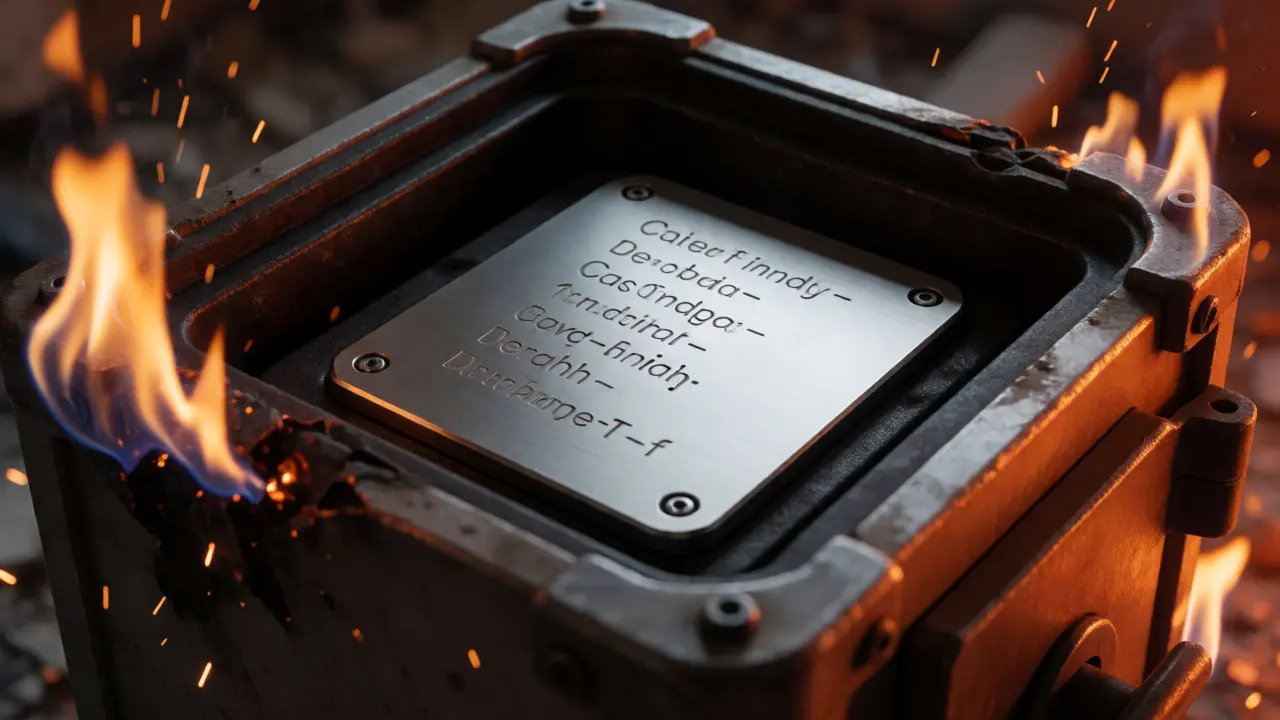
If paper is risky, metal is robust. Metal backup solutions like Cryptosteel and Billfodl are designed to withstand extreme conditions. These devices allow you to stamp or slide your seed phrase onto stainless steel or titanium plates.
Why go metal? Durability. Cryptosteel’s stainless steel construction can handle temperatures up to 1,400°C for 15 minutes. That covers almost any house fire scenario. Billfodl uses titanium, which resists corrosion even when submerged in saltwater for days. Lab tests show these metal plates retain 99.8% integrity after 50 years of simulated home storage.
Yes, they cost more. A Cryptosteel Capsule Solo runs about $119, and a Billfodl is around $100. Compare that to the potential loss of thousands in crypto. It is cheap insurance. Plus, metal doesn't fade, burn, or rot. It survives earthquakes, floods, and forgotten safes.
Where Should You Keep It?
Owning a metal plate is half the battle. Where you put it matters just as much. Do not hide it in obvious spots like behind picture frames or inside books. Thieves look there first.
For most users holding under $50,000, a permanently installed home safe bolted to the floor or wall is sufficient. Pair this with a second backup in a bank safe deposit box. This creates redundancy. If your house burns down, you still have the bank copy. If the bank closes unexpectedly, you have the home copy.
For high-value holdings ($50,000+), geographic distribution is key. Experts recommend keeping backups at least 50 miles apart. Why? Because local disasters-like a regional flood or power grid failure-affect everything nearby. Storing one backup in Toronto and another in Vancouver ensures that a single event won't wipe out both copies.
Avoid common traps. Don't store backups in kitchen containers like coffee cans or sugar bowls. Users frequently discard these during routine cleaning. One Reddit user lost $75,000 because he stored his phrase in a Gmail draft, assuming it was secure. Another lost funds because a family member threw out a "junk" envelope containing a metal plate.

Advanced Strategies: Multisig and Shamir’s Secret Sharing
If you are managing significant wealth, simple single-key storage might not be enough. Consider multisignature (multisig) setups. Instead of one seed phrase controlling your funds, you require multiple signatures to authorize a transaction. For example, a 2-of-3 setup means you need two out of three possible keys to move money.
This eliminates the single point of failure. If someone steals one seed phrase, they still can't access your funds. You would need to steal two separate physical locations' worth of data. This adds complexity but drastically reduces theft risk.
Another advanced method is Shamir's Secret Sharing Scheme (SSSS). This splits your seed phrase into fragments. For instance, you split your 12-word phrase into 5 pieces. Any 3 pieces can reconstruct the full phrase, but 2 pieces reveal nothing. You can distribute these fragments to trusted family members or different safe deposit boxes. Even if one fragment is stolen, the thief learns nothing about your actual seed phrase.
However, SSSS requires technical expertise. Ledger estimates that only 5% of users implement this correctly. If you choose this route, test the reconstruction process thoroughly before moving large amounts of capital.
Practical Checklist for Secure Storage
- Never digitize: Do not type your seed phrase into any internet-connected device unless absolutely necessary for initial setup.
- Verify accuracy: After writing or stamping your phrase, read it back word-for-word against the screen. Check spelling carefully.
- Test recovery: Before funding your wallet heavily, try restoring it from your backup on a different device. Ensure the process works.
- Use tamper-evident bags: Store your metal plate in a sealed bag. If the seal is broken, you know someone accessed it.
- Review annually: Check your backups once a year. Ensure the location is still secure and the media hasn't degraded.
Frequently Asked Questions
Can I take a photo of my seed phrase?
You should avoid taking photos if possible. Photos sync automatically to cloud services like Google Photos or iCloud, exposing your keys to hackers. If you must take a photo for emergency access, disable cloud syncing first and delete the image from your gallery immediately after saving it offline.
Is it safe to store my seed phrase in a password manager?
Generally, no. Password managers are online databases. While encrypted, they represent a single point of failure. If your master password is weak or the service is breached, your keys are vulnerable. Physical offline storage is always safer for primary backups.
What happens if I lose my hardware wallet?
Nothing bad happens to your funds, provided you have your seed phrase backed up. You simply buy a new compatible wallet and enter your existing seed phrase. Your assets are on the blockchain, not inside the device.
Should I share my seed phrase with family?
Only if you trust them completely. Anyone with your seed phrase has full control over your funds. For estate planning, consider using multisig or Shamir's Secret Sharing so that no single person holds the entire key.
How often should I check my backup?
Check your physical backups at least once a year. Verify that the metal plate is intact, the safe is accessible, and the location hasn't changed. This prevents surprises during emergencies.