




You can buy Bitcoin in Jakarta. You can hold Ethereum in your wallet. But if you try to pay for your morning kopi with it, the system will block you. This is the reality of Indonesia crypto payment ban, a rule that has confused merchants, frustrated tech-savvy consumers, and created a unique regulatory landscape in Southeast Asia.
As of mid-2026, the situation isn't just about what you can't do; it's about how the government is trying to control what you *can* do. The rules have shifted dramatically since early 2025, moving oversight from commodity regulators to financial authorities and changing how taxes are calculated. If you are trading, mining, or running a business in Indonesia, understanding these nuances is critical to avoiding fines and losing money.
The Core Rule: Why Crypto Isn't Money Here
To understand the ban, you have to look at the legal foundation. In Indonesia, the rupiah is the sole legal tender. This status is protected by the Currency Law. Because of this, Bank Indonesia (BI) is the central bank responsible for maintaining monetary stability and regulating the national currency has explicitly stated that virtual currencies are not recognized as valid payment instruments.
This prohibition isn't new. It stems from Bank Indonesia Regulation Number 18/40/PBI/2016 and Regulation Number 19/12/PBI/2017. These rules forbid any payment system operator-from banks to e-wallet providers like GoPay or OVO-to process transactions using cryptocurrency.
In November 2025, BI reiterated this stance publicly. Agusman, Executive Director of the Department of Communication at BI, warned that using Bitcoin or other tokens for payments poses risks to financial system stability. The message was clear: crypto is an asset class, not a medium of exchange. You can trade it, but you cannot spend it directly at a checkout counter.
The Big Shift: From Bappebti to OJK
While the payment ban remains absolute, the rules for *trading* crypto changed significantly on January 10, 2025. For years, crypto was treated as a commodity under the supervision of Bappebti the Commodity Futures Trading Regulatory Agency, which previously oversaw crypto as a tradable commodity.
That era ended when authority transferred to the Financial Services Authority (OJK) the independent regulatory body overseeing Indonesia's financial services sector, including banks and securities. Under OJK Regulation No. 27 of 2024, crypto assets were reclassified as "digital financial assets." This moves them closer to stocks and bonds than to gold or crude oil.
Why does this matter? Because the OJK treats these assets with stricter financial safeguards. The new framework requires licensed exchanges to meet high capital and security standards:
- Digital Asset Exchanges: Minimum capital of IDR 50 billion (approx. USD 3.2 million).
- Custodians: Minimum capital of IDR 25 billion (approx. USD 1.6 million).
- Token Issuers: Minimum capital of IDR 10 billion (approx. USD 640,000).
All entities must implement robust anti-money laundering (AML) protocols compliant with Financial Action Task Force (FATF) standards. They also need distributed ledger technology with 99.5% uptime and multi-factor authentication meeting ISO/IEC 27001:2022 security standards. The goal is to protect investors from the kind of fraud and insolvency that plagued the industry globally in previous years.

Tax Changes: A Breather for Traders
If the regulatory shift felt heavy, the tax changes effective August 1, 2025, offered some relief. The Ministry of Finance introduced Minister of Finance Regulation No. 50 of 2025 (PMK 50), which fundamentally reshaped how crypto income is taxed.
Previously, crypto transactions were subject to a 1% Value Added Tax (VAT). That is gone. Instead, there is now a 0.21% final income tax rate on transaction values. This change reclassifies crypto assets from "taxable goods" to "digital financial assets," aligning them more closely with securities trading.
For active traders, this is a significant reduction in friction. However, the government hasn't let up on enforcement. The Directorate General of Taxes (DJP) established a dedicated Crypto Asset Taxation Unit with 147 specialized auditors by September 2025. They use automated monitoring systems integrated with OJK's data to track transactions. So while the rate is lower, the visibility of your trades is higher.
| Aspect | Pre-2025 (Bappebti Era) | Post-January 2025 (OJK Era) |
|---|---|---|
| Regulatory Body | Bappebti (Commodity Regulator) | OJK (Financial Services Authority) |
| Asset Classification | Tradable Commodity | Digital Financial Asset |
| Tax Rate | 1% VAT | 0.21% Final Income Tax |
| Payment Usage | Prohibited by Bank Indonesia | Still Prohibited by Bank Indonesia |
| Regulatory Fees (2025) | IDR 50M - 500M annually | Suspended/Waived for all of 2025 |
The Cost of Doing Business Without Crypto Payments
The disconnect between allowing trading but banning payments creates real-world problems for businesses. An analysis by Alvarez & Marsal in July 2025 highlighted that Indonesian businesses face 37% higher transaction costs and take 3.2 business days longer to process international settlements compared to countries that allow crypto-based payments.
Consider a small merchant in Jakarta who receives an order from a client in Singapore. The client wants to pay in USDT (Tether) because it's faster and cheaper than a wire transfer. The Indonesian merchant cannot legally accept this. They have to decline the order, or they have to navigate complex workarounds.
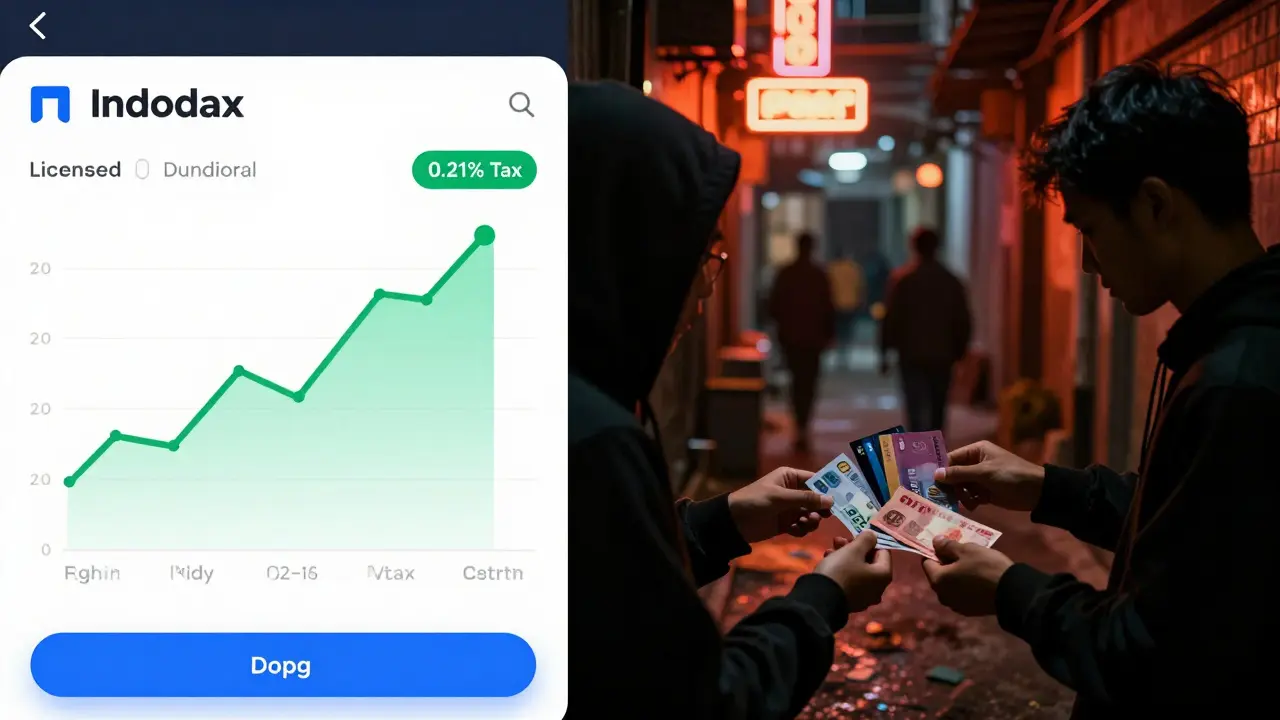
These workarounds are common but risky. A survey by Indodax in August 2025 found that 63% of users reported using informal peer-to-peer channels to make crypto-based payments despite knowing the ban. On forums like Kaskus, sellers discuss converting crypto payments into gift cards or prepaid credits to circumvent the prohibition. While this solves the immediate cash flow problem, it exposes both parties to fraud and offers zero consumer protection.
William Sutanto, CTO of Indodax, described this situation as "operational schizophrenia." Businesses want to innovate, but the central bank says no. Meanwhile, the financial regulator says yes to trading, creating a fragmented experience.
How Indonesia Compares to Its Neighbors
Indonesia’s approach is strict compared to some regional peers, but not unique. Here is how it stacks up:
- Thailand: Allows crypto payments for certain merchants under specific conditions. Thailand has a more integrated approach where the Securities and Exchange Commission (SEC) works closely with payment providers.
- Singapore: The Monetary Authority of Singapore (MAS) allows crypto payments through licensed payment service providers. Singapore is a global hub for crypto infrastructure.
- Malaysia: Similar to Indonesia, Bank Negara Malaysia prohibits crypto as a means of payment but allows it as an investment asset. However, Malaysia has signaled potential relaxation through pilot programs.
- Vietnam: Bans crypto payments and regulates trading platforms, but lacks a dedicated, unified regulatory authority like Indonesia's OJK.
Indonesia’s move to place crypto under the OJK makes its framework structurally similar to the European Union’s MiCA (Markets in Crypto-Assets) regulation. It prioritizes investor protection over utility. The downside? As noted by Professor Budi Suharjo of Universitas Gadjah Mada, this creates "regulatory arbitrage opportunities" where 68% of surveyed merchants still accept crypto informally, increasing risk rather than eliminating it.
What This Means for You in 2026
If you are an individual trader, the news is mostly positive. The OJK fee waiver for 2025 reduced operational costs for exchanges, which often leads to tighter spreads and better liquidity for users. The lower 0.21% tax rate makes frequent trading more viable. The increased security requirements mean your funds are safer on licensed platforms like Indodax, Tokocrypto, or Pintu.
If you are a business owner, the challenges remain. You cannot integrate a crypto payment gateway directly. You must rely on traditional banking channels for international settlements, accepting the higher fees and slower speeds. However, keep an eye on the Draft Law No. 12/2025 on Digital Rupiah Integration. This bill could potentially create a pathway for limited crypto usage via Central Bank Digital Currency (CBDC) bridges. But don't count on it soon. Bank Indonesia Governor Perry Warjiyo stated in October 2025 that any relaxation would require comprehensive assessment of monetary policy transmission mechanisms. In plain English: they aren't ready to change the core ban yet.
The market continues to grow despite these constraints. Indonesia had 14.3 million active crypto users by the end of 2024, with trading volume reaching IDR 127.5 trillion (USD 8.1 billion). Institutional interest is rising too, with 87% of Indonesia's top 100 publicly listed companies reporting crypto holdings in their 2025 Q2 statements. The demand is there; the regulatory channel is just narrow.
Can I use Bitcoin to pay for goods in Indonesia?
No. Bank Indonesia strictly prohibits the use of cryptocurrency as a means of payment. Only the rupiah is legal tender. Merchants who accept crypto directly violate regulations, and payment operators are banned from processing such transactions.
Who regulates crypto in Indonesia now?
Since January 10, 2025, the Financial Services Authority (OJK) has regulated crypto assets as "digital financial assets." Previously, the Commodity Futures Trading Regulatory Agency (Bappebti) oversaw them as commodities.
What is the current tax rate for crypto transactions?
As of August 1, 2025, the 1% VAT was replaced by a 0.21% final income tax on transaction values under Minister of Finance Regulation No. 50 of 2025.
Is it safe to trade crypto in Indonesia?
Trading on OJK-licensed platforms is considered safer due to strict capital requirements, AML compliance, and security standards. However, using informal peer-to-peer channels for payments carries significant fraud and legal risks.
Will the payment ban be lifted soon?
There are no imminent plans to lift the ban. Bank Indonesia maintains that crypto poses risks to monetary stability. While draft laws explore CBDC integration, direct crypto payments remain prohibited.