
Did you miss the biggest privacy-focused crypto event of 2025? The Midnight Network launched its massive 'Glacier Drop' airdrop in August 2025, distributing 24 billion NIGHT tokens to eligible holders across eight major blockchains. If you held Bitcoin, Ethereum, or Cardano back in June, you might have been sitting on a free allocation. But here is the catch: the primary claiming window closed on October 4, 2025. Since today is October 13, 2025, the clock has stopped for the initial drop. However, the story doesn't end there. Unclaimed tokens are moving into new phases, and understanding how this works is crucial if you want to participate in what Charles Hoskinson calls the future of "rational privacy."
What Is the Midnight Network?
Before we dive into the numbers, let's get clear on what you were actually getting. Midnight Network is a privacy-centric sidechain built on the Cardano ecosystem. Unlike traditional blockchains where every transaction is visible to everyone (like Bitcoin or Ethereum), Midnight uses advanced cryptography to keep your data private unless you choose to share it. Think of it as having a bank account where only you can see the balance, but you can still prove to a lender that you have enough funds without revealing your exact spending habits.
This concept is called "rational privacy." It solves a huge problem in crypto: the tension between transparency and privacy. Most chains force you to pick one. Midnight tries to give you both. The native utility token for this network is NIGHT the governance and utility token of the Midnight Network. There is also a second token called DUST, which pays for transaction fees, but the airdrop focused entirely on NIGHT.
The Glacier Drop: Eligibility and Snapshot Details
The "Glacier Drop" was not just a random giveaway; it was a calculated effort to bootstrap a decentralized community. The project team took a snapshot of wallets on June 11, 2025. This date is critical. If you bought tokens after this date, you were not eligible. If you sold them before, you missed out.
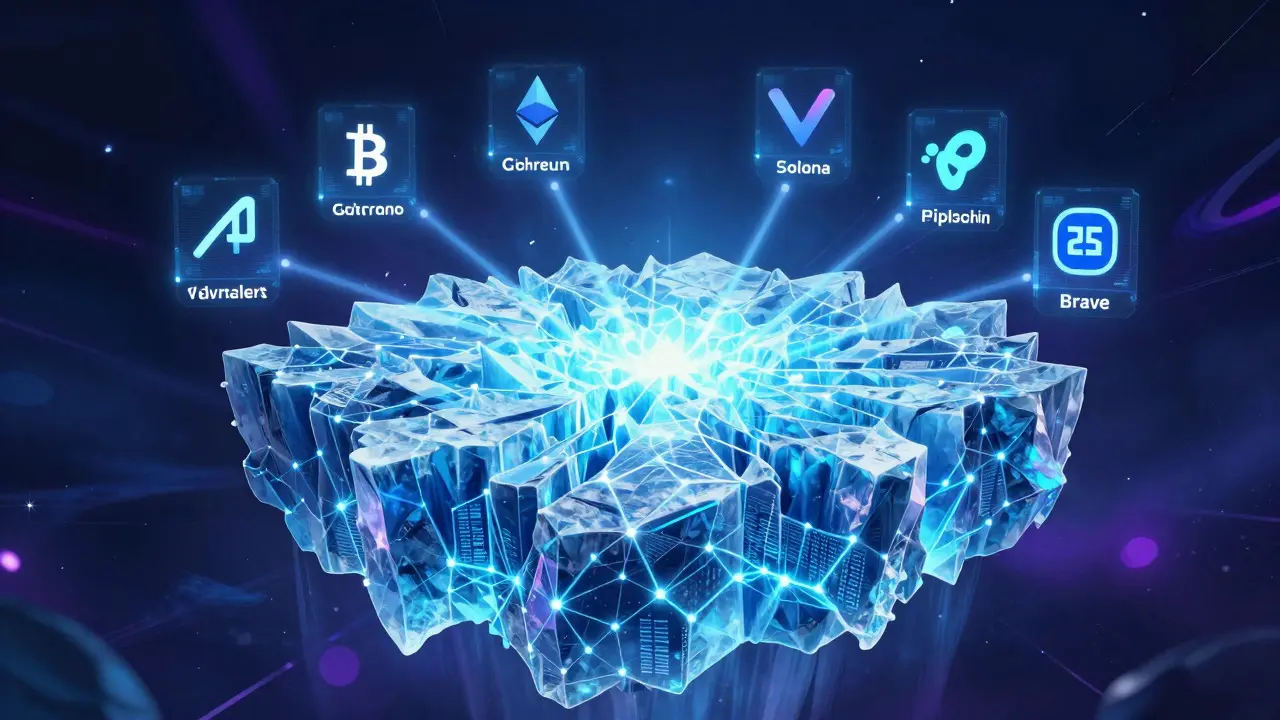
To qualify, you needed to hold at least $100 worth of cryptocurrency in the native asset of any supported chain at that specific moment. The supported networks included:
- Bitcoin (BTC)
- Ethereum (ETH)
- Cardano (ADA)
- Solana (SOL)
- Ripple (XRP)
- Avalanche (AVAX)
- BNB Chain (BNB)
- Brave (BAT)
Here is the tricky part: the $100 threshold was based on market price on June 11. For example, if Bitcoin was trading at $50,000, you needed about 0.002 BTC. If Cardano was at $2.50, you needed roughly 40 ADA. This meant that holding a small amount of a high-value coin could make you eligible, while holding thousands of a low-value coin might not.
How Was the Token Allocation Distributed?
Not all chains were treated equally. Midnight wanted to reward its core community while expanding to others. The 24 billion NIGHT tokens were split using a weighted model:
| Blockchain Ecosystem | Allocation Percentage | Tokens Reserved |
|---|---|---|
| Cardano (ADA) | 50% | 12 Billion |
| Bitcoin (BTC) | 20% | 4.8 Billion |
| Ethereum, XRP, Solana, AVAX, BNB, BAT | 30% (Shared Proportionally) | 7.2 Billion Total |
If you held assets on multiple chains, you could potentially claim from each pool you qualified for. This cross-chain approach was rare for 2025. Most airdrops stick to one ecosystem. By targeting eight major networks, Midnight aimed to bring millions of users into the Cardano sphere, even if they started with Bitcoin or Ethereum.
Why You Might Have Missed the Claim Window
The claim portal opened in July 2025 and closed on October 4, 2025. As of today, October 13, 2025, that door is shut. But why did so many people miss it? Several barriers made the process harder than a simple click:
- Self-Custody Requirement: The snapshot only counted private keys you controlled. If your coins were sitting on Coinbase, Binance, or Kraken, you were ineligible unless the exchange decided to distribute the tokens on your behalf (which most didn't).
- Wallet Complexity: Even if you held Bitcoin or Ethereum, you had to connect a wallet like MetaMask or Eternl to the official site (
midnight.gdormidnight.network) and sign a cryptographic message. This proved you owned the keys without moving funds. - Cardano Destination: To receive NIGHT tokens, you had to provide a fresh, unused Cardano wallet address. Many Bitcoin-only users didn't have a Cardano wallet set up, creating a friction point that caused them to abandon the process.
- OFAC Exclusions: Addresses linked to the Specially Designated Nationals list were automatically blocked. While fair for compliance, it meant some legitimate users got flagged erroneously or gave up due to fear.
Vesting Schedule: No Instant Liquidity
Even if you claimed successfully, you couldn't sell your tokens immediately. Midnight designed the vesting schedule a mechanism that locks tokens over time to prevent immediate selling. to discourage speculation. The tokens are locked via a Cardano smart contract and unlock in four equal phases over 360 days after the mainnet launch.
Every 90 days, 25% of your allocated tokens become tradable. The exact times are randomized within those windows to prevent coordinated dumping. This "gradual thawing" strategy ensures that early adopters stay engaged with the network rather than cashing out instantly. It also means the full value of your airdrop won't be liquid until more than a year after the mainnet goes live.

What Happens to Unclaimed Tokens?
Don't panic if you missed the deadline. The unclaimed NIGHT tokens don't vanish. They enter a cascading recovery system designed to keep the network active:
- Phase 1: Glacier Drop (Closed): The initial claim period for eligible holders.
- Phase 2: Scavenger Mine (Active): Unclaimed tokens are now available for users who solve public-good computational puzzles. This acts like mining, rewarding participants who help seed the network infrastructure.
- Phase 3: Lost-and-Found: Any remaining tokens after Phase 2 will be distributed in a final recovery phase post-mainnet launch.
This structure ensures the entire 24 billion supply enters circulation through community participation. If you missed the easy claim, you can still earn NIGHT by contributing compute power or engaging deeply with the testnet.
Is Midnight Right for You?
Midnight represents a shift in how we think about blockchain privacy. It’s not about hiding illicit activity; it’s about protecting personal data in a digital economy. If you believe in the long-term vision of a privacy-first internet, NIGHT tokens offer a stake in that future. However, be aware of the risks. The token has no immediate liquidity, the mainnet launch date is still pending, and the dual-token model (NIGHT and DUST) adds complexity.
For Cardano holders, this was a significant milestone, allocating half the supply to the ADA community. For multi-chain users, it was an experiment in cross-chain synergy. Whether you claimed or missed out, the Midnight Network continues to build. Keep an eye on the testnet updates and the upcoming mainnet announcement, as that triggers the vesting clock for everyone involved.
Can I still claim the Midnight NIGHT airdrop in October 2025?
No, the primary "Glacier Drop" claim window closed on October 4, 2025. However, unclaimed tokens are now entering the "Scavenger Mine" phase, where you can earn tokens by solving computational puzzles. Future opportunities may also arise in the "Lost-and-Found" phase after the mainnet launch.
Was the Midnight airdrop available for centralized exchange users?
Generally, no. The snapshot required self-custody wallets. Unless your exchange (like Coinbase or Binance) explicitly announced they would distribute the tokens on your behalf, holdings on exchanges were not eligible for the direct claim.
When do NIGHT tokens become tradable?
Tokens unlock in four phases over 360 days after the Midnight mainnet launch. 25% unlocks every 90 days. Since the mainnet date is not yet fixed, the exact unlock dates are currently unknown.
Which blockchains were eligible for the Midnight airdrop?
The airdrop targeted eight ecosystems: Bitcoin, Ethereum, Cardano, Solana, Ripple, Avalanche, BNB Chain, and Brave. Cardano holders received 50% of the total supply, Bitcoin holders 20%, and the rest was shared among the other six chains.
What is the difference between NIGHT and DUST tokens?
NIGHT is the governance and utility token distributed in the airdrop. DUST is a separate resource token used to pay for transaction fees on the Midnight network. The airdrop only included NIGHT tokens.
Comments
25 Comments
Carl Michaud
It's obvious this is just another pump-and-dump scheme disguised as 'privacy.' They want you to think you're getting something for free, but the vesting schedule is a trap. Once they lock your tokens, they control the narrative. Don't be a sheep.
Eric Zehr
I actually think there's some real potential here if you look past the hype. The cross-chain eligibility was pretty innovative for 2025. It shows Cardano is trying to bridge gaps that other chains ignore. I claimed mine and now I'm just waiting for the mainnet launch with optimism!
Namrata Mapgaonkar
missed it again :( i had my ada on binance so no luck for me. maybe next time ill keep more in cold storage. hope the scavenger mine phase is easy enough for normies like me to join in :)
Rita Dutta
The concept of rational privacy is fascinatingly paradoxical. To have transparency without exposure is the holy grail of digital existence. Yet, the mechanism feels clumsy, almost archaic in its reliance on snapshots. One must wonder if the true value lies in the token or the ideological shift towards data sovereignty. It is a philosophical experiment wrapped in cryptographic complexity.
Paul Smith
Hey everyone! 👋 Just wanted to say that even if you missed the drop, the community aspect is what really matters. 🤝 I've been diving into the testnet and it's super fun. Let's support each other while we wait for mainnet! 🚀💙
Rodmun Tarnowski
The structure of this distribution is remarkably sound; however, one must consider the implications of the vesting period. It is not merely a delay; it is a strategic alignment of incentives. Those who participate are demonstrating a commitment to the long-term viability of the network. This is, undoubtedly, a positive development for the ecosystem.
Prudence Flemming
look, most people dont get the zero-knowledge proof angle here. its not just about hiding stuff its about proving solvency without revealing balance. the tech stack is heavy but necessary. stop complaining about the wallet setup and learn how to use a hardware signer already
Matt Kay
too much reading. did i get tokens? probably not since i used coinbase. sucks.
Dave Kjendal
You folks are missing the point. It's not about the money right now. It's about being part of the early adopter wave. If you didn't claim, you're out. Simple as that. Don't cry about it later when the price goes up.
Kat Bennett
I found the whole process surprisingly engaging, especially the part about the different blockchains having different weights. It made me realize how fragmented our crypto holdings actually are across all these platforms. I spent hours organizing my wallets just to see if I qualified on Solana too. It was a bit tedious but also kind of satisfying to finally get everything in order for future drops. I think this will encourage more people to move off exchanges eventually which is good for decentralization overall.
Candice Cornett
everyone says privacy is good until it comes time to prove you're not a terrorist. the OFAC exclusions are just a band-aid on a bullet hole. real privacy means no lists at all. this is just regulated privacy which is an oxymoron
Lance Jantz
Oh, darling, do try to keep up. The sheer elegance of the Midnight Network's architecture is lost on the masses. It’s a symphony of cryptography, not just another meme coin circus. I, for one, am basking in the glow of my allocated NIGHT tokens, knowing I’m part of an elite few who understand the true value of discreet wealth. You’re welcome for the insight.
Don Fizy
Don't worry if you missed it! (: The Scavenger Mine phase is a great alternative. I helped a friend set up his wallet last week and he got started with the puzzles. It's actually quite rewarding to earn them through participation rather than just holding. Keep at it!
Phil Babb
LISTEN UP!!! This is huge!! The fact that Cardano got 50% of the supply shows dominance!! Get your wallets ready for the next phase!! Don't sleep on this opportunity!! We are going to the moon together!! 🚀🚀🚀
Dominic Greco
They're watching you. Every snapshot is a data harvest. They claim privacy but they need your address to verify eligibility. Classic surveillance capitalism wrapped in blockchain jargon. Wake up sheeple! 👁️👄👁️
Sean Rowland
The semantic distinction between 'rational privacy' and mere secrecy is often overlooked by the layperson. Furthermore, the integration of DUST as a fee mechanism creates a dual-token economy that requires sophisticated understanding. Most users fail to grasp the liquidity constraints imposed by the smart contract vesting schedules.
Sus Sawyer
Hey team! Sus here. I know the claim window closed but hey, every cloud has a silver lining. The scavenger hunt is a blast and a half. Plus, learning about ZK-proofs is super cool. Let's crush those puzzles and show the naysayers what community power looks like! 💪✨
Ed Wallace
What fascinates me is the intersection of game theory and privacy. By making the unclaimed tokens available through computational puzzles, they incentivize network security. It’s a beautiful loop where scarcity meets utility. I’m curious to see how the market reacts once the first tranche unlocks.
Joshua Hofford
I think this is a great step for the industry. We need more projects that care about user data. Even though I missed the drop, I'm excited to see how Midnight evolves. The Cardano community is strong and I believe in Charles's vision. Let's keep building! 🌱
Marcia Albert
it's wild how many people still leave their coins on exchanges. the whole point of crypto is self-custody. midnight just highlighted that flaw in the system. interesting times ahead for sure.
Emma Smith
the ontological status of a token that cannot be traded immediately is questionable. is it property if it is locked? the legal framework surrounding these vesting contracts is murky at best. one should tread carefully lest they find themselves owning nothing but code.
Ed Mitchell
This is clearly a front for institutional accumulation. The retail investors are distracted by the 'airdrop' hype while the whales load up on DUST. The vesting schedule ensures that when we finally can sell, the price will be dumped on us. Stay vigilant.
Michael Mostyn
The methodology behind the allocation percentages seems arbitrary yet deliberate. Why 50% to Cardano? It suggests a strong bias towards the parent chain, which may alienate multi-chain holders. A more balanced approach might have fostered greater inclusivity.
Erica Johnson
I read the docs thoroughly and I can tell you that the technical requirements were straightforward if you knew what you were doing. Many failed because they lacked basic wallet knowledge. Not an excuse though. Do your own research next time! ;)
Ken G
morally bankrupt to gatekeep privacy behind a paywall of sorts. only the rich with enough assets to meet the threshold get in. the poor are left out. typical elitist crypto nonsense. shame on charles
Write a comment