
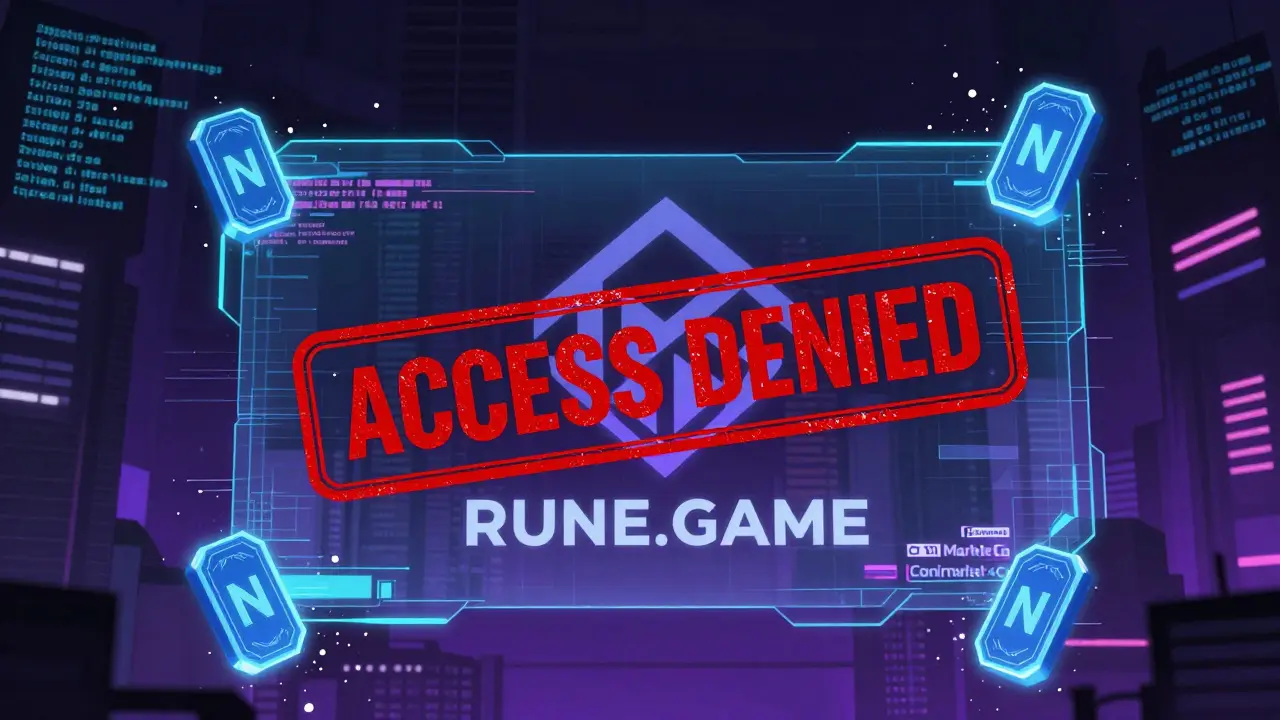
You might be searching for a way to claim free tokens from the Rune Game airdrop. If that is your goal, you need to stop right here and save yourself some time. The major promotional campaign involving RUNE.GAME and CoinMarketCap ended years ago. Specifically, it closed on September 8, 2021. Any website or social media account claiming you can still sign up for this specific event is likely trying to scam you.
However, understanding what happened with this airdrop is valuable. It was one of the most significant early examples of the "Play-to-Earn" (P2E) boom. By looking at how this campaign worked, you can learn what to look for in legitimate modern gaming projects and avoid common pitfalls in the crypto space today.
The End of an Era: What Happened to the Rune Game Airdrop?
To set the record straight, let's look at the facts. The collaboration between the blockchain-based MMO game RUNE.GAME and the cryptocurrency data platform CoinMarketCap was a limited-time event. It ran during the peak of the first major play-to-earn hype cycle. The total prize pool was $70,000. This money was distributed through Non-Fungible Tokens (NFTs) and in-game items.
The campaign targeted exactly 1,000 winners. Each eligible participant had the chance to receive up to 1 RUNE NFT. When you break down the math, the average reward value per winner was around $70. While that doesn't sound like millions of dollars, in the context of 2021 crypto marketing, it was a substantial community-building effort. Today, if you try to access the original landing page, you will see a clear message: "It looks like you are too late. The airdrop is closed."
| Feature | Detail |
|---|---|
| Campaign End Date | September 8, 2021 |
| Total Prize Pool | $70,000 USD |
| Number of Winners | 1,000 Participants |
| Reward Type | RUNE NFTs & In-Game Items |
| Blockchain Network | Binance Smart Chain (BSC) |
| Partner Platform | CoinMarketCap |
How You Could Have Participated (And Why It Matters Now)
If you were alive and active in crypto in mid-2021, you might remember the grind required to enter these draws. It wasn't just clicking a button. The campaign required participants to complete multiple social media and platform engagement tasks. This model is still used today, so knowing the steps helps you recognize legitimate requirements versus fake ones.
Here is what participants had to do back then:
- Add RUNE token to their CoinMarketCap watchlist.
- Follow Rune's official Twitter account, which was @RuneMMO.
- Like and retweet the official Rune x CoinMarketCap NFT Airdrop Tweet.
- Tag at least three friends in that retweet using specific hashtags: #BSC, #BSCgems, #playtoearn, and #Binance.
- Join Rune's Telegram group.
- Join Rune's Discord server.
- Subscribe to Rune's newsletter.
Notice something? Most of these tasks were about spreading the word. The project wanted visibility. They leveraged the trust of CoinMarketCap to reach users who were already interested in cryptocurrency. This multi-platform approach was designed to build a community, not just distribute tokens. Today, when you see a new project asking you to join five different chat groups before claiming anything, ask yourself: Are they building a community, or are they farming your attention for a rug pull?
The Technology Behind the Game: Binance Smart Chain
A crucial detail often overlooked is the technology stack. RUNE.GAME utilized the Binance Smart Chain (now known as BNB Chain). This choice was strategic. In 2021, Ethereum gas fees were notoriously high. For a game where players might earn small amounts of value daily, paying $50 in transaction fees made no sense.
BSC offered lower transaction fees and higher throughput. This allowed RUNE.GAME to process numerous microtransactions for in-game activities without breaking the bank. The integration meant that the NFTs awarded in the airdrop were ERC-20 compatible but lived on a cheaper network. This accessibility was key to the "massively multiplayer" aspect of the game. If only wealthy whales could afford to transact, it wouldn't be a mass-market MMO.
This highlights a vital lesson for current gamers: Always check which blockchain a game uses. High fees can kill the economics of play-to-earn models. Projects on Layer 2 solutions or alternative chains like Solana, Polygon, or BSC often provide a better user experience for frequent transactions.
Understanding the "Play-to-Earn" Value Proposition
Why did people care about RUNE.GAME? The core promise was "full ownership of digital assets." In traditional games, if you spend $100 on a sword, the game company owns that sword. If the servers shut down, your sword disappears. In RUNE.GAME, the heroes and items were unique blockchain heroes functioning as player-owned NFTs.
This meant you could potentially sell those assets outside the game ecosystem. You could trade them on marketplaces. You could transfer them to another player. This ownership model aligned with the broader P2E trend that gained massive momentum in 2021. Players weren't just killing monsters; they were generating real-world value through their time investment.
However, we must be realistic. The long-term success of such early play-to-earn projects varied significantly. Many projects launched during that hype cycle struggled with sustained development. Some failed to retain their communities once the initial financial incentives dried up. RUNE.GAME was part of this wave. While the airdrop executed successfully, the broader market correction in subsequent years affected many similar projects' viability.
Red Flags: How to Spot Fake Airdrops Today
Since the original RUNE.GAME airdrop closed in 2021, scammers have tried to capitalize on the name. They create fake websites that look identical to the original. They claim the airdrop is "reopening" or that there is a "late entry" bonus. Do not fall for this.
Here is how to protect yourself:
- Check the Date: If a source claims a 2021 campaign is still open, it is lying.
- Verify Official Channels: Only trust information from verified Twitter accounts or official Discord servers. Look for the blue checkmark or consistent historical posts.
- Never Share Private Keys: No legitimate airdrop will ever ask for your private key or seed phrase. They only need your public wallet address.
- Beware of "Gas Fee" Scams: Legitimate airdrops usually cover gas fees or use meta-transactions. If you are asked to send ETH or BNB to a random address to "claim" your reward, it is a scam.
The rise of AI-generated phishing sites makes this harder than ever. These fake sites can mimic the design of legitimate platforms perfectly. Always double-check the URL. A slight misspelling like "rune-game.com" instead of "rune.game" is a dead giveaway.
The Legacy of Early Crypto Gaming Partnerships
The partnership between RUNE.GAME and CoinMarketCap represented a shift in how established crypto platforms viewed gaming. CoinMarketCap provided legitimacy and reach. RUNE.GAME provided exposure to the growing play-to-earn audience. It was a symbiotic relationship.
This model became common in 2021. Established data platforms sought to diversify their offerings. They tapped into new user segments who were more interested in gaming than trading charts. For gamers, seeing their favorite data aggregator endorse a project added a layer of trust. It signaled that the project had done due diligence.
Today, we see similar partnerships evolving. Instead of just social media tasks, modern campaigns often involve actual gameplay milestones. You might need to win a certain number of matches or craft specific items to qualify. This ensures that rewards go to engaged players, not just bots creating throwaway accounts.
What Should You Do Now?
If you are looking for opportunities in the crypto gaming space, don't dwell on past events. The landscape has matured. Here are actionable steps for 2026:
- Research New Projects: Look for games with active development teams. Check their GitHub repositories for recent code commits. An empty repo is a bad sign.
- Join Communities Carefully: Engage in Discord and Telegram. Ask questions. See if developers respond directly. Active moderation is a good indicator of health.
- Understand Tokenomics: Before playing, read the whitepaper. How are tokens emitted? Is there inflation? Who holds the majority of supply? Poor tokenomics lead to price crashes, regardless of how fun the game is.
- Use Secure Wallets: Use hardware wallets for significant holdings. Keep separate wallets for interacting with new, unverified dApps to minimize risk.
The dream of earning while playing is still alive, but the days of easy money via simple social media clicks are largely over. Success now requires genuine engagement, research, and patience. Treat every opportunity with skepticism until proven otherwise.
Is the RUNE.GAME airdrop still active in 2026?
No, the RUNE.GAME x CoinMarketCap airdrop permanently closed on September 8, 2021. Any claims suggesting it is currently open are false and likely scams.
How much was the total prize pool for the Rune Game airdrop?
The total prize pool was $70,000 USD, distributed among 1,000 winners in the form of NFTs and in-game items.
Which blockchain did RUNE.GAME use for its assets?
RUNE.GAME operated on the Binance Smart Chain (BSC), now known as BNB Chain, to ensure low transaction fees and high throughput for gaming activities.
Can I get my RUNE NFTs if I participated in 2021?
If you won the airdrop in 2021, the NFTs should already be in your connected wallet. If you missed the deadline, there is no retroactive distribution. Be wary of anyone offering to "recover" lost assets for a fee.
Why did CoinMarketCap partner with RUNE.GAME?
CoinMarketCap partnered with RUNE.GAME to tap into the emerging Play-to-Earn gaming sector. This allowed them to engage with a new demographic of users interested in blockchain gaming and NFTs.
Are there any current airdrops similar to the Rune Game campaign?
While the specific Rune Game campaign is closed, many new Web3 games run similar engagement campaigns. Always verify the project's legitimacy, check official announcements, and never share private keys.
Comments
17 Comments
John Doe
I honestly feel for everyone who fell for those fake links back in the day. It’s just devastating to think about how many people lost their life savings chasing a ghost that died four years ago. The emotional toll of being scammed is real and it lingers long after the money is gone. We need more empathy in this space instead of just pointing fingers at victims. It’s a wild ride out there and sometimes you just get crushed by the sheer volume of bad actors.
Mekz Wheoki
Oh wow, look at all these naive souls still crying over a $70 NFT from 2021. Truly pathetic. You people really thought clicking 'like' on a tweet was going to make you rich? The audacity to expect free money without doing actual work is staggering. Grow up and learn how markets actually function before coming here to whine about closed doors.
Skm Shubham
The entire premise of RUNE.GAME was fundamentally flawed from a technical standpoint. BSC might have had low fees, but the congestion issues during peak P2E hype were catastrophic. Smart contract vulnerabilities were rampant and the tokenomics were designed to bleed early adopters dry. It wasn't an accident that it failed; it was a mathematical certainty given the inflationary pressure and lack of real utility. Stop romanticizing garbage projects.
Rob Aronson
Let's be clear about the DeFi mechanics here. The integration with CoinMarketCap was a classic marketing synergy play, not a technological breakthrough. The use of ERC-20 compatible tokens on BSC allowed for seamless bridging, which was crucial for liquidity pools at the time. However, the reliance on social engagement metrics as a gating mechanism for distribution is highly inefficient. Modern DAOs are moving towards proof-of-stake or proof-of-contribution models that are far more robust against Sybil attacks. 🧠💡
Kwon Bill
In my experience consulting for Web3 gaming studios in Seoul and Singapore, we saw this exact pattern repeat across dozens of titles. The initial hype cycle is always driven by speculative demand rather than organic user retention. RUNE.GAME was just one of many casualties of the 2021 bull run mania. What matters now is sustainable ecosystem development and cross-chain interoperability protocols that actually add value beyond simple asset transfer. The industry has matured significantly since then.
Danna Charris
Really? This is what passes for financial literacy now? Please. Only amateurs chase expired airdrops. Real investors understand opportunity cost and due diligence. If you can't even verify a date, you don't deserve capital. Stay in your lane.
Fede Faith
Hey everyone, let's take a breath here. It's totally normal to feel frustrated when opportunities slip away, especially in crypto where FOMO is so intense. I've been tracking gaming tokens for years and I can tell you that the landscape is shifting towards quality over quantity. Don't beat yourself up for missing this one. There are plenty of new projects emerging that are building genuine communities. Focus on learning and staying safe. You've got this! 💪✨
Josh Dodson
honestly i felt the same way when i missed the train on axie infinity too lol but hey its ok u cant win em all. just keep ur eyes open for the next big thing. dont let the haters get u down. stay strong fam!! 🔥
Suman Patil
Great discussion here! As someone deeply involved in the Indian blockchain community, I see this as a valuable learning curve for all of us. The shift from pure speculation to utility-based gaming is exciting. Let's embrace the knowledge gained from past mistakes and build a more inclusive future for Web3 gamers worldwide. Together we can create better standards! 🚀🌍
Kumaran sowkarpet
namaste friends :) i remember joining that discord back in 2021. it was such a vibrant community then. shame it didnt last. but hey, every experience teaches us something right? hope everyone stays safe from scams. keep smiling and happy trading! 😊🙏
Mauricio Contreras Loredo
Wow, look at us, acting like we're pioneers because we clicked a few buttons in 2021. Hilarious. But seriously, if you're still looking for easy money, you're already behind. The game changed. Adapt or die. Not that any of you will listen anyway. 🙄
sreeja boora
It is imperative that we recognize the sovereignty of our digital assets. Foreign platforms often exploit users through opaque terms of service. We must advocate for stricter regulations within our own jurisdictions to protect citizens from such predatory practices. The international nature of blockchain does not exempt entities from local legal standards.
Grace Newman
One must consider the deeper implications of centralized data aggregators partnering with decentralized games. Is it truly decentralization when CoinMarketCap holds the keys to visibility? I suspect there are hidden agendas controlling the narrative. Always question the source. The truth is rarely as simple as they present it. Be vigilant. 🕵️♀️
Abby Sivertsen
Listen, I get why people are mad. It sucks to miss out. But getting angry at a closed door isn't gonna bring it back. Just move on. Life goes on. Don't be so dramatic about a video game token. Chill out. 😒
Benjamin Eisen
i totally agree with the point about checking github repos. it's so easy to spot a dead project if u just look at the commit history. most scams havent updated code in months. great tip for keeping urself safe out there. thanks for sharing!
Kenneth Riley
you guys are all missing the forest for the trees. the whole p2e model was a ponzi scheme dressed up as innovation. rune.game was just another victim of its own success. nobody cared about the game mechanics only the token price. and now its dead. typical. wake up sheeple.
ravi mahla
Haha, nice try trying to revive a dead horse! But seriously, good info here. Just don't fall for the next shiny object. Keep your wallet secure and your expectations realistic. Cheers! 🍻😂
Write a comment