

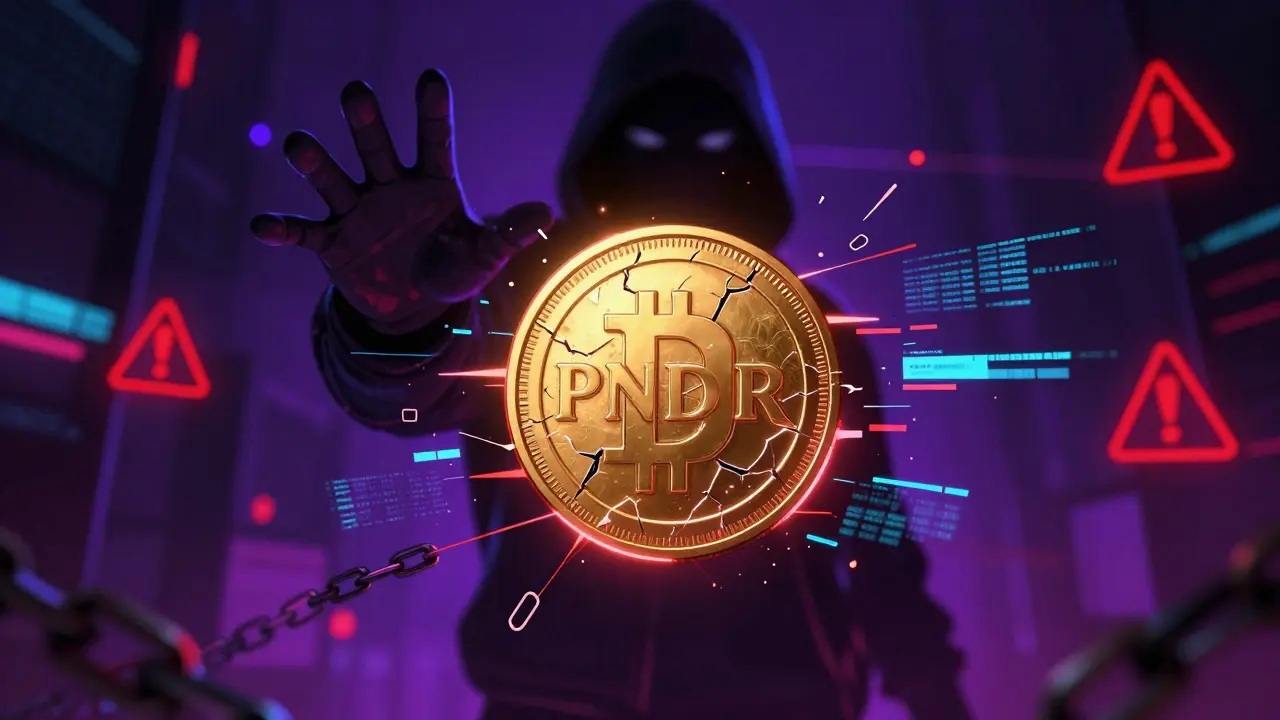
Have you seen the posts claiming that Pandora Protocol is handing out free PNDR tokens to the CoinMarketCap Community in a massive 2026 airdrop? It sounds too good to be true. In the world of cryptocurrency, when something promises free money with little effort, your first instinct should be suspicion. As of July 2026, there is no verified evidence of an official partnership between Pandora Finance and CoinMarketCap for a community airdrop. In fact, the data suggests this might be a scam designed to steal your wallet credentials.
The crypto space is flooded with fake announcements. Scammers create fake websites and social media posts that look exactly like legitimate projects. They use the names of trusted platforms like CoinMarketCap to gain credibility. If you are looking for the truth behind the PNDR airdrop hype, you need to separate marketing noise from on-chain reality. This guide breaks down what Pandora Protocol actually is, why the current market data looks dangerous, and how to verify if any airdrop claim is real before you risk your funds.
What Is Pandora Protocol (PNDR)?
To understand the risk, we first need to understand the asset. Pandora Finance is a decentralized finance ecosystem built primarily on the Binance Smart Chain (BSC). Founded by Pushkar Vohra in January 2021, the project aimed to create a customer-centric environment for crypto users. The native token, PNDR, was designed to serve as a governance instrument within their transitioning Decentralized Autonomous Organization (DAO) structure.
The project’s architecture consists of three functional layers intended to integrate various DeFi services. The idea was to keep users within the ecosystem by offering multiple products incrementally. However, the execution has struggled significantly. The maximum supply of PNDR tokens is capped at 100 million. While the vision was ambitious, the market response has been overwhelmingly negative over the last few years.
| Attribute | Value / Detail |
|---|---|
| Token Symbol | PNDR |
| Network | Binance Smart Chain (BSC) |
| Founder | Pushkar Vohra |
| Launch Date | January 2021 |
| Max Supply | 100 Million Tokens |
| Governance Model | Transitioning to DAO |
The Reality Check: Market Data and Performance
If a project is launching a major community airdrop, it usually indicates strong growth, high liquidity, and active development. The numbers for PNDR tell a completely different story. As of mid-2026, the token is trading at approximately $0.0031. This price represents a catastrophic decline of nearly 86% from its all-time high of $0.74 reached in earlier years.
More concerning than the price drop is the lack of activity. The 24-hour trading volume sits at a mere $97.28. For context, most active DeFi protocols handle millions in daily volume. A volume under $100 means there is almost no liquidity. You could try to sell your tokens during a supposed "airdrop boom" and find no buyers. The market capitalization is effectively zero, placing PNDR alongside other distressed assets like TEN and SafeMoonCash rather than thriving ecosystems like Uniswap or Aave.
This financial stagnation makes the promise of a lucrative CoinMarketCap partnership highly suspicious. Legitimate partners do not associate with dead chains or illiquid tokens because it damages their own brand reputation. CoinMarketCap is a data aggregator, well-known platform for tracking crypto data, but they do not typically host direct airdrops for obscure BSC tokens without extensive prior announcement and verification.
Is the CoinMarketCap Partnership Real?
You might see screenshots on Twitter or Telegram showing a "CoinMarketCap Community" badge next to a PNDR airdrop form. Here is how scammers operate:
- Domain Spoofing: They register domains like pndr-cmc-airdrop.com or coinmarketcap-rewards.net. These look similar to the real site but are completely fake.
- Fake Social Proof: They use bots to generate thousands of comments saying "Just received my PNDR!" to create a false sense of urgency and trust.
- The Hook: They claim that connecting your wallet to the "official" portal qualifies you for rewards. In reality, connecting your wallet to a malicious contract allows them to drain your assets.
There is no record of an official collaboration between Pandora Finance and CoinMarketCap in any credible news outlet or blockchain explorer. CoinMarketCap does have a "Community" feature where users can earn points for engagement, but these points are rarely distributed as direct airdrops of low-cap tokens like PNDR. Always check the official CoinMarketCap blog and the Pandora Finance Discord server for announcements. If it isn't there, it doesn't exist.

How to Verify Crypto Airdrops Safely
In 2026, the standard for verifying an airdrop has changed. You cannot rely on social media posts alone. Here is a checklist to protect yourself:
- Check Official Channels: Go directly to the project's verified Twitter/X account and Discord. Look for pinned messages. Do not click links in bio unless you verify the URL matches the official domain exactly.
- Inspect the Contract: Use tools like Etherscan or BscScan. Look at the token holder distribution. If one wallet holds 50% of the supply, it is likely a honeypot or rug pull risk.
- Analyze Liquidity: Check the liquidity pool on PancakeSwap or Uniswap. Is the liquidity locked? If not, developers can pull the funds and run away at any moment.
- Search for Red Flags: Search "[Project Name] scam" or "[Project Name] review" on independent forums. Look for recent complaints about inability to withdraw funds.
Why Scammers Target Low-Cap Tokens
Scammers love tokens like PNDR because they have minimal oversight. Large projects like Ethereum or Solana have rigorous security audits and legal teams. Small projects on the Binance Smart Chain often lack these safeguards. When a token drops 99% from its peak, the remaining holders are desperate for a reason to believe in the project again. Scammers exploit this hope.
They create a narrative of a "partnership" or "airdrop" to drive traffic to their phishing sites. Even if you don't connect your wallet, simply visiting these sites can expose you to malware or browser exploits. The goal is not just to steal PNDR; it is to steal the Bitcoin, Ethereum, or USDT sitting in your connected wallet.

Alternatives: Legitimate Airdrop Strategies in 2026
If you are looking for legitimate ways to earn crypto through early participation, focus on projects with transparent roadmaps and active development. Instead of chasing rumors around PNDR, consider researching established protocols that have announced retroactive reward programs.
Projects building on Layer 2 solutions like Arbitrum, Optimism, or Base often distribute tokens to early users who bridge funds or swap assets. Similarly, decentralized exchanges on emerging networks like Monad or Abstract have shown interest in rewarding early testers. These projects publish their criteria clearly on their official documentation pages. They do not ask you to connect your wallet to random third-party sites.
For example, platforms like Axiom Exchange on Solana have used points-based systems to reward traders based on actual volume and referrals. This is transparent, measurable, and verifiable on-chain. Compare this to the vague promises of the PNDR airdrop. One offers data; the other offers only hope.
Conclusion: Protect Your Capital
The rumor of a Pandora Protocol (PNDR) CoinMarketCap Community airdrop appears to be unfounded and potentially malicious. Given PNDR's near-zero liquidity, 86% price decline, and lack of official partnership announcements, engaging with any site claiming to offer these tokens is highly risky. Always prioritize safety over FOMO (Fear Of Missing Out). Verify every link, check every contract, and remember: if an airdrop seems too good to be true for a dying token, it is almost certainly a scam.
Is the Pandora Protocol PNDR airdrop real?
As of July 2026, there is no verified evidence of an official PNDR airdrop partnered with CoinMarketCap. Most claims circulating on social media appear to be scams designed to phish wallet credentials. Always verify information through official project channels like the verified Discord or website.
What is the current price of PNDR token?
The PNDR token trades at approximately $0.0031, representing a significant decline of over 85% from its all-time high. The trading volume is extremely low, often under $100 per day, indicating very little market activity.
Did CoinMarketCap partner with Pandora Finance?
No. There are no official records or announcements from either CoinMarketCap or Pandora Finance confirming a partnership for an airdrop. CoinMarketCap lists tokens for data tracking but does not typically host direct airdrops for low-cap assets.
How can I spot a fake crypto airdrop?
Look for unofficial domains, requests to connect your wallet to unknown sites, and promises of high returns for low-cap tokens. Always cross-reference announcements with the project's official Twitter and Discord channels. If liquidity is low or locked status is unclear, avoid participation.
Is PNDR a safe investment in 2026?
Based on current market data, PNDR carries high risk. With near-zero market cap, minimal trading volume, and a steep historical price decline, it lacks the fundamentals of a stable investment. Exercise extreme caution and conduct thorough due diligence before interacting with the token.