
For decades, gaming was simple: you bought a game, played it, and that was it. Your characters, weapons, and skins? You didn’t own them. You just had permission to use them-until the game company decided to shut down servers or change the rules. Then came play-to-earn gaming, promising something radical: you play, you earn real money. But is it really better? Or just a different kind of grind?
How Traditional Gaming Works (And Why It Still Rules)
Traditional gaming built its empire on fun, immersion, and competition. Games like Call of Duty, Fortnite, or The Legend of Zelda don’t ask you to invest in tokens or set up wallets. You pay $60 upfront (or play free-to-play with microtransactions), and you get access to a world designed to entertain you. Developers control everything-the economy, the updates, the rules. And players? They’re customers. Not investors. Not workers. In 2024, the global gaming market hit $221 billion, with 3.4 billion people playing. Why? Because it just works. You download a game on your PlayStation, Xbox, or PC. You start playing in minutes. No crypto wallet. No gas fees. No worrying if your rare skin will vanish tomorrow because the company changed its terms. And the numbers show it: Fortnite’s Trustpilot rating sits at 4.3 out of 5, with 78% of users praising its consistent updates and pure entertainment. Players don’t log in to make rent. They log in to escape, compete, or connect. That’s why traditional gaming still dominates.How Play-to-Earn Gaming Was Supposed to Change Everything
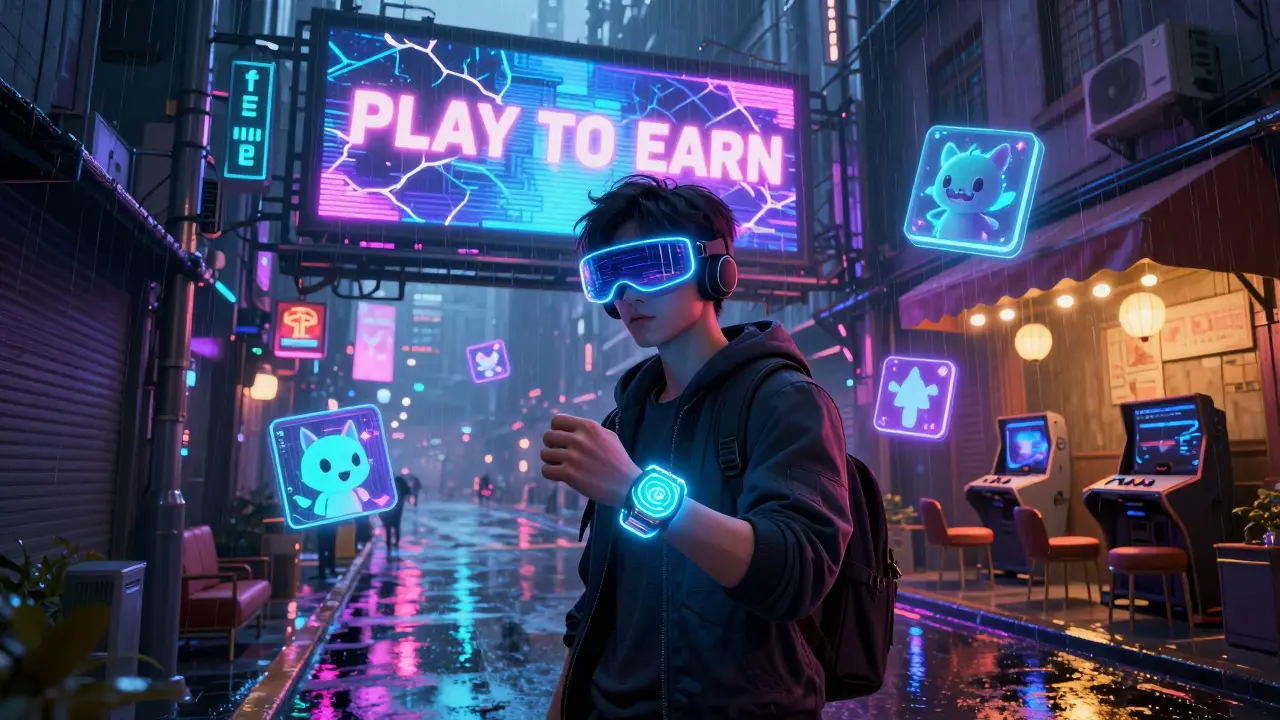
Play-to-earn (P2E) gaming exploded around 2021 with Axie Infinity. For the first time, players in the Philippines, Venezuela, and Nigeria could earn cryptocurrency just by playing. One Filipino player, u/MangJuanGamer, reported making $12.50 a day in 2021-more than his country’s minimum wage. Suddenly, gaming wasn’t just a hobby. It was a livelihood. P2E games run on blockchain networks like BNB Chain or Polygon. Your in-game creatures, weapons, and land aren’t just pixels. They’re NFTs-unique digital assets you actually own. You can sell them on OpenSea. You can trade them. You can even rent them out. And instead of developers hoarding all the profits, P2E models distribute value. Players earn 30-60% of in-game economic activity through gameplay rewards. Axie Infinity used two tokens: SLP (earned by playing) and AXS (used for governance). At its peak, AXS hit $155. But by early 2023, it dropped to $4.20. That’s the risk. The economy isn’t controlled by a company. It’s driven by supply, demand, and speculation. And when the hype fades, so does the income.Ownership: The Real Difference
Here’s the biggest shift: in traditional gaming, you don’t own anything. You’re told you “bought” a skin in Fortnite. But according to a 2024 Consumer Reports survey, 92% of gamers didn’t realize they had no legal right to that item. If Epic Games deletes your account? Your $100 skin is gone. Forever. In P2E, your NFTs live on the blockchain. They’re yours. No company can take them away. Even if Axie Infinity shuts down, your Axies still exist. You can still trade them. You can still use them in other games that accept the same standard. That’s verifiable, permanent ownership. It’s not a feature. It’s a revolution. But ownership doesn’t mean value. Just because you own an NFT doesn’t mean someone will pay for it. Most P2E NFTs are worth less than $5 today. And if the game dies? The marketplace dies with it.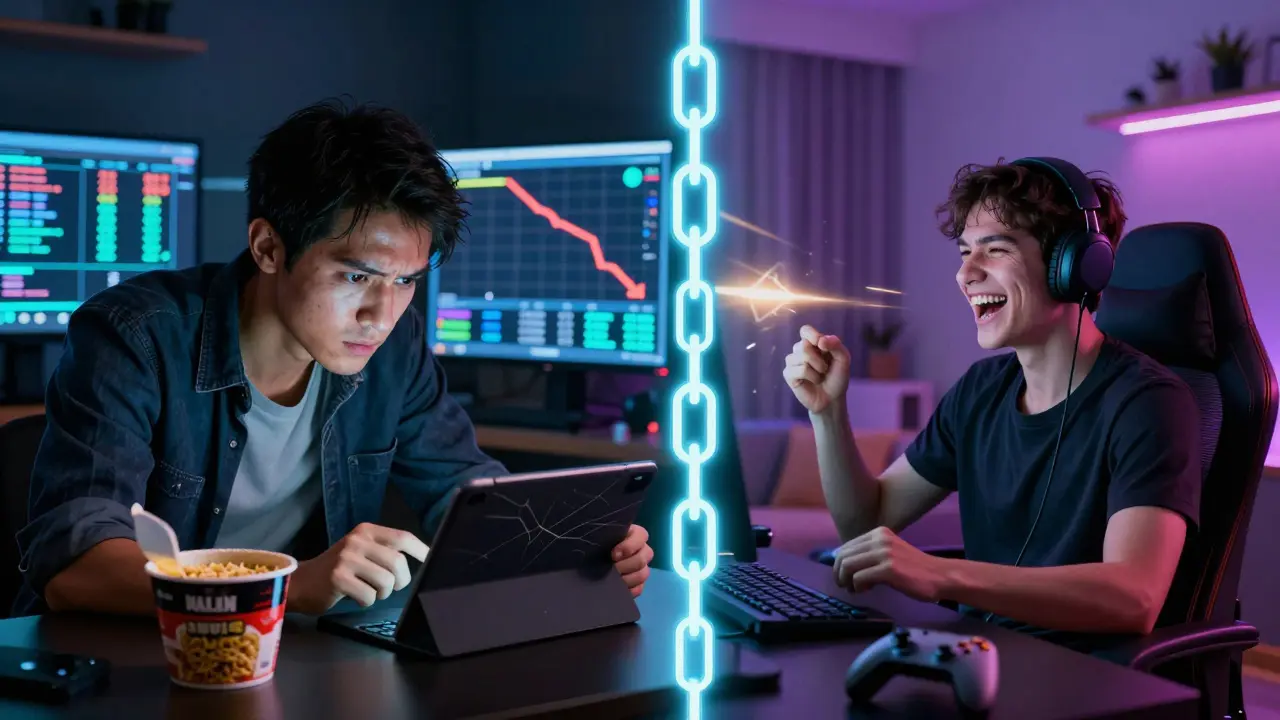
Money vs. Fun: The Hidden Trade-Off
A 2024 ESA survey found that 78% of traditional gamers play for fun. That’s it. No bonus points for earning. No pressure to grind. Just play. P2E flips that. For many, especially in developing countries, it’s not about fun-it’s about survival. Chainalysis data shows 65% of P2E players in the Philippines, Nigeria, and Venezuela rely on it for income. That changes the game. A 2024 UC Berkeley study found that 43% of P2E players felt less enjoyment because they were stressed about earnings. It stopped feeling like play. It felt like a job. Reddit threads are full of this tension. One user, u/Gamer4Life, wrote: “I quit P2E after 3 months. It felt like a second job without benefits.” Another, from the Philippines, still plays because it pays the bills. Neither is wrong. But the experience is fundamentally different.The Cost of Entry: It’s Not Just Time, It’s Money
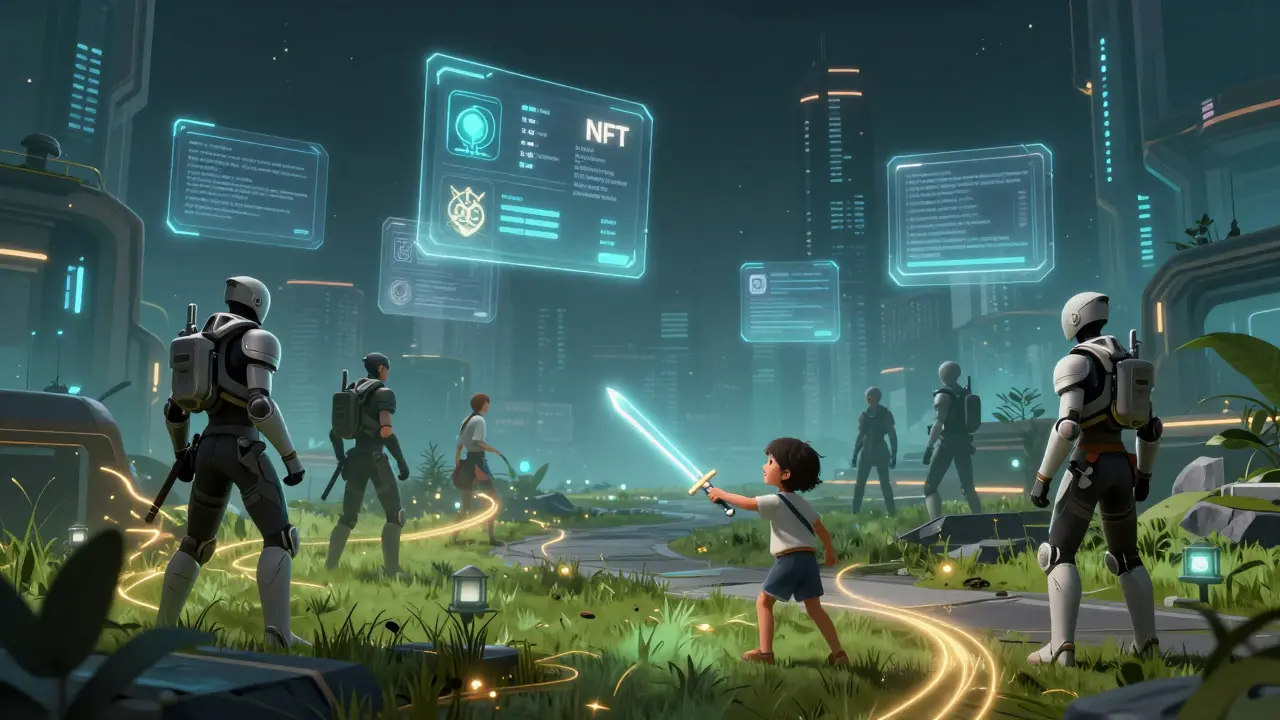
Starting a traditional game? Buy it. Install it. Play. Done. 95% of players get in within 15 minutes. Starting a P2E game? You need:- A crypto wallet (MetaMask, Trust Wallet)
- Some cryptocurrency (ETH, BNB, MATIC)
- Starter NFTs (often $5 to $500)
- Understanding of gas fees (0.50-5.00 per transaction)
- Knowledge of decentralized exchanges
The New Reality: Web3 Gaming Is Evolving
By 2025, the hype around “GameFi” is fading. The industry has moved into “Web3 Gaming.” That means fewer games trying to be crypto casinos. More games trying to be… fun. Projects like Big Time and Ember Sword are leading the shift. They call it “Play-and-Earn” (P&E). You play for fun. You earn rewards-but not as the main goal. Ownership matters. Earning is a bonus. That’s the future. BNB Chain’s 2025 report says 68% of new Web3 games now use hybrid models. The best ones hide the blockchain. You don’t need to know what a wallet is to play. You just play. And if you want to cash out? You can. But you don’t have to. And that’s where things are headed. Blockchain won’t disappear. It’ll just become like Wi-Fi: invisible, but everywhere.Who Wins? Who Loses?
Traditional gaming wins for people who want to relax, escape, or compete without stress. It’s polished, predictable, and safe. It’s the movie theater of digital entertainment. P2E wins for people who need income, especially in places with unstable economies. A Venezuelan player, Maria Lopez, used Axie Infinity to feed her family during hyperinflation. That’s not a game. That’s survival. And that matters. But P2E loses when it becomes a pyramid scheme. The Squid Game token collapse in 2022 wiped out $3.36 million overnight. That’s not innovation. That’s fraud. And it poisoned trust for everyone else. The industry is thinning out. In 2022, there were 1,200 P2E games. By early 2025, only 287 remained. Most of those were bad. The survivors? They’re better. They focus on gameplay first. Earning second.What Should You Do?
If you just want to play? Stick with traditional games. They’re better. They’re cheaper. They’re safer. If you’re in a region where income is scarce? Try a P2E game-but only with money you can afford to lose. Start small. Learn the system. Don’t quit your job for it. If you’re curious about ownership? Try a hybrid game like Big Time. Play for fun. See if you like owning your items. If you do? You’re already ahead of the curve. The future of gaming isn’t P2E or traditional. It’s both. And the games that last won’t be the ones that promise riches. They’ll be the ones that let you play-and own-without making you feel like a worker.Can you really make money with play-to-earn games today?
Yes-but only in specific cases. A few well-designed Web3 games still offer real earnings, especially in emerging markets where minimum wages are low. However, most early P2E games collapsed. Today’s survivors focus on gameplay over rewards. Earning is possible, but it’s not guaranteed. Treat it like a side hustle, not a job.
Why do most play-to-earn games fail?
Most fail because their economies are built on hype, not sustainability. They pump out too many tokens without enough ways to spend them. Players earn, but there’s nowhere to spend their earnings-so value crashes. Also, many games had no real fun. People played only to earn, and when earnings dropped, they left. 70% of early P2E games died within 18 months.
Do you need to invest money to start playing play-to-earn games?
Yes, most do. You need to buy starter NFTs-often costing $5 to $500-before you can play. That’s a major barrier. Traditional games cost $60 upfront, but you get a full experience. P2E games ask you to pay first, then hope you earn it back. Some newer games offer free-to-play tiers, but they’re still rare.
Is play-to-earn legal?
It’s complicated. In the U.S., the SEC is investigating whether game tokens are unregistered securities. In China, P2E is banned outright. In the Philippines and Nigeria, it’s tolerated because it provides income. Regulations are still catching up. Always check your country’s rules before investing.
What’s the difference between NFTs in P2E and in-game items in traditional games?
In traditional games, in-game items are just data on a company’s server. You can’t sell them. You can’t move them. If the game shuts down, they disappear. In P2E, NFTs are stored on a public blockchain. You control them. You can sell them on third-party marketplaces. Even if the game dies, the NFT still exists as digital property.
Are play-to-earn games better for the environment than traditional games?
No-actually, they’re worse. Blockchain transactions require energy, especially on networks like Ethereum before its 2022 upgrade. While many P2E games now use low-energy chains like Polygon or BNB Chain, they still add unnecessary computational load compared to traditional games, which run on centralized servers with far less energy use per player.
Will play-to-earn replace traditional gaming?
No. Traditional gaming is too big, too polished, and too focused on pure entertainment. But P2E is changing it. More traditional games are now adding blockchain-based ownership features-like limited-edition NFT skins in FIFA or Valorant. The future isn’t P2E vs. traditional. It’s traditional games borrowing from P2E to give players real ownership, without turning play into work.
Comments
24 Comments
Angelica Stovall
This whole P2E thing is just a crypto scam with extra steps. They’re not selling games-they’re selling lottery tickets with graphics. And you? You’re the sucker buying tickets with your life savings. Wake up. The only thing being earned here is a one-way ticket to debt city.
Taylor Holloman.
I get why people are skeptical… but I also remember when people said the same thing about online shopping. Or streaming. Or even video games themselves. There’s something real here-ownership. Not hype. Not tokens. Just… being able to say, 'This thing is mine.' Even if it’s worth $2 now. That matters.
Bryan Roth
Look, I’ve played both sides. Traditional gaming? I’ve spent thousands on loot boxes and DLCs that vanished when I switched consoles. P2E? I lost $80 on Axie starter NFTs… but I still have the Axies. They’re sitting in my wallet. They’re mine. And if I want to sell them tomorrow? I can. No company can take them. That’s power. That’s freedom. Stop calling it ‘gambling’-it’s just capitalism with better UX.
sai nikhil
In India, many of us don’t have access to traditional gaming because of cost. P2E gave us a chance. Not everyone is rich. Not everyone lives in America. For some, playing isn’t about fun. It’s about survival. And that’s not something to mock.
Sahithi Reddy
P2E is just work with better graphics
George Hutchings
I’ve lived in 5 countries. The difference between traditional gaming and P2E? One lets you escape. The other lets you breathe. For someone in Venezuela or the Philippines, that’s not a game. It’s oxygen. We need to stop judging from our cozy couches.
Henrique Lyma
The idea that blockchain gives you ‘ownership’ is laughable. You don’t own anything. You own a reference to a string of characters on a server you can’t access. And if the blockchain goes down? Poof. Gone. Just like your dreams of being a crypto millionaire. This isn’t revolution. It’s digital snake oil wrapped in whitepapers.
Steph Andrews
I used to think P2E was trash… until I saw a girl in Manila play Axie for 3 hours a day to pay for her brother’s insulin. I didn’t cry. I just sat there. And I realized-this isn’t about games. It’s about dignity. And maybe… we’re too quick to call it a scam because we don’t understand what it means to be hungry
Prakash Patel
You say traditional gaming is safe? Name one AAA game that didn’t delete your account for a typo. Or change the rules because ‘balance.’ Or charge $100 for a skin that’s gone in 6 months. P2E is messy. But at least it’s honest about being a gamble.
Elizabeth Kurtz
If you’re new to P2E, start with free-to-play options like Big Time. No upfront cost. No wallet needed. Just play. If you like it, then consider investing. But don’t go all-in. Treat it like a hobby, not a job. You’ll thank yourself later.
john peter
The fundamental flaw in this entire discourse is the conflation of utility with value. Ownership, in the ontological sense, is not conferred by cryptographic hashes. It is conferred by social consensus. And social consensus, in the case of NFTs, is as ephemeral as the meme it was built upon. Therefore, one does not ‘own’ an NFT. One merely holds a symbolic token in a fragile narrative economy. The tragedy is not its collapse. The tragedy is that we believed it could ever be real.
Marc Morgan
So let me get this straight… you’re telling me that instead of paying $60 for a game that lasts 30 hours, I should pay $300 for a game that… still lasts 30 hours… but now I have to do math? And pay gas fees to log in? And worry if my ‘assets’ will be worth less than my coffee tomorrow? Cool. I’ll stick with my Switch. Thanks, but no thanks.
Anastasia Thyroff
I just watched my cousin cry because her Axie income dropped from $15/day to $1.50. She thought she was building a future. Turns out she was building a pyramid. And now she’s terrified. This isn’t innovation. It’s exploitation dressed up as empowerment. I’m sick of people calling this progress.
Kira Dreamland
I tried a P2E game last year. It was fun. I didn’t earn much. But I kept playing because I liked the world. Then I realized-I didn’t need to cash out. I just wanted to explore. So I stopped worrying about tokens. And suddenly… it felt like a game again. Maybe the answer isn’t P2E or traditional. It’s just… play.
shreya gupta
You Americans think ownership means having a wallet. In India, ownership means not being evicted. P2E isn’t about crypto. It’s about agency. And if you don’t understand that, maybe you’ve never had to choose between food and a game subscription.
Derek Lynch
Stop acting like P2E is the enemy. It’s the future. And if you’re scared of it, that’s fine. But don’t scream ‘scam’ because you don’t get it. The real scam is pretending that traditional gaming isn’t rigged. Loot boxes. Pay-to-win. Account bans for no reason. P2E is messy. But at least it’s transparent about the rules. And you can leave anytime. Try that with Activision.
Shreya Baid
I come from a country where the minimum wage is $120/month. I used to play traditional games on my brother’s phone. Then I found a P2E game that let me earn $2/day. It’s not much. But it bought my sister her first pair of shoes. This isn’t about gaming. It’s about dignity. And I won’t apologize for that.
Christopher Hoar
P2E is just crypto bros trying to get rich off people who dont know what a blockchain is. They make games that look cool, then pump tokens, cash out, and vanish. The whole thing is a giant pyramid. And you? You’re the last guy holding the bag. Wake up. It’s not a game. It’s a con.
Robert Kunze
I lost $200 on a P2E game. I know. I’m dumb. But I still have the NFTs. I can sell them. I can trade them. I can even use them in another game. That’s more than I can say for my $100 Fortnite skin that vanished when I got banned for saying ‘lol’ too loud. So yeah. I made a mistake. But at least I still have something.
Sarah Zakareckis
The paradigm shift here isn’t about money-it’s about sovereignty. Traditional gaming = centralized control. P2E = decentralized ownership. The real innovation? You’re no longer a consumer. You’re a stakeholder. And that changes everything. The UI is clunky. The economics are unstable. But the principle? Revolutionary.
Heather James
I play both. Traditional games for chill. P2E for curiosity. I don’t earn from it. But I love that my dragon isn’t locked to a server. I can show it to friends. I can trade it. It’s like having a digital pet that doesn’t die. That’s… kinda beautiful.
Sarah Hammon
I used to hate P2E. Then I tried Big Time. I didn’t know what a wallet was. I just clicked ‘play.’ Got a free skin. Played for 2 hours. Liked it. Later, I sold the skin for $3. Didn’t need it. But I felt like I won. No one took it away. That’s the magic. It’s not about the money. It’s about knowing you’re not just borrowing fun.
iam jacob
I just want to play. Why does everything have to be a transaction? Why can’t I just enjoy a game without someone telling me I’m ‘investing’? You turned my escape into a spreadsheet. I miss the days when games were just… games.
Jesse Pals
I’m from Australia. We don’t have a minimum wage here. But we do have $200 internet bills. P2E? I play for fun. Sometimes I earn $5. Sometimes I lose $5. It’s like a lottery. But I get to play the game while I wait. And hey-if I win? Sweet. If I lose? No biggie. It’s not work. It’s just… extra.
Write a comment