



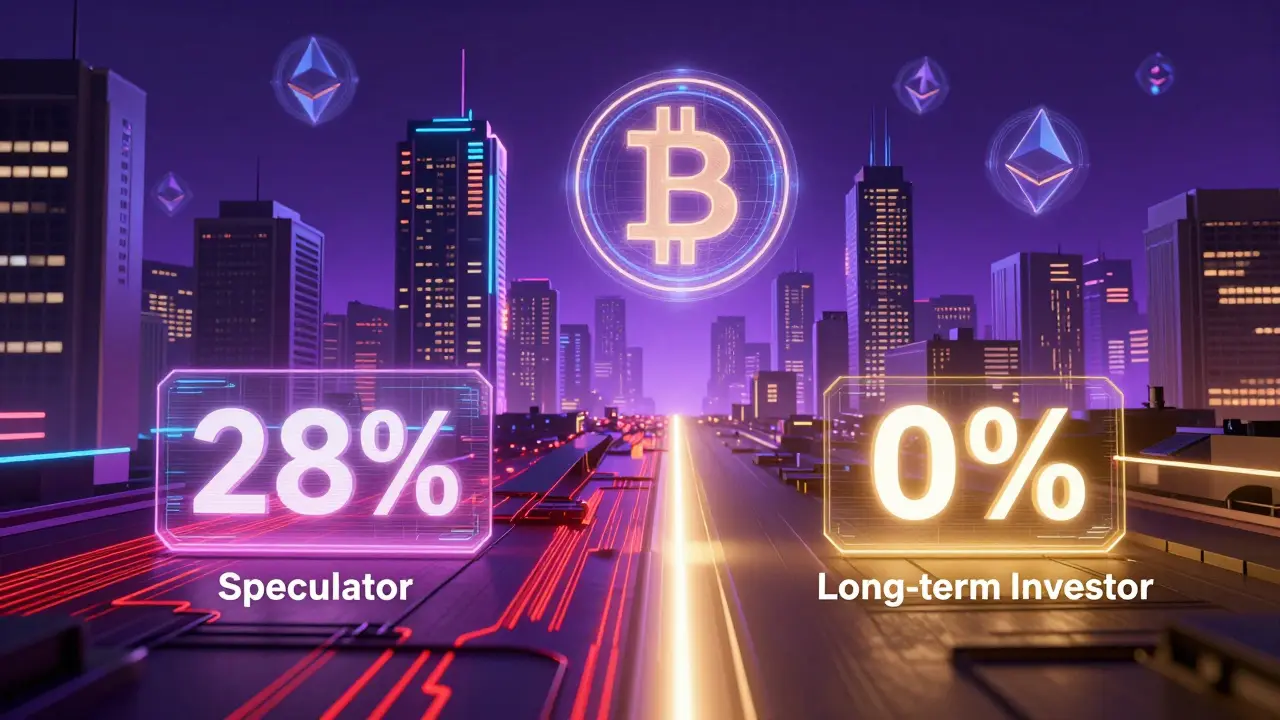
For years, Portugal was the ultimate sanctuary for crypto investors-a place where digital gains were virtually invisible to the taxman. That era of total exemption ended in 2023. Now, if you're trading assets and selling them quickly, you're looking at a Portugal crypto tax hit of 28% on your short-term gains. While this sounds steep, the reality is more nuanced: Portugal hasn't abandoned its crypto-friendly reputation; it has simply drawn a line between speculators and long-term investors.
| Holding Period | Tax Rate | Tax Treatment |
|---|---|---|
| Less than 365 days | 28% (Flat) | Taxable as short-term capital gains |
| 365 days or more | 0% | Completely Tax-Free |
| Professional Trading | 14.5% to 53% | Taxed as Business Income (Progressive) |
The 365-Day Rule: Speculation vs. Investment
The core of the current system is the holding period. If you buy a token and sell it within a year, the Portuguese government views that as a short-term gain. Capital Gains Tax is a tax on the profit realized from the sale of a non-inventory asset. In this case, that rate is a flat 28%.
But here is the kicker: if you hold your assets for 365 days or more, your gains remain tax-free. This creates a massive incentive for the "HODL" strategy. If you're sitting on a profit at day 300, waiting just 65 more days could save you nearly a third of your winnings. This distinction is designed to discourage high-frequency flipping while still attracting long-term wealth and blockchain innovation to the country.
Choosing Your Tax Path: Flat Rate or Progressive?
You aren't always stuck with the 28% flat rate. Portuguese law allows for some flexibility depending on your total financial picture. You can choose to "aggregate" your crypto gains with your other annual income. This means your crypto profits are taxed according to the standard IRS (Imposto sobre o Rendimento de Pessoas Singulares), which is Portugal's progressive personal income tax system brackets.
For some, this is a huge advantage. If your total income is low, you might fall into a bracket as low as 13.25%, making the progressive route much cheaper than the 28% flat tax. However, for high earners, this can backfire. If your total income exceeds €81,199, you could be pushed into the top bracket of 48%. In those cases, the 28% flat rate acts as a ceiling, protecting you from the highest progressive tiers.
Staking, Lending, and Passive Income
It's not just about buying and selling. If you're earning passive income through Staking, which is the process of participating in a Proof-of-Stake blockchain to earn rewards , or providing liquidity to a DeFi (Decentralized Finance) protocol, the rules are different. These rewards are generally treated as income and are subject to the 28% flat rate from the moment you receive them, regardless of how long you hold the reward tokens.
This means that while your original investment might be tax-free after a year, the "interest' you earn on that investment is taxable. This is a common pitfall for investors who assume everything in their wallet is exempt just because they've lived in Portugal for a while.

Are You a Professional Trader?
There is a big difference between an investor and a professional trader in the eyes of the Autoridade Tributária e Aduaneira (AT), which is Portugal's tax and customs authority . If you trade cryptocurrency as your primary source of income, use sophisticated algorithmic strategies, or maintain an incredibly high volume of daily trades, the AT may classify you as a professional.
Once you are labeled a professional, the 28% flat rate and the one-year exemption vanish. Instead, your profits are treated as business income. This means you're taxed on a progressive scale from 14.5% up to 53%. The line between "active investor" and "professional trader" can be blurry, and this is where most people end up needing a specialized accountant to avoid a surprise audit.
How to Report Your Crypto on Portal das Finanças
Reporting isn't as simple as entering one number. You'll use the Portal das Finanças, the official online portal for Portuguese tax administration , and navigate several specific annexes:
- Anexo G: This is where you report capital gains. You must separate assets held for less than 365 days (taxable) from those held longer (exempt).
- Anexo E: Use this for passive income, such as staking rewards or lending interest, which typically hit the 28% rate.
- Anexo B: This is strictly for those classified as professional traders reporting business income.
To make this work, you need a meticulous paper trail. You can't just provide a final balance. You need the exact purchase date, the sale date, and the Euro value at the time of both events. Using crypto tax software is almost mandatory here, as manually calculating the cost basis for a portfolio with hundreds of trades is a recipe for disaster.

The NHR Factor and New Residents
You might have heard of the Non-Habitual Resident (NHR) program, which was a tax regime designed to attract high-net-worth individuals and professionals to Portugal . For those who signed up before January 2024, there are still potential exemptions on foreign-sourced income for up to 10 years. Some NHR holders have successfully argued that their crypto gains are foreign-sourced and therefore exempt.
However, if you're moving to Portugal now, the NHR door is closed. New residents must follow the standard rules: 28% for short-term gains and 0% for long-term. While not as lucrative as the old NHR days, Portugal is still significantly more attractive than France (which has a 30% flat tax regardless of time) or Germany (where short-term gains are taxed as high as 45%).
Does the 28% tax apply to crypto-to-crypto trades?
Yes. In Portugal, swapping one cryptocurrency for another is generally considered a disposal of the first asset. If you held that first asset for less than 365 days, the gain from that swap is taxable at 28%.
Is there any way to avoid the 28% short-term tax?
The most effective way is to hold your assets for at least 365 days. Once you cross that threshold, the gain is 0% taxed. Alternatively, if your total income is low, you can choose to aggregate your gains into the progressive tax brackets, which might start as low as 13.25%.
What happens if I'm an NHR holder?
Existing NHR holders may be exempt from tax on foreign-sourced crypto gains, depending on the specific nature of the income and how it is categorized. Since the NHR program closed to new applicants in early 2024, this benefit only applies to those already in the system.
Are NFTs taxed the same way as Bitcoin?
Generally, yes, but there are specific exemptions for certain types of NFT transfers, particularly if they are classified as art or collectibles rather than purely financial assets. However, most speculative NFT flipping is treated under the same capital gains rules.
What records do I need for my tax return?
You need a complete transaction history including: the date of acquisition, the date of sale/exchange, the amount of crypto, and the fair market value in Euros at the time of each transaction. CSV exports from exchanges are a good start, but a dedicated tax software report is better for the Portal das Finanças.
Next Steps for Investors
If you're currently living in Portugal or planning to move, your first step should be an audit of your holding periods. Check your most profitable assets; if you're at the 10-month mark, it's likely worth waiting a few more weeks to hit that 365-day exemption.
For those with high transaction volumes, don't wait until April to start your bookkeeping. The Portal das Finanças can be unforgiving with errors. Gather your API keys from your exchanges, sync them to a tax calculator, and determine if you fit the "professional trader" profile. If you do, seek out a certified accountant who specializes in digital assets to ensure you're using the correct Anexo B filings.

Comments
19 Comments
Rob Mitchell
Still a great spot for long-termers.
Jonathan Chamma
It's kind of like a little game of patience, isn't it? Just hanging on for that magic year to keep your gold. Pretty sweet deal compared to the madness elsewhere.
Samson Selleck
The superficial analysis of the aggregated IRS brackets fails to account for the systemic volatility of the underlying assets. If you're utilizing high-frequency algorithmic execution, the classification as a professional trader is an inevitability, not a possibility. The fiscal drag created by a 28% flat tax on short-term liquidity is negligible for those with actual capital, but for the retail mid-curve traders, it's a total death knell. Most of you are probably just chasing ghost gains anyway while ignoring the actual tax liability of the swap events. It's honestly embarrassing how many people think 'HODLing' is a sophisticated financial strategy rather than just a lack of an exit plan. You need to factor in the slippage and the spread before you even think about the tax man taking a cut. The structural arbitrage opportunities in Portugal are dwindling as the AT gets more aggressive with their audits. If you don't have a proper cost-basis tracking system, you're basically just gambling with the government's money. I've seen portfolios decimated not by the market, but by the sheer incompetence of reporting on Anexo G. The sheer lack of sophistication in the retail crypto space is staggering. Good luck with your little coins.
Adam Auksel
Love seeing people move to Portugal! 🇵🇹 It's such a beautiful place to build a life. Just keep those records tidy and you'll be golden! 🚀✨
Swati Sharma
The DeFi liquidity provisioning side of things is where the real friction lies due to the immediate taxability of rewards. We really need to look at the tokenomics of these rewards and how they impact the overall APY after the 28% haircut. It's basically a drag on the compound yield. If we collaborate on some better tracking sheets, it'd be a huge win for the community. Let's optimize our tax-loss harvesting to mitigate the short-term hit!
Lane Montgomery
Who's your accountant?
Agnessa Dale
This is so helpful! It's actually really inspiring that there's still a way to be tax-free if you're just patient.
EDOZIEM MICHAEL
time is the only true currency we have and the government just wants a piece of our digital dreams
James Bone
The irony is that people think they're 'beating the system' by moving to Europe. You're just trading one set of shackles for another, just with better wine. The moral failure of speculative bubbles is that they attract the kind of people who need a 'guide' to avoid paying their fair share.
Stanly Hayes
Whatever, Portugal is still better than the US government stealing everything! 🇺🇸 Let's go!
Omotola Balogun
Actually you forgot to mention that the cost basis is’ calculated on FIFO basis usualy in most EU jurisdictions so you gotta be carful with which coins you sell first or you will pay way more than 28% in real terms lol
Alan Seiden
Absolutely pathetic that we have to move to the edge of Europe just to keep our own money. The UK system is a joke, but this 365-day nonsense is just another way to leash the people. Total rubbish!
Scott Fenton
I would strongly advise any individual considering a move to consult with a certified tax professional in Lisbon to ensure full compliance with the AT.
Mikayla Murphy
It's interesting to see how different countries handle this. Portugal seems to be trying to find a middle ground between attracting talent and maintaining a tax base.
Aaliyah BROTHERS
WAKE UP!!! They are just tracking your wallets to prepare for the GREAT RESET!!!! 🚨 The 365 day rule is just a way to keep you trapped in their system while they suck the liquidity out of the market!!!! TOTAL SCAM!!!! 🐍
Chidinma Sandra okafor
Oh sure, because the Portuguese government is just so famously honest and transparent. I'm sure they'll just 'forget' about your gains if you hold for a year. How quaint!
Akshay Gorad
I appreciate the clarity on the progressive tax brackets. It makes the decision process much simpler.
Tyler Webb
Man, that 28% hit on staking rewards is a bummer. 😕 Hope everyone is tracking that carefully!
logan bates
America first. Who cares about Portugal.
Write a comment