

By 2026, if you're still trying to trade Monero or Zcash on Binance, Coinbase, or Kraken, you're out of luck. These privacy coins have been quietly removed from nearly every major centralized exchange in the U.S., Europe, and South Korea. It’s not because they’re broken. It’s because regulators decided they can’t be trusted.
Why Privacy Coins Are Being Delisted
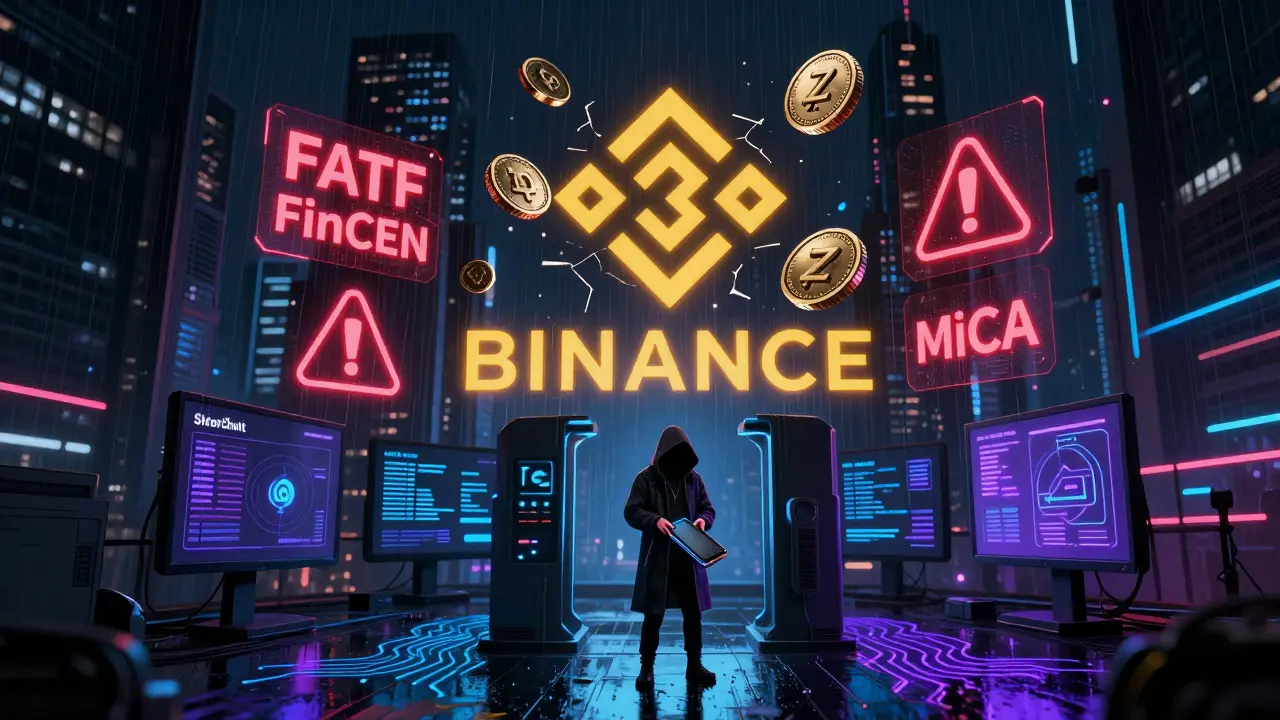
Privacy coins like Monero (XMR), Zcash (ZEC), and Dash were built to hide transaction details. Unlike Bitcoin, where every transfer is visible on a public ledger, these coins use advanced cryptography to mask sender, receiver, and amount. That’s great if you want to protect your financial privacy. It’s a nightmare for regulators trying to stop money laundering and terrorist funding. The Financial Action Task Force (FATF) has been pushing its Travel Rule since 2019, but enforcement hit full force in 2025. The rule says exchanges must collect and share customer data for transfers over $1,000. Privacy coins can’t do that. They literally can’t tell you who sent the money or where it went. So exchanges chose compliance over convenience. They delisted them. In the U.S., the Bank Secrecy Act treats crypto companies as financial institutions. That means they’re legally required to follow AML (Anti-Money Laundering) and CFT (Countering the Financing of Terrorism) rules. The FinCEN and SEC don’t care if you’re using privacy coins to avoid corporate tracking or pay for a private business deal. If the transaction can’t be traced, it’s flagged as high-risk. South Korea and Japan outright banned privacy coins from exchanges in 2024. The European Union’s MiCA regulation will fully ban them by 2027. Even though privacy coins aren’t illegal in the U.S., most exchanges won’t touch them. Why risk a $50 million fine when you can just list Bitcoin and Ethereum instead?How Privacy Coins Work (And Why They’re Hard to Regulate)
Monero doesn’t just hide addresses. It uses ring signatures to mix your transaction with dozens of others, making it impossible to tell which one is yours. It also uses stealth addresses - one-time addresses generated for every payment. Even if you know someone’s public wallet, you can’t see their incoming transactions. Zcash is different. It lets users choose between transparent and shielded transactions. But regulators still don’t trust it. Why? Because shielded transactions can be turned on and off. That means someone could send $10 million in a shielded transaction, then later claim it was a mistake. There’s no way to prove otherwise. These features make privacy coins technically superior for anonymity. But they also make them incompatible with global financial systems built on transparency. No bank, no exchange, no payment processor can audit a Monero transaction. And that’s the core conflict.The Rise of Decentralized Exchanges
With centralized exchanges gone, users didn’t disappear. They moved. Platforms like Flashift, SideShift, and ThorChain now handle most privacy coin trading. These are non-custodial, decentralized exchanges (DEXs). No KYC. No ID checks. No paperwork. You connect your wallet, swap coins, and walk away. No one knows who you are. This shift has changed the market. Liquidity for Monero dropped by 60% on centralized platforms in 2025. But on decentralized platforms, trading volume stayed steady - even grew in regions with weak regulation like Southeast Asia and parts of Africa. The problem? These platforms aren’t safe. They’re not regulated, so there’s no customer support. If you send funds to the wrong address, you lose them. No one can help. No chargebacks. No refunds. And now, regulators are starting to盯 (watch) these platforms too. The U.S. Treasury is already exploring ways to apply Travel Rule rules to DEXs. The next wave of delisting might not be on Coinbase - it might be on your wallet.
Legitimate Uses vs. Criminal Abuse
Let’s be honest: privacy coins aren’t just for criminals. They’re used by journalists in authoritarian countries to receive donations without fear of retaliation. Small businesses use them to negotiate mergers without competitors seeing their cash flow. Activists in places like Iran and Venezuela use them to bypass state-controlled banking. But regulators don’t see the difference. To them, a privacy coin transaction is a black box. It doesn’t matter if it’s for a good reason - if it can’t be traced, it’s a risk. This is why some privacy coin developers are trying to adapt. Zcash added optional transparency. Monero’s team refuses. They believe privacy is a right, not a feature you can toggle. That’s why Monero still has the strongest privacy protections - and why it’s the most targeted.What’s Next for Privacy Coins?
There are two paths ahead. One: Privacy features get built into bigger blockchains. Ethereum is testing zero-knowledge proofs that let you prove you have funds without revealing the amount. This could mean you get privacy when needed, but regulators can still audit if they have a warrant. It’s a compromise. And it might kill standalone privacy coins. Two: Privacy coins go underground. They survive only on decentralized networks, peer-to-peer trades, and non-custodial wallets. Their value stays high among those who need anonymity - but they become inaccessible to the average person. No app store listings. No bank integration. No easy buy button. Right now, Monero trades at around $180, down from $500 in 2024. Zcash is at $55, half of its 2023 peak. Volume is down. But demand hasn’t vanished. It’s just harder to access.
What You Should Do in 2026
If you own privacy coins:- Check your local laws. In Canada, you can still hold them. In Germany? You can’t trade them on regulated platforms.
- Don’t rely on centralized exchanges. Move your coins to a non-custodial wallet like Monero GUI or ZecWallet.
- Learn how to use decentralized swaps. They’re clunky, but they’re your only option.
- Keep records. If you ever get audited, you need to prove you didn’t use them for illegal activity.
- Ask yourself: Why do you need privacy? If it’s just to avoid taxes - you’re playing with fire.
- Understand the risks. You’re trading on unregulated platforms. No one is watching out for you.
- Consider alternatives. Bitcoin with a mixer? Not as private as Monero, but easier to trade.
Frequently Asked Questions
Are privacy coins illegal?
No, privacy coins aren’t illegal in most countries - but trading them on regulated exchanges is. In places like the U.S., EU, South Korea, and Japan, you can still own Monero or Zcash in your wallet. But you can’t buy or sell them on Coinbase, Kraken, or Binance. Some countries, like South Korea, have outright bans on exchange listings. Always check your local laws.
Can I still trade Monero in 2026?
Yes, but not on major exchanges. You’ll need to use decentralized platforms like ThorChain, SideShift, or local P2P networks. These services don’t require KYC, so they’re not regulated. Be careful: scams are common, and there’s no customer support. Always test with small amounts first.
Why did Zcash get delisted if it has optional privacy?
Regulators don’t trust optional privacy. If a user can switch between transparent and shielded transactions, it creates ambiguity. A company might claim a $5 million transfer was transparent - but the blockchain shows it was shielded. There’s no way to verify. Exchanges can’t audit that risk, so they removed Zcash entirely.
Will privacy coins disappear completely?
No. They’re too valuable for users who need true financial privacy. But their market will shrink. Most users will either move to hybrid solutions (like Ethereum with ZK-proofs) or use privacy coins only on decentralized platforms. Standalone privacy coins will survive - but as niche tools, not mainstream assets.
Can I use privacy coins for payroll or business?
Technically yes - but it’s risky. If you’re a business in the U.S. or EU, paying employees in Monero could trigger AML investigations. Banks might freeze your account. Regulators see anonymous payments as red flags. Some startups are building compliant payroll tools that convert privacy coins to fiat before payout, but those are rare. Proceed with legal advice.
Are privacy coins more secure than Bitcoin?
In terms of anonymity, yes. Monero’s ring signatures and stealth addresses make it far harder to trace than Bitcoin. But security isn’t just about privacy. Bitcoin has more miners, more audits, and more wallet support. If you lose your Monero private key, there’s no recovery. Bitcoin is more resilient - Monero is more private. Choose based on your need.