




Imagine holding a volatile meme coin like WIF or BONK and wanting to hedge your position against a market crash. On most platforms, you’d have to sell that asset, convert it to a stablecoin, and then open a short position. That process eats up time and costs you in fees. Quanto is a decentralized perpetual exchange on the Solana blockchain that lets you use any token as collateral for trading. It skips the conversion step entirely. You can use your risky assets directly to trade Bitcoin, Ethereum, or even other meme coins with leverage. This review breaks down whether this innovative approach is a game-changer or a trap for retail traders.
What Is Quanto and How Does It Work?
Quanto is not your typical centralized exchange like Binance or Coinbase. It operates as a non-custodial Decentralized Exchange (DEX) built specifically on the Solana blockchain, known for its high speed and low transaction costs. Launched in Q3 2024 by an anonymous team calling themselves 'Solana Perp Labs,' Quanto focuses on perpetual futures contracts. These are derivatives that allow you to bet on the price direction of an asset without actually owning it.
The core innovation here is the "any collateral" model. Traditional DeFi platforms usually require you to deposit stablecoins (like USDC) or major assets (like ETH) to secure your trades. If you want to trade using a smaller, volatile token, you’re often locked out. Quanto changes this rule. It accepts almost any Solana-based asset as collateral. This means if you hold a bag of a trending meme coin, you don’t need to sell it to participate in the broader market. You just lock it up and start trading.
Technically, Quanto uses a dual-layer architecture. The settlement layer runs on Solana’s Sealevel parallel processing engine, which handles transactions incredibly fast. The order book layer utilizes a decentralized matching system similar to Serum. This setup allows for sub-second finality, meaning your trades execute almost instantly, which is crucial when dealing with leveraged positions where milliseconds matter.
Fees, Leverage, and Trading Costs
Cost is a major factor when choosing a crypto exchange. Let’s look at the numbers. Quanto charges a maker fee of 0.02% and a taker fee of 0.05%. To put that in perspective, competitors like Hyperliquid charge 0.025% for makers and 0.075% for takers. While the difference seems small, it adds up significantly for high-frequency traders.
On top of exchange fees, you have network gas fees. Because Quanto lives on Solana, these are negligible. We’re talking about $0.00025 per trade on average. Compare that to Ethereum-based DEXs where gas fees can range from $1 to $50 depending on network congestion. For a trader executing multiple strategies a day, Quanto’s cost structure is highly attractive.
You can also reduce these fees further by holding the native QTO token, which serves governance purposes and offers tiered trading fee discounts ranging from 5% to 15%. The tokenomics include a burn mechanism where 70% of all trading fees are permanently removed from circulation. This deflationary pressure is designed to increase the value of the QTO token over time, rewarding long-term holders.
In terms of leverage, Quanto supports up to 100x leverage across various asset classes. This includes majors like BTC, SOL, and ETH, as well as stablecoins and highly volatile tokens like Fartcoin. High leverage amplifies both gains and losses, so while 100x sounds exciting, it requires strict risk management.
Quanto vs. Competitors: The Liquidity Trade-Off
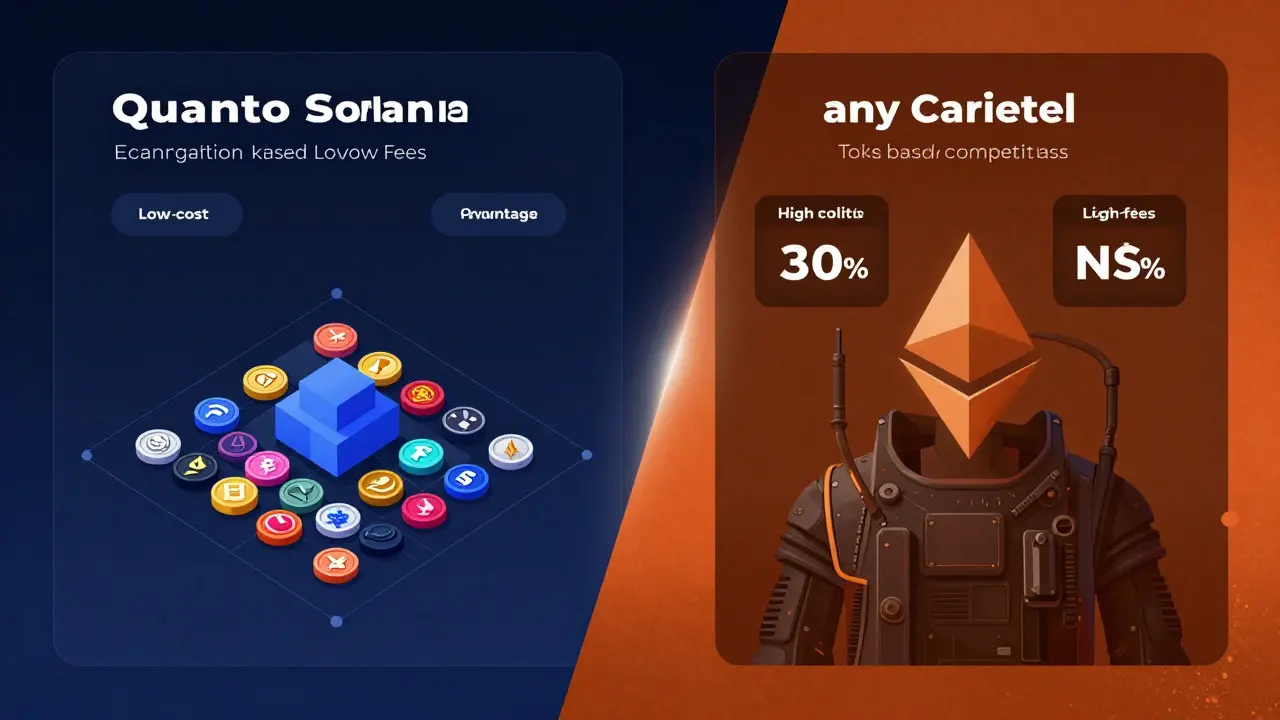
No platform exists in a vacuum. To understand Quanto’s place in the market, we need to compare it to established players. The main competitors in the perpetual DEX space are Hyperliquid (on Ethereum Layer 2), Aster (on BNB Chain), and GMX.
| Feature | Quanto | Hyperliquid | Aster |
|---|---|---|---|
| Blockchain | Solana | Ethereum L2 | BNB Chain |
| Maker/Taker Fees | 0.02% / 0.05% | 0.025% / 0.075% | Varies |
| Collateral Types | Any Solana Asset | Limited Stablecoins/ETH | BSC Assets |
| Avg. Order Book Depth | $1.2 Million | $15 Million | High |
| Best For | Retail/Meme Coins | Institutional/Large Volume | BSC Ecosystem Users |
The biggest differentiator is liquidity depth. Hyperliquid boasts an average order book depth of $15 million per major pair. Quanto sits at around $1.2 million. What does this mean for you? If you are trying to execute a large trade-say, $50,000 or more-you might experience significant slippage on Quanto. Your buy order could push the price up before it fully fills, resulting in a worse entry price. Hyperliquid is better suited for institutional-sized orders.
However, for retail traders moving smaller amounts, this depth is sufficient. Quanto’s advantage lies in its collateral flexibility. Unlike GMX or Kwenta, which restrict you to specific assets, Quanto lets you use niche tokens. If you believe a specific meme coin will pump but want to hedge your exposure, Quanto allows you to do that natively without exiting your position.
Risks and User Experience
Innovation comes with risk. Using volatile assets as collateral introduces a unique danger: cascading liquidations. If you use a meme coin that drops 20% in an hour as collateral for a BTC short, your margin buffer shrinks rapidly. You might get liquidated not because your trade went wrong, but because your collateral lost value.
To mitigate this, users must maintain a higher collateral ratio. Standard requirements might be 110%, but with volatile assets, experts suggest keeping it above 105% and monitoring positions closely. Quanto recently implemented a "Collateral Shield" feature after a protocol loss in September 2024. This system temporarily restricts highly volatile assets from being used as collateral during extreme market crashes, protecting the pool from insolvency.
User feedback reflects a mixed but generally positive experience. On Trustpilot, Quanto holds a 4.1/5 rating based on early reviews. Users praise the seamless integration with wallets like Phantom and Backpack. One Reddit user noted saving $200 in conversion fees by using WIF tokens directly as collateral. However, complaints about thin order books for less popular pairs and occasional liquidation miscalculations during volatility spikes are common. A YouTube reviewer documented a loss due to a failed liquidation execution during a sharp SOL swing, though support later compensated 80% of the loss.
The learning curve is moderate. New users take about 23 minutes to complete their first trade, slightly longer than the industry average of 18 minutes. This is due to the complexity of managing multi-collateral interfaces. You need a basic understanding of perpetual contracts and Solana wallet management. Documentation is available in 12 languages, and community support via Telegram responds within an average of 22 minutes.
Is Quanto Worth It in 2026?
As we move through 2026, the perpetual DEX sector has matured. Total Value Locked (TVL) in this space has grown significantly, with Solana-based platforms capturing a larger share. Quanto currently holds about 0.7% of Solana’s perpetual DEX TVL. It is not yet a market leader, but it occupies a specific niche.
If you are an institutional trader looking for deep liquidity and large-cap stability, stick with Hyperliquid or centralized exchanges. But if you are a retail trader deeply embedded in the Solana ecosystem, especially one who holds volatile altcoins and meme coins, Quanto offers a utility that few others match. It turns your idle, risky assets into active trading capital.
The platform’s future depends on increasing liquidity depth. Industry analysts project that Quanto needs to hit $10 million+ in daily trading volume by mid-2025 to remain competitive. With upcoming features like cross-chain collateral support targeting Ethereum and Arbitrum, the roadmap looks ambitious. For now, it remains a powerful tool for specific trading strategies, provided you respect the risks associated with high leverage and volatile collateral.
Is Quanto a centralized or decentralized exchange?
Quanto is a decentralized exchange (DEX). It is non-custodial, meaning you retain control of your funds through your own Solana-compatible wallet (like Phantom or Backpack) rather than depositing them into an exchange-controlled account.
What assets can I use as collateral on Quanto?
You can use almost any Solana-based asset as collateral. This includes major cryptocurrencies like SOL, BTC, and ETH, stablecoins like USDT and USDC, and highly volatile meme coins such as WIF, BONK, or Fartcoin. This flexibility is Quanto's main differentiator.
How much leverage does Quanto offer?
Quanto supports up to 100x leverage on perpetual contracts. While this allows for significant potential gains, it also increases the risk of liquidation. Traders should exercise caution and monitor their positions closely, especially when using volatile collateral.
Are there KYC requirements to use Quanto?
No, Quanto does not require Know Your Customer (KYC) verification. Since it is a decentralized platform operating on the Solana blockchain, you only need a compatible wallet to connect and start trading. This provides privacy but places the responsibility of security on the user.
What happens if my collateral asset crashes?
If the value of your collateral asset drops significantly, your margin buffer decreases. This can lead to a forced liquidation of your open positions to protect the protocol. To avoid this, keep a healthy collateral ratio and consider using the "Collateral Shield" feature during high-volatility events.
How do Quanto fees compare to Hyperliquid?
Quanto generally has lower fees. Maker fees are 0.02% and taker fees are 0.05% on Quanto, compared to 0.025% and 0.075% respectively on Hyperliquid. Additionally, Solana's network gas fees are fractions of a cent, whereas Ethereum L2 solutions may have higher variable costs.


Comments
22 Comments
Guy Davis
typical shill piece, dont fall for it
Heather Austin
i mean the fee structure is actually pretty solid if you are doing high freq trading on solana, gas is basically free so why not, just watch out for slippage on the smaller pairs though because the depth is thin compared to hyperliquid or even aster
also the collateral shield thing sounds like a bandaid for bad risk management but better than nothing i guess
Lisa Chong
they want your money and they want your soul, this anonymous team is clearly part of the great reset agenda to track every single transaction via blockchain surveillance state protocols, trust no one who hides their face behind a pseudonym in finance especially when dealing with volatile assets that can be manipulated by insiders at any moment to crash the market and steal from the little guy
the whole concept of using meme coins as collateral is a trap designed to keep you leveraged into oblivion while the central bankers print more fiat to devalue your holdings further, stay woke and keep your gold under the mattress instead of feeding these digital leeches
look at the history of centralized exchanges failing and now decentralized ones are just the next step in the same pyramid scheme, they promise freedom but deliver servitude through smart contract vulnerabilities that only the elite know how to exploit, be careful out there folks
Andrew Schneider
bro this is literally the future of trading 🚀🔥
imagine hedging your wif bag without selling it, genius right? most people are too scared to use leverage but thats where the alpha is, you gotta take risks to get rewards otherwise you might as well put your money in a savings account and die poor
solana is the way and quanto is riding that wave hard, ignore the haters who cant handle volatility, we going to the moon together 💎🙌
Eric Braddock
classic psyop, they feed you low fees to get you addicted to the dopamine hit of gambling then liquidate you during the next engineered flash crash, the dual-layer architecture is just a fancy term for a honeypot designed to siphon liquidity from retail traders who think they are smarter than the algorithm
who really controls solana perp labs? probably the same shadowy cabal running the fed reserve, its all connected, wake up sheeple before your collateral gets vaporized by a coordinated short squeeze orchestrated by whale bots
the burn mechanism is a lie, they just move the tokens to cold wallets controlled by insiders, nothing is truly deflationary in a system built on infinite expansion of credit, stay paranoid stay safe
Ray Arney
seems decent for small trades, i tried it last week and the interface was okayish, took me a bit to figure out the collateral ratio stuff but once i got it down it was smooth enough
just make sure you dont overleverage yourself like i did lol
Brad Semp
one must appreciate the technical elegance of the Sealevel parallel processing engine, which facilitates sub-second finality-a requisite feature for sophisticated arbitrage strategies that demand precision beyond the capabilities of legacy Ethereum-based protocols
however, the reliance on such a nascent infrastructure introduces systemic fragility that the uninitiated often overlook in their fervor for speculative gains, thus requiring a disciplined approach to position sizing and risk mitigation akin to classical portfolio theory rather than the reckless abandon typical of retail speculation
furthermore, the economic model predicated on token burns assumes a continuous influx of volume that may prove unsustainable absent institutional adoption, rendering the long-term viability of the QTO token questionable unless significant structural improvements are implemented to deepen liquidity pools substantially
Alicia Hull
I have been analyzing the order book dynamics extensively and frankly the lack of depth is alarming for anyone serious about executing meaningful positions without severe slippage, how can one trust a platform with only $1.2 million in average depth when competitors offer an order of magnitude more?
this disparity suggests either a lack of interest from professional market makers or a deliberate strategy to fragment liquidity and capture spreads from uninformed participants, which raises serious questions about the sustainability of the business model
investors should demand transparency regarding the identity of the Solana Perp Labs team before committing capital, anonymity breeds impunity and ultimately harms the ecosystem integrity
Anuj Kashyap
the irony is palpable when one considers that the very volatility these platforms seek to monetize is also the force that will inevitably destroy them if not managed with philosophical detachment and rigorous discipline 😐
humans crave control in chaotic systems yet crypto is inherently anarchic, trying to impose traditional financial structures like perpetuals on meme coins is like building a cathedral on quicksand, impressive engineering perhaps but doomed to sink eventually
still, i respect the audacity, maybe it will work, maybe it wont, but the journey of learning from losses is more valuable than the profits themselves 🤷♂️
KEITH WONG
nah bro this is mid at best, hyperliquid is king 👑
why would u trade on a platform with half the liquidity of the competition? makes zero sense unless u love getting rekt by slippage, save urself the headache and stick to the proven giants, quanto is just another clone trying to ride the solana hype train 📉💀
Nick G
it is interesting to observe how different cultural approaches to risk manifest in trading behaviors across global communities, some embrace the high-stakes nature of leverage as a form of modern alchemy while others view it with deep suspicion rooted in historical precedents of financial ruin
perhaps the true value of platforms like Quanto lies not merely in their technological innovation but in their ability to facilitate cross-cultural dialogue around asset management and personal responsibility in an increasingly digitized world
we must remain open to diverse perspectives and learn from both successes and failures, fostering a community that supports informed decision-making rather than blind speculation, after all, knowledge is the ultimate currency
Hamza k
the drama unfolds like a Shakespearean tragedy where hubris meets volatility and the audience watches in rapturous terror as fortunes vanish in milliseconds ⚡
yet amidst the chaos there is beauty in the raw expression of human greed and fear, unfiltered and unapologetic, painting a vivid tapestry of digital excess that transcends mere financial transactions
embrace the spectacle friends, for in the end we are all just actors on the grand stage of the blockchain, performing our roles with varying degrees of skill and grace until the curtain falls on our portfolios forever 🎭
Johan Otto
boring post tbh, everyone knows solana is fast but does it matter if the exchange rugs you? 🤷♂️
i lost money on gmx once and never looked back, these new dexes are just casinos with extra steps, save ur time and go play poker instead, at least the dealer has a face u can glare at when things go south 😂
Natalie Lucas
you guys are missing the point entirely!!! this is about empowerment!!!
finally regular joes can use their meme coins to do something productive instead of just holding bags hoping for a pump, its exciting and scary but mostly exciting because we are breaking barriers!
let's goooooo support the builders who are trying to innovate despite the haters saying it wont work, positivity wins always!! ✨💪
Tracy Marshall
:( look at all these sheep following the herd into the slaughterhouse, morality has died in this space, people chasing quick riches while ignoring the ethical implications of gambling with other peoples money in opaque systems
the self-righteousness of the developers claiming innovation while hiding behind anonymity is disgusting, they should be ashamed of themselves for preying on the vulnerable masses who cannot comprehend the complex derivatives they are selling
return to simplicity and honesty, reject this corrupt system before it consumes your soul along with your wallet :(
Curtis Johnson
hey hey lets keep it respectful here everyone has their own journey and what works for one person might not work for another, no need to trash talk the devs or each other
its cool to experiment with new tools like quanto as long as you understand the risks involved, boundaries are important so let's respect those who choose to participate and those who don't, peace and love out there 🕊️
Steven Briggs
quietly watching from the sidelines, seems risky but intriguing
Kim Kay
i found the tutorial helpful but wish there were more examples for beginners, sometimes the terms are confusing like maker vs taker fees, maybe add a glossary?
overall good effort tho, thanks for sharing this info with us newbies trying to navigate the defi world safely
Korn Arrieta
The fundamental flaw in this analysis is the assumption that liquidity depth correlates linearly with safety, whereas in reality fragmented liquidity creates hidden pockets of vulnerability that sophisticated actors exploit ruthlessly
Furthermore the narrative surrounding 'any collateral' ignores the second-order effects of correlated asset crashes which amplify systemic risk exponentially rather than diversifying it as proponents claim
One must dissect the underlying mechanics with surgical precision to avoid being blindsided by the inevitable correction that awaits such overleveraged structures
Nick Wengel
in my country we have similar platforms but they are regulated heavily, here it feels wild west, both ways have pros and cons i suppose
some people like the freedom others like the safety, hard to say which is better really, depends on what you value more in life i guess
Ran Tao
oh please spare me the tech bro enthusiasm 🙄
everyone thinks they are the next warren buffett until they get liquidated at 3am on a tuesday, then suddenly they are blaming the code, the network, the moon phase whatever excuse fits
this is pure entertainment for the elites who sit back and laugh as you bleed out your savings chasing green candles, enjoy your doom spiral losers 📉🖕
Ella Collinson
The asymmetry in information flow between institutional players and retail participants remains the primary driver of wealth transfer in these ecosystems, rendering individual strategy largely irrelevant against algorithmic dominance
Quanto’s attempt to democratize access via flexible collateral merely masks the inherent predatory nature of derivative markets where edge is consistently harvested by those with superior data latency and execution power
Retail traders should recognize they are not investors but prey in a highly optimized hunting ground designed specifically to extract value from behavioral biases and emotional reactions to price action
Write a comment