


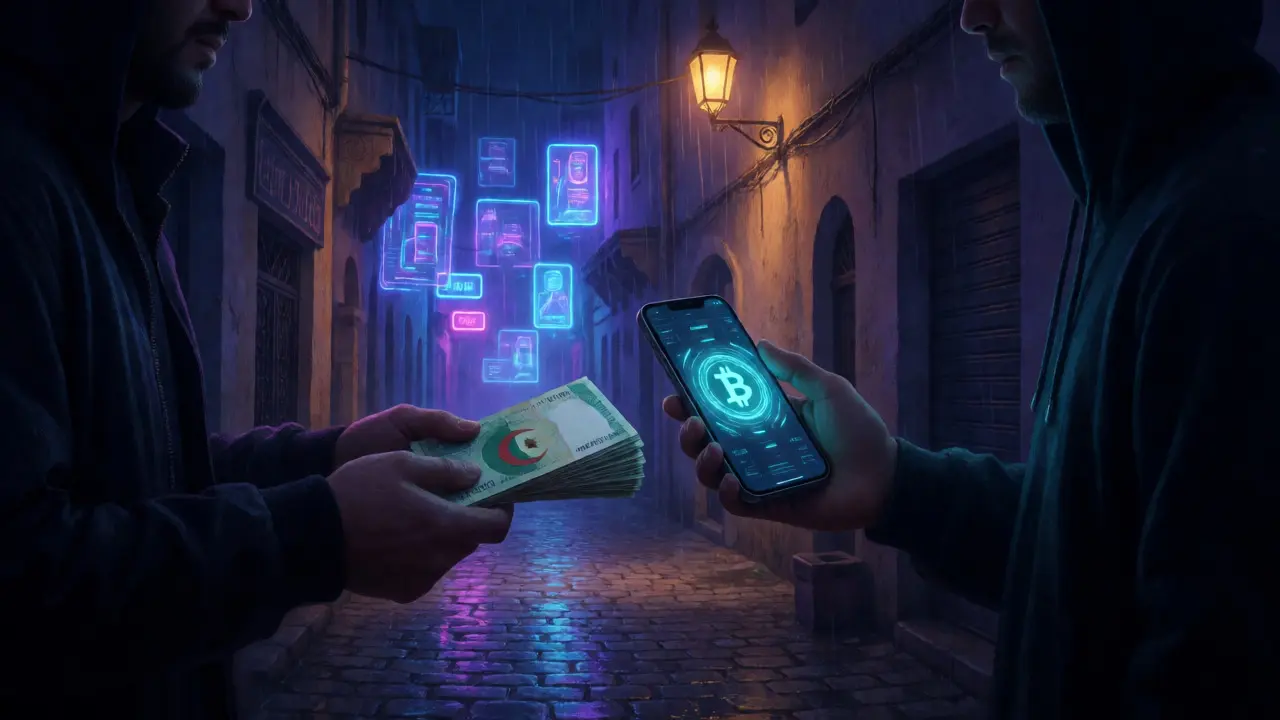
Imagine buying a coffee in Algiers and paying with Bitcoin, only to find out that the transaction itself is a crime punishable by prison time. That is the reality for Algerians since July 24, 2025. The government didn't just regulate cryptocurrency; they criminalized it entirely under Law No. 25-10. Yet, if you look closely at the streets of Oran or the digital chats of young entrepreneurs in Constantine, the money hasn't stopped moving. It has just gone underground.
This isn't about people ignoring the law out of rebellion alone. It's about economic survival. Before the ban, Algeria held one of the largest crypto markets in the Middle East and North Africa (MENA) region, according to a 2024 Chainalysis report. When you suppress a market that size, it doesn't vanish; it mutates. Today, we're looking at how this shadow economy functions, what risks traders face, and why the Algerian dinar's instability keeps pushing people toward digital assets despite the threat of jail.
The Legal Hammer: What Exactly Is Banned?
Let's be clear about the rules. This isn't a gray area where enforcement is lax. Article 6 bis of Law No. 25-10 explicitly lists eight categories of prohibited activities. If you are holding, buying, selling, mining, or even promoting crypto through content creation, you are technically breaking the law. The penalties are severe: first-time offenders can face up to one year in prison and fines ranging from 200,000 to 1 million Algerian dinars ($1,540 to $7,700). For repeat offenses, those fines can double, reaching up to 2 million dinars ($14,700).
| Offense Type | Potential Prison Time | Fine Range (DZD) | Fine Range (USD Approx.) |
|---|---|---|---|
| First-time Offense | Up to 1 year | 200,000 - 1,000,000 | $1,540 - $7,700 |
| Repeat Offense | Doubled penalties | 400,000 - 2,000,000 | $3,080 - $14,700 |
| Active Mining/Promotion | Varies by severity | High end of range | Up to $14,700+ |
The definition of "virtual currency" here is broad. It covers any instrument used as a means of exchange via computer systems without central bank backing. This includes everything from Bitcoin to Ethereum and stablecoins like USDT. The state's goal is clear: protect monetary sovereignty and prevent money laundering. But does banning the tool stop the need for it? History suggests no.
How the Underground Market Operates
If you can't walk into an exchange, how do you trade? The answer lies in decentralized, peer-to-peer (P2P) networks. The underground market in Algeria relies heavily on trust circles and encrypted communication channels. Think of it like the old-school hawala system, but digital. Users connect via Telegram groups or WhatsApp communities, often using pseudonyms to avoid detection.
Most transactions involve stablecoins, particularly USDT (Tether). Why? Because the Algerian dinar faces inflationary pressure, and the black market dollar rate is significantly higher than the official bank rate. People use USDT as a store of value and a medium of exchange to bypass these disparities. You might buy USDT from a local trader who accepts cash in hand, then send it to a friend abroad to pay for goods or services.
- P2P Cash Deals: Buyers meet sellers in person to exchange DZD for crypto. This avoids bank transfer trails but increases physical risk.
- International Exchanges: Some users still access platforms like Binance or KuCoin via VPNs, though this is risky due to IP tracking and KYC requirements.
- Privacy Coins: Monero (XMR) sees niche usage among tech-savvy traders who prioritize anonymity over liquidity.
The friction is real. Liquidity is lower, spreads are wider, and settlement times are slower. A trade that takes seconds in Dubai might take hours in Algiers because finding a trustworthy counterparty is hard. You aren't just paying for the asset; you're paying a premium for the risk of getting caught.

Risk vs. Reward: Why Keep Trading?
You might ask, "Why risk jail for a few percent profit?" For many Algerians, it's not about speculation anymore. It's about preserving wealth. With limited options for foreign currency exchange through official banks, crypto offers a lifeline. Freelancers working with international clients often receive payments in USD or EUR. Converting these funds through official channels can be slow and bureaucratic. Crypto allows them to move value quickly across borders.
However, the risks are multifaceted. Beyond legal prosecution, there is zero consumer protection. If you get scammed in a P2P deal, you can't go to the police. Reporting the theft means admitting you were engaged in illegal activity. Financial losses from hacks or platform failures are total write-offs. Furthermore, the psychological toll of constant vigilance-checking your phone for messages while watching your back-is significant.
Experts like Amir Haddadi, a North Africa-based fintech analyst, note that this approach stifles innovation. While the government aims to curb terrorism financing and fraud, critics argue it drives talent away. Young developers who could build blockchain solutions for local problems are leaving for Tunisia or Morocco, where regulations are more welcoming.

Enforcement and Future Outlook
Enforcement in Algeria remains opaque. There are few publicized arrests specifically for casual crypto holding, which suggests authorities may be targeting larger operations or visible promoters rather than every individual trader. However, the threat is enough to keep the market quiet. Social media chatter about crypto has dropped dramatically, not because interest died, but because posting about it could now be seen as "promotion," a criminal act.
Looking ahead, the sustainability of this ban is questionable. Technology evolves faster than legislation. As privacy tools improve and decentralized finance (DeFi) protocols become easier to use, the barrier to entry lowers. If the Algerian government doesn't adapt, they risk creating a parallel financial system that operates completely outside their oversight. We saw similar patterns in China after its 2021 ban: the market shrank initially, then stabilized in a smaller, more sophisticated underground layer.
For now, the underground crypto market in Algeria is a testament to human adaptability. It’s messy, risky, and expensive, but it persists because the demand for financial freedom outweighs the fear of punishment. Whether this leads to policy reform or stricter crackdowns depends on how much the state values control versus economic integration.
Is it illegal to own Bitcoin in Algeria?
Yes. Under Law No. 25-10 enacted in July 2025, the purchase, sale, use, and holding of virtual currencies are strictly prohibited. Mere possession constitutes a violation of the law.
What are the penalties for crypto trading in Algeria?
First-time offenders face up to one year in prison and fines between 200,000 and 1 million Algerian dinars. Repeat offenses result in doubled penalties, potentially reaching 2 million dinars in fines.
Can I use a VPN to trade crypto in Algeria?
While technically possible, using a VPN to access international exchanges is risky. It does not legalize the activity, and digital footprints can still lead to investigations. Most active traders prefer P2P methods to minimize digital traces.
Which cryptocurrency is most popular in the Algerian underground market?
Stablecoins, particularly Tether (USDT), dominate the underground market. They are preferred for their stability against the volatile Algerian dinar and their utility in cross-border transfers.
Why did Algeria ban cryptocurrencies?
The government cites concerns over money laundering, terrorism financing, uncontrolled speculation, and the protection of national monetary sovereignty. The ban aligns with recommendations from the Financial Action Task Force (FATF).