



CPChain (CPC) isn't just another crypto coin. It was built to solve a real problem: how do you let millions of smart devices - from security cameras to traffic sensors - share data safely, without relying on one company to control it all? The idea sounds simple, but the execution has been rough. Launched in 2018, CPC was meant to be the backbone of a decentralized Internet of Things (IoT), but today, it's struggling to stay relevant.
What CPChain Actually Does
Most blockchains handle money. CPChain handles data. It's designed to let IoT devices - like smart thermostats, factory sensors, or connected cars - record, store, and share information without a central server. Think of it like a shared notebook that every device can write in, but no one can erase or fake. That’s done by combining blockchain for trust, encryption for privacy, and distributed storage so data isn’t stuck on one company’s cloud.
The platform calls this the "chimney architecture" problem. Right now, most IoT systems are isolated. Your smart home device talks to one app. Your city’s traffic sensors talk to another. CPChain wants to connect them all on one open network. That means better traffic flow, smarter energy use, and more accurate weather predictions - if the system ever gets adopted.
How CPC Token Works
CPC is the fuel for this system. You don’t buy it to flip it like Bitcoin. You use it to pay for services on the CPChain network. For example:
- A factory pays CPC to store sensor data from its machines
- A city pays CPC to let traffic cameras share real-time footage with public transit systems
- A farmer pays CPC to let soil sensors upload data to a shared weather model
It’s an ERC-20 token, meaning it runs on the Ethereum blockchain. That gives it stability - Ethereum’s network is huge and secure - but it also means CPC depends on Ethereum’s fees and speed. If Ethereum gets slow or expensive, CPChain feels it too.
Total supply is 1 billion CPC. As of late 2025, about 407 million are in circulation. That leaves a lot of tokens still locked up, possibly for future network rewards or development funds.
Price History and Market Reality
CPChain had a wild start. In early 2018, it hit an all-time high of $0.57. That was during the last crypto boom. Today, it trades around $0.0003 to $0.00055 - a drop of over 99.9%. That’s not a dip. That’s a collapse.
Here’s what that looks like in real terms:
- On February 10, 2018: 1 CPC = $0.571
- On December 5, 2024: 1 CPC = $0.000132 (all-time low)
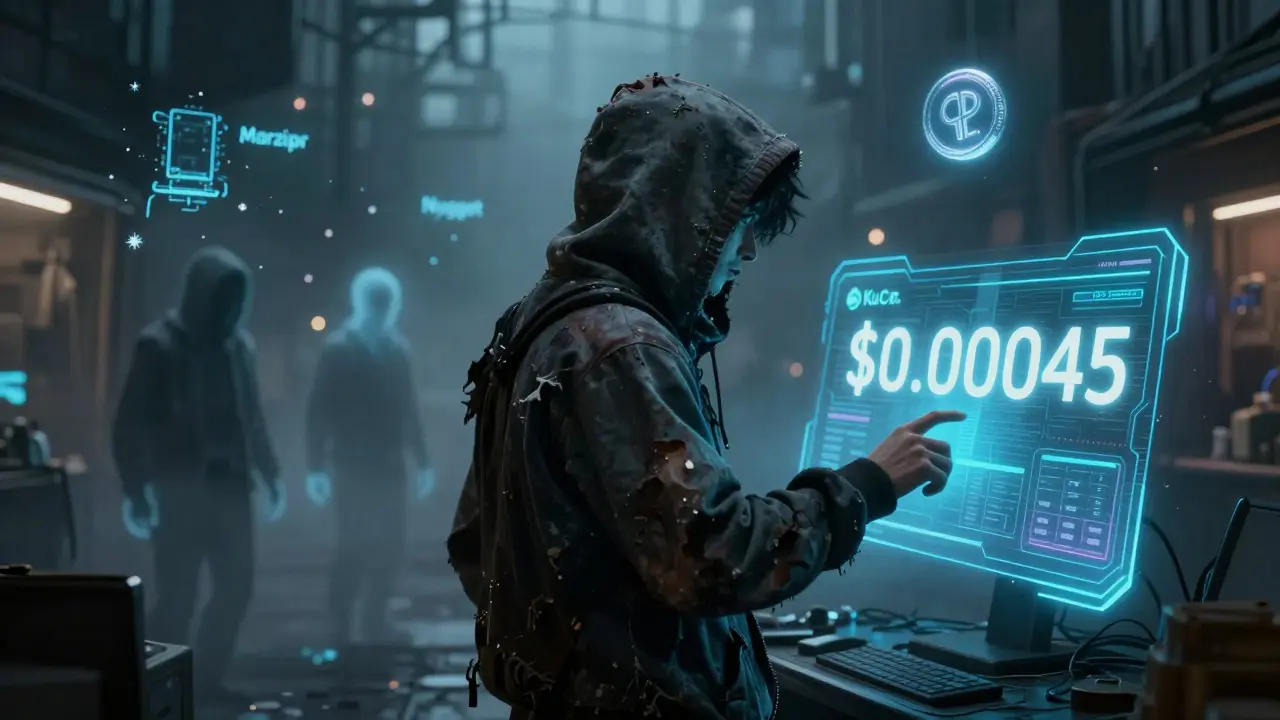
- As of February 2026: 1 CPC ≈ $0.00045
Market cap numbers vary wildly. CoinMarketCap says it’s $0. BeInCrypto says $223K. WorldCoinIndex says $124K. Why the gap? Because there’s almost no trading. CoinMarketCap recorded $0 in 24-hour volume. That means almost no one is buying or selling CPC right now.
Only about 8,550 wallet addresses hold CPC. Compare that to Bitcoin’s millions. This isn’t a dead coin - it’s a barely alive one.
Where You Can Buy and Store CPC
If you still want CPC, your best bet is KuCoin. It’s the only exchange with consistent trading activity. You’ll need to:
- Create a KuCoin account
- Complete KYC (identity verification)
- Deposit ETH, USDT, or another supported coin
- Trade it for CPC
Storage options are standard:
- Custodial wallets (on KuCoin or other exchanges) - easy, but you don’t control keys
- Self-custody wallets (MetaMask, Trust Wallet) - you control the private keys
- Hardware wallets (Ledger, Trezor) - safest for long-term holding
- Paper wallets - offline, print-and-store method
Don’t store CPC on a platform that doesn’t support ERC-20 tokens. It could get lost forever.
Who’s Behind CPChain?
The project was founded by a team with ties to Shanghai Jiao Tong University. That’s a respected school in China, known for engineering and AI research. Their whitepaper is still online, laying out a vision for decentralized IoT data markets.
The ecosystem includes projects like:
- Marzipr - data marketplace for IoT sensors
- Nuggets - identity and access control layer
- Hyperion - decentralized infrastructure for edge computing
- Chain News - blockchain-focused news platform
But here’s the problem: none of these projects have gained real traction. There are no public case studies. No major companies have announced partnerships. No smart cities have rolled out CPChain-based systems. The GitHub repo shows minimal updates in the last two years. The Telegram group has fewer than 50 active users.
Why CPChain Isn’t Working (Yet)
There are three big reasons:
1. Too niche, too late. IoT blockchain projects like IOTA, Helium, and IoTeX got more funding, more attention, and more real-world tests. CPChain never caught up.
2. No incentive to use it. Why would a factory pay in CPC when AWS or Azure offers cheaper, easier data storage? CPChain hasn’t proven it’s faster, cheaper, or more secure.
3. Zero marketing. There are no ads. No influencer campaigns. No press releases. The website looks outdated. The team is silent. When a project disappears from public view, it’s not a technical issue - it’s a trust issue.
Is CPChain Worth Anything?
Technically? Yes. The idea is solid. Decentralized IoT data sharing is a real need. The tech stack - blockchain + encryption + distributed storage - makes sense.
Practically? No. The token is worth almost nothing. The network is inactive. The community is gone. The team hasn’t shared updates in years.
If you’re looking to invest, CPC is a high-risk, low-reward bet. If you’re curious about IoT blockchain, look at projects with live deployments, not just whitepapers.
CPChain’s story isn’t over. But right now, it’s a ghost. A once-promising idea buried under market indifference.
Is CPChain (CPC) a good investment?
As of early 2026, CPC is not a good investment. The token has lost over 99.9% of its peak value, trades with near-zero volume, and has no active development or partnerships. There’s no clear path to recovery. Only speculative traders might consider it, and even then, it’s extremely risky.
Can I use CPC to pay for IoT services today?
No. While CPChain was designed to let devices pay for data services using CPC, there are no known real-world implementations. No factories, cities, or companies are currently using CPC to transact. The ecosystem remains theoretical.
Where is CPC listed?
CPC is primarily traded on KuCoin. A few smaller exchanges may list it, but trading volume is negligible. Most major platforms like Binance, Coinbase, and Kraken do not support CPC. Always verify the listing before trading.
Is CPChain built on its own blockchain?
No. CPChain is an ERC-20 token built on the Ethereum blockchain. This means it inherits Ethereum’s security and network effects, but also its limitations - like high gas fees and slower transaction speeds during congestion. It does not have its own consensus mechanism or native blockchain.
Why did CPChain’s price crash so hard?
The crash was caused by multiple factors: lack of adoption, competition from better-funded IoT blockchain projects, no clear use cases, minimal development activity, and the broader crypto bear market. After its 2018 peak, the project failed to deliver on its promises, leading investors to lose confidence and exit.
Can I mine CPC?
No. CPC is an ERC-20 token and cannot be mined. All tokens were pre-mined and distributed through sales, team allocations, and ecosystem incentives. There is no mining or staking mechanism for CPC.
What’s the future of CPChain?
Without public updates, new partnerships, or development activity, the future of CPChain is uncertain. The concept still has merit, but the project has been dormant for years. Unless the team re-emerges with a clear roadmap and real-world pilot projects, CPChain will likely remain a footnote in crypto history.


Comments
17 Comments
Elana Vorspan
I love how CPChain tried to solve IoT data sharing but got lost in the noise. 🌱 I mean, the idea is beautiful - decentralized sensor networks? Yes please. But no one’s using it because it’s not *fun* to use. We need more UX love, not just whitepapers. Maybe if they made a TikTok explainer, people would care. 😅
Kenneth Genodiala
The notion that a blockchain-based IoT data marketplace could compete with AWS or Azure is not just naive - it’s a fundamental misunderstanding of scale, economics, and infrastructure. This isn't a technical problem. It's a delusional one.
Michael Rozputniy
You ever notice how every 'decentralized' project gets bought by a Chinese university or state-linked entity? CPChain? Shanghai Jiao Tong? Coincidence? Or is this just the PLA’s quiet way of collecting sensor data under the guise of 'IoT innovation'? 🤔 I’ve seen this pattern before - always ends in surveillance.
Danny Kim
So… we’re supposed to be impressed that this thing runs on Ethereum? That’s like saying your horse-drawn carriage is 'electric' because it’s painted blue. The token’s dead. The devs are gone. The GitHub repo hasn’t been touched since Trump was president. The only thing alive is the irony.
Cathy Sunshine
It’s tragic. The architecture was elegant - a symphony of encryption, distributed storage, and blockchain trust. But capitalism doesn’t reward elegance. It rewards visibility. And CPChain? It never learned to scream. It whispered into a hurricane and expected to be heard. Now it’s just… static. 🖤
Shannon Black
In many Asian economies, especially in Southeast Asia, the concept of decentralized data sovereignty is gaining traction. While CPChain may have faltered in the West, there are emerging regional initiatives in Vietnam and Indonesia that are adapting similar frameworks - with local governance models. The idea wasn't wrong. The execution was too Western-centric.
Richard Cooper
cpc is dead. no one cares. kucoin is the only place left. even the devs stopped replying. its like a ghost town. just move on.
Dee Resin
I swear, every time someone says 'the tech is sound' about a dead crypto project, I die a little inside. The tech is never the issue. It’s always the people. No hustle. No hype. No heart. Just a GitHub repo collecting dust like a forgotten birthday card.
Tanvi Atal
This is why crypto fails. Too much theory. No real users. No revenue. No product. Just a token with a fancy name. I told you all this would happen.
Sony Sebastian
The ERC-20 dependency is the fatal flaw. Layer 2 solutions like Polygon or Arbitrum could have saved it, but they didn’t even attempt interoperability. CPChain was a monolithic monstrosity built on a shaky foundation. The team lacked architectural maturity. This is not a failure of market conditions - it’s a failure of engineering discipline.
Brian Lemke
Look - I know it’s bleak, but I still believe in the vision. Decentralized IoT isn’t dead. It’s just sleeping. CPChain didn’t fail because the idea was bad. It failed because no one gave it a fighting chance. Imagine if a startup had funded 10 pilot cities with real sensors, not just whitepapers. We’d be talking about this differently. Don’t bury it - revive it. 💪🌍
Megan Lavery
Honestly? I kinda miss when crypto felt like a wild experiment. CPChain was one of those weird, beautiful ideas that made you go 'huh, that’s actually kinda cool.' Now it’s just a sad chart on CoinMarketCap. I hope someone picks it up. It deserves better.
christopher luke
i still hold cpc just because i believe in the dream 🤞 maybe one day it’ll wake up. or maybe i’m just the last person at the party holding a half-empty cup. either way, i’m not letting go. 🌟
Mary Scott
cpc is a trap. theyll pump it again. then vanish. mark my words. this is a honeypot. dont touch it. the team is already in the car with the money.
Shannon Holliday
I just wish someone had made a cute animated video explaining how CPChain could help farmers in rural India. 🌾📱 That’s the kind of storytelling that moves markets. Not whitepapers. Not GitHub commits. Just a simple story with a smiling farmer and a sensor. That’s how change starts.
Jeremy buttoncollector
The chimneys of IoT are not merely isolated - they are cathedral-like monoliths of proprietary control. CPChain’s architectural critique was ontologically sound - yet epistemologically unmoored from capital’s gravitational pull. The blockchain was never the solution. It was the symptom. We are not building networks. We are ritualizing data.
Michelle Xu
While CPChain may have failed to gain traction, its underlying framework remains one of the most technically rigorous approaches to decentralized IoT data exchange. The use of homomorphic encryption for privacy, combined with sharded distributed storage, was ahead of its time. The issue was not technical - it was organizational. Without a clear governance model and phased rollout strategy, even brilliant architecture collapses under its own weight. This is a case study in innovation without implementation.
Write a comment