


You might have heard the name Worken or seen the ticker WORK floating around crypto forums. But what exactly is it? Is it another speculative meme coin, or does it have a real job to do? Here’s the short answer: Worken is a cryptocurrency designed specifically for the Paidwork platform, a massive freelance and micro-task site with over 15 million users. It’s not just a token you trade; it’s the currency used to pay people for doing small digital tasks.
If you are looking for a quick summary before diving into the details, here are the key takeaways:
- Utility First: WORK is the native payment asset for Paidwork, allowing freelancers to earn and withdraw funds instantly.
- Deflationary Model: Every time a user withdraws earnings from Paidwork, a portion of WORK tokens is burned, reducing total supply.
- Solana Based: The token runs on the Solana blockchain, ensuring low fees and fast transaction speeds.
- Fixed Supply: The total maximum supply is capped at 100,000,000 WORK.
- Micro-Cap Status: As of late 2026, it remains a niche asset with very low market capitalization and trading volume compared to major coins.
The Core Concept: Connecting Freelancers and Blockchain
Think about how hard it is to get paid quickly when you do small online tasks. Traditional banking transfers can take days, and payment processors often charge high fees that eat into small earnings. This is the problem Paidwork tries to solve using a blockchain-based payment system. Launched in 2023, Worken was introduced as the bridge between traditional gig work and modern crypto infrastructure.
The idea is simple but effective. Users complete daily tasks on the Paidwork website-things like watching videos, taking surveys, or testing apps. Instead of waiting for a PayPal transfer or a bank wire, they can choose to receive their rewards in WORK tokens. Because these transactions happen on the Solana network, the settlement is nearly instantaneous. You finish a task, click withdraw, and the WORK hits your wallet in seconds. This speed is crucial for the gig economy, where cash flow matters more than long-term investment potential for many workers.
But why use a crypto token instead of just paying in dollars? For Paidwork, integrating WORK creates a closed-loop ecosystem. It encourages users to hold onto the token rather than immediately converting it to fiat currency. If you hold WORK, you are technically an investor in the platform’s success. If the platform grows and more people withdraw tokens, the burn mechanism kicks in, potentially increasing scarcity.
Tokenomics: How the Deflationary Burn Works
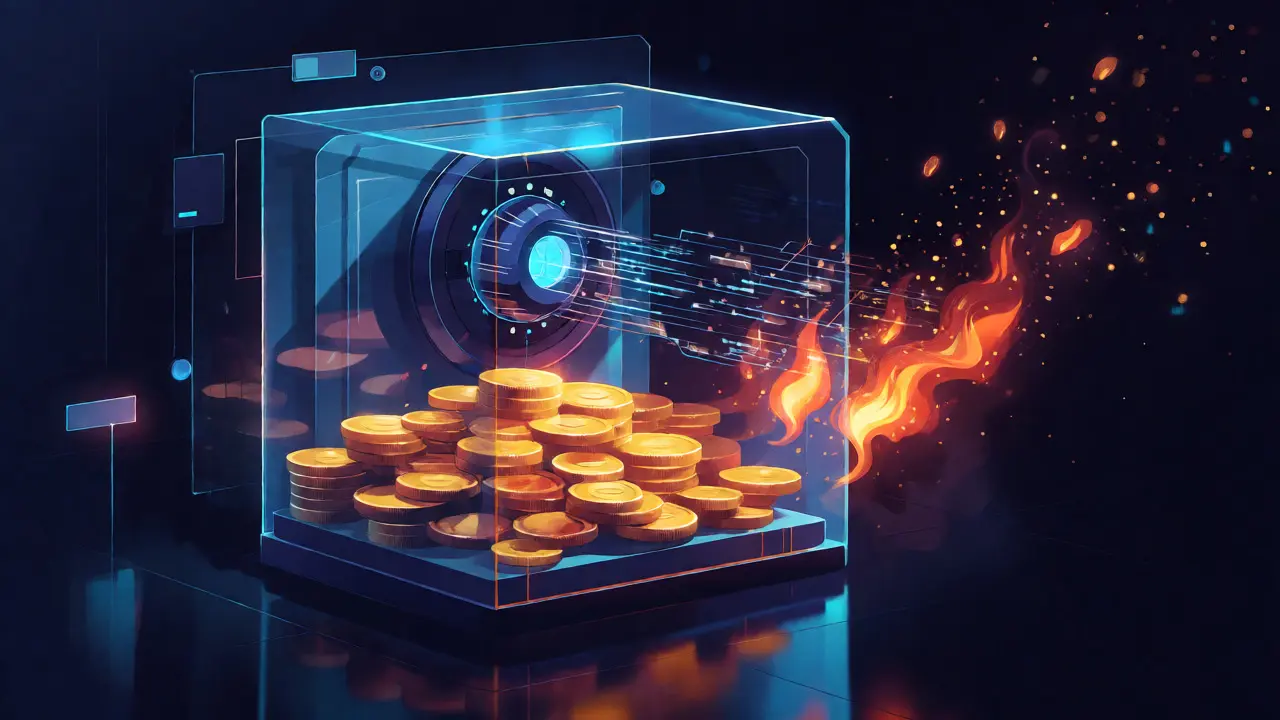
Most cryptocurrencies have inflationary models where new coins are minted over time. Worken flips this script. It operates on a fixed supply model with a hard cap of 100,000,000 WORK tokens. No new tokens will ever be created beyond this number. But the project goes a step further by actively removing tokens from circulation through a process called "burning."
Here is how the burn mechanism functions in practice. Whenever a user withdraws their earnings from the Paidwork platform, a specific percentage of those withdrawn WORK tokens is permanently destroyed. This isn’t a manual event done once a year; it happens automatically with every single withdrawal. The logic is straightforward: higher platform activity leads to more withdrawals, which leads to more burns, which reduces the circulating supply.
| Metric | Value / Description |
|---|---|
| Total Supply | 100,000,000 WORK (Hard Cap) |
| Blockchain | Solana (Proof-of-Stake) |
| Burn Mechanism | Automatic burn on every Paidwork withdrawal |
| Primary Use Case | Freelance payouts and micro-transactions |
| Staking | Available for governance and reward participation |
This deflationary design aims to support the token's value over time. If demand for Paidwork services increases while supply shrinks due to burns, basic economic principles suggest price pressure could move upward. However, it’s important to note that the exact percentage burned per withdrawal isn't always publicly detailed in simple terms, and the impact depends entirely on user adoption. If only a tiny fraction of Paidwork’s 15-17 million registered users opt for WORK payouts, the burn rate will remain negligible.
Technical Infrastructure: Why Solana?
Worken didn’t launch on Ethereum, despite its popularity. It chose Solana for good reason. When you are dealing with micro-payments-earnings that might be worth $0.50 or $1.00-you cannot afford transaction fees (gas fees) of $5 or $10. Ethereum’s congestion issues make it impractical for frequent, low-value transfers.
Solana offers high throughput and sub-second finality. This means the network can handle thousands of transactions per second without clogging up. For a platform like Paidwork, where thousands of users might withdraw simultaneously after finishing their daily tasks, this scalability is non-negotiable. Additionally, Solana’s Proof-of-Stake consensus mechanism ensures that the network remains energy-efficient and secure without requiring heavy mining hardware.
The token interacts primarily with decentralized exchanges (DEXs) within the Solana ecosystem, such as Raydium. This allows users to swap their earned WORK for other assets like SOL or USDC directly from their wallets. While there have been periods where wrapped versions of WORK appeared on Ethereum-based DEXs like Uniswap V2, the core utility and liquidity reside on Solana.
Market Performance and Liquidity Challenges
Let’s talk numbers, because this is where reality checks hit hard. Worken is a micro-cap asset. In early 2025 and throughout 2026, its price has hovered in the fractions of a cent range. Data from various trackers shows prices fluctuating between $0.00012 and $0.0002 USD. At one point in May 2024, it saw a spike to around $0.037 USD, likely driven by speculative hype rather than fundamental changes, but it quickly corrected back down.
Liquidity is another critical factor. Unlike Bitcoin or Ethereum, you won’t find deep order books for WORK on major centralized exchanges like Binance or Coinbase. These platforms track the price but often don’t offer direct spot trading pairs for WORK. Most trading activity occurs on smaller DEXs. Consequently, daily trading volumes can swing wildly-from a few hundred dollars to perhaps $15,000 on active days. This low liquidity means large buy or sell orders can significantly impact the price, creating volatility that scares off institutional investors.
Furthermore, there is significant confusion regarding data accuracy. Some aggregators list the circulating supply as zero or show a market cap of $0, not because the token doesn’t exist, but because the project hasn’t fully integrated with those APIs or provided verified on-chain data. Always cross-reference multiple sources like CoinGecko, CoinMarketCap, and Bitget to get a clearer picture, though even these sites may lag behind real-time on-chain metrics.

How to Buy and Store Worken (WORK)
If you want to acquire WORK, you generally cannot just credit card purchase it directly from a major exchange. The typical path involves a few steps. First, you need a Solana-compatible wallet, such as Phantom or Solflare. Next, you’ll need to buy some SOL (Solana’s native token) on a centralized exchange like Coinbase or Binance and send it to your wallet.
Once you have SOL in your wallet, you head to a decentralized exchange like Raydium. There, you can swap your SOL for WORK using the WORK/SOL pair. Be mindful of slippage settings. Since liquidity is thin, setting a higher slippage tolerance (e.g., 1-2%) might be necessary to ensure your transaction goes through. After swapping, your WORK tokens will appear in your wallet, ready to be sent back to Paidwork for staking or held for speculation.
Storage is straightforward since it’s an SPL token (the Solana equivalent of ERC-20). You don’t need a separate blockchain explorer; standard Solana wallets handle it seamlessly. Just remember that holding crypto comes with risks. If the Paidwork platform faces regulatory hurdles or technical failures, the token’s primary use case disappears, potentially crashing its value.
Risks and Considerations
Before jumping in, consider the specific risks tied to Worken. First, it is heavily dependent on a single entity: Paidwork. If Paidwork loses its user base or decides to switch to a different payment method, WORK loses its intrinsic utility. Second, the competition in the "crypto-for-gig-work" space is fierce. Other projects offer similar solutions, and none have achieved mass mainstream adoption yet.
Additionally, keep an eye out for ticker confusion. Several unrelated projects use the symbol "WORK," including "The Employment Commons" and "Work X." Ensure you are interacting with the correct contract address associated with Paidwork on Solana. Misidentifying the token could lead to buying the wrong asset.
Finally, regulatory uncertainty looms over all crypto payments. Tax laws regarding earning income via cryptocurrency vary by country. In Canada, for instance, receiving crypto for services is treated as business income, subject to tax upon receipt. Users should consult local tax professionals before relying on WORK as their primary payout method.
Is Worken (WORK) a good investment?
It depends on your risk tolerance. Worken is a high-risk, high-reward micro-cap asset. Its value is tightly linked to the growth of the Paidwork platform. If Paidwork continues to attract millions of users who opt for crypto payouts, the deflationary burn could drive value up. However, low liquidity and dependence on a single platform make it volatile and risky for conservative investors.
Can I buy WORK directly with a credit card?
Generally, no. Most major centralized exchanges do not list WORK for direct fiat-to-crypto purchases. You typically need to buy Solana (SOL) first, transfer it to a Web3 wallet, and then swap it for WORK on a decentralized exchange like Raydium.
What makes Worken different from other freelance tokens?
Its integration with Paidwork’s massive existing user base (15-17 million users) and its automatic deflationary burn mechanism triggered by withdrawals set it apart. Many other tokens rely solely on speculation, whereas WORK has a built-in utility loop within a functioning gig-economy platform.
Is Worken built on Ethereum?
No, Worken is primarily built on the Solana blockchain. This choice allows for faster transactions and lower fees, which are essential for micro-payments. While wrapped versions may have existed on other chains, the native token lives on Solana.
How does the burning mechanism affect my holdings?
Burning reduces the total supply of WORK tokens. If demand stays constant or increases while supply decreases, the theoretical value per token rises. However, this effect is gradual and depends entirely on the volume of withdrawals occurring on the Paidwork platform.