


Imagine proving you are over 21 without showing your driver's license. Or verifying your medical degree to a new employer without sending a scanned PDF that could be faked. This is the promise of blockchain-based identity verification. It shifts control from massive corporate databases back to you. Instead of trusting a central server with your secrets, you hold the keys. The system uses cryptography to prove facts about you-like your age or qualifications-without revealing unnecessary personal details. This approach solves the biggest problem in digital life today: data breaches. When centralized servers get hacked, millions of records vanish into the dark web. With blockchain, there is no single target to hack. Your identity is fragmented, encrypted, and distributed.
What Is Blockchain-Based Identity Verification?
Blockchain-based identity verification is a decentralized method for authenticating individuals using distributed ledger technology to ensure security, transparency, and user autonomy. To understand it, you first need to unlearn how traditional identity works. Currently, if you want to prove who you are online, you usually create an account on a website. That site stores your name, email, and password in its database. You trust them to keep it safe. If they fail, your identity is compromised. Blockchain flips this model. It creates a Self-Sovereign Identity (SSI) system. In SSI, you are the administrator of your own data. You store proof of your identity in a digital wallet on your phone. When a service needs to verify you, they ask your wallet for proof. Your wallet provides a cryptographic signature that confirms the information is true, issued by a trusted source, but doesn't expose your raw data.
The Core Components: DIDs and Verifiable Credentials
You cannot build this system without two specific technical standards defined by the World Wide Web Consortium (W3C). These are the building blocks that make different systems talk to each other.
- Decentralized Identifiers (DIDs): Think of a DID as a unique username that exists independently of any company. Unlike an email address owned by Google or Yahoo, a DID is generated by you. It points to a public key stored on the blockchain. No one can cancel your DID unless you lose your private key. It is permanent and portable across platforms.
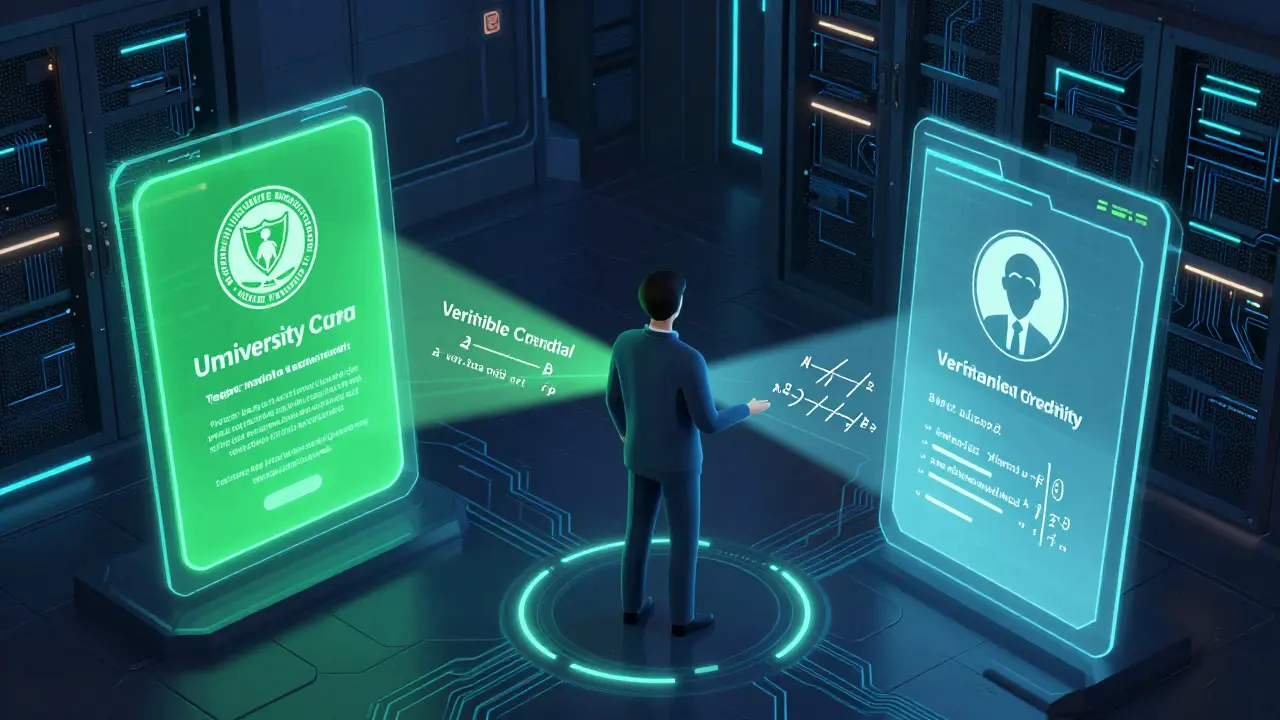
- Verifiable Credentials (VCs): These are digital versions of physical documents. A university issues a VC for your diploma. A government issues a VC for your passport. These credentials are digitally signed by the issuer. Because the signature is tied to the issuer's public key on the blockchain, anyone can verify that the credential is genuine and hasn't been altered, without calling the university or government agency.
Together, these components allow for zero-knowledge proofs. This is a cryptographic method where you can prove a statement is true without revealing the underlying data. For example, you can prove you are over 18 without revealing your exact birthdate. You prove you have a valid license without revealing your home address. This minimizes the data footprint and reduces privacy risks significantly.
How the Verification Process Actually Works
Let’s walk through a real-world scenario. You are applying for a high-security job. The employer needs to verify your professional certifications.
- Issuance: Years ago, when you earned your certification, the issuing body sent a Verifiable Credential to your digital wallet. They signed it with their private key. You now hold this credential securely on your device.
- Request: The employer sends a request to your wallet asking for proof of certification. They specify exactly what they need to see.
- Verification: Your wallet checks the request. You approve it. The wallet retrieves the credential and generates a response. It does not send the original file. Instead, it sends a mathematical proof that links your DID to the credential and confirms the issuer's signature is valid.
- Validation: The employer’s system checks the blockchain. It sees that the issuer’s public key matches the signature on your credential. It confirms the credential hasn’t been revoked. The process takes seconds, not days.
Notice that at no point did the employer store your personal data in a vulnerable database. They only received a "yes" or "no" answer backed by immutable math. This flow eliminates the need for manual background checks and reduces fraud because the credential cannot be forged without the issuer's private key.
| Feature | Traditional Centralized System | Blockchain-Based System |
|---|---|---|
| Data Storage | Centralized servers (honeypots for hackers) | Distributed ledger + off-chain secure storage (IPFS) |
| User Control | None; provider owns data | Full control; user holds private keys |
| Privacy Level | Low; full document sharing required | High; selective disclosure and zero-knowledge proofs |
| Fraud Resistance | Moderate; relies on internal security | High; cryptographic signatures prevent forgery |
| Portability | Low; locked into specific platforms | High; works across any compatible verifier |
Security Architecture and Data Privacy
A common misconception is that all your personal data sits on the blockchain. It doesn’t. And it shouldn’t. Storing sensitive data like Social Security numbers or medical records directly on a public ledger would be a privacy disaster. Instead, blockchain identity systems use a hybrid approach. The actual documents or biometric hashes are stored off-chain, often in secure decentralized storage solutions like IPFS (InterPlanetary File System) or private cloud environments. Only a cryptographic hash-a unique fingerprint of that data-is written to the blockchain.
This architecture ensures immutability without exposing content. If someone tries to alter your stored document, the hash changes. The blockchain immediately flags the mismatch because the stored hash no longer matches the presented data. Furthermore, access is controlled via asymmetric encryption. You generate a pair of keys: a private key (which you keep secret) and a public key (shared openly). Only you can sign transactions with your private key. Anyone can verify that signature using your public key. This means even if the blockchain network is monitored, no one can impersonate you or read your encrypted off-chain data without your explicit permission.
Real-World Adoption and Industry Use Cases
This technology is moving beyond theory. Several sectors are already piloting or deploying these solutions due to the high cost of fraud and identity theft.
- Financial Services: Banks use blockchain identity for Know Your Customer (KYC) processes. Traditionally, every time you open an account at a new bank, you repeat the same verification steps. With shared blockchain identity, you verify once. Other banks can instantly verify your status without re-collecting documents. IBM and Consensys have led significant implementations here, reducing onboarding time from weeks to minutes.
- Healthcare: Patient records are notoriously siloed. Blockchain allows patients to carry their medical history securely. Doctors can access verified records with patient consent, improving emergency care coordination. Dock.io has demonstrated cases where patient onboarding time dropped from 45 minutes to under five minutes.
- Government Services: Estonia was an early adopter, integrating blockchain into its e-residency program. Citizens control access to their tax, health, and legal records. Recent pilots show high satisfaction rates regarding data control, though initial setup complexity remains a hurdle for non-tech-savvy users.
Market growth reflects this utility. The sector expanded from $0.87 billion in 2021 to $1.84 billion in 2023. Projections suggest it will reach $17.24 billion by 2030. This isn't just hype; it's driven by regulatory pressures like GDPR and the rising cost of identity fraud, which costs businesses billions annually.

Challenges and Limitations
Despite the benefits, blockchain identity is not a magic bullet. There are significant friction points that developers and organizations must navigate.
Key Management Complexity: The biggest risk falls on the user. In a centralized system, you click "Forgot Password" and reset via email. In a blockchain system, if you lose your private key, you lose your identity. There is no admin to call. Solutions like social recovery (where trusted friends help restore access) are emerging, but they add complexity. A PreciseHire survey found that 28% of enterprise users cited key management as their top challenge.
Regulatory Uncertainty: Laws vary wildly by region. The European Union’s eIDAS 2.0 framework actively supports digital wallets and blockchain identity. However, other jurisdictions lack clear guidelines. Compliance with data protection laws like GDPR is tricky because GDPR includes the "right to be forgotten," while blockchain is designed to be immutable. Developers solve this by keeping data off-chain and deleting the off-chain data upon request, leaving only an empty hash on-chain, but legal interpretations remain unsettled.
Interoperability Standards: While W3C standards exist, implementation varies. Not all wallets talk to all verifiers smoothly. Companies like Microsoft (with ION), IBM, and Civic Technologies are building their own ecosystems. Until universal adoption occurs, users may face fragmented experiences.
Future Outlook: AI and DeFi Integration
The next phase of blockchain identity involves deeper integration with other technologies. Artificial Intelligence is being layered onto identity systems to detect anomalies in real-time. For instance, AI can analyze behavioral patterns during a login attempt to confirm it’s the legitimate user, adding a dynamic layer to static cryptographic proofs. Additionally, the convergence with Decentralized Finance (DeFi) is accelerating. As more financial services move on-chain, having a verified, yet private, identity becomes crucial for accessing loans, insurance, and investments without undergoing repetitive KYC checks. By 2025, nearly 80% of blockchain identity providers plan to integrate with DeFi protocols. This suggests that within a few years, your digital identity might be as essential as your credit score, but fully owned and controlled by you.
Is my personal data stored on the blockchain?
No. Best practices dictate that sensitive personal data should never be stored directly on the blockchain due to its immutable nature. Instead, only cryptographic hashes (digital fingerprints) of your data are stored on-chain. The actual data resides in secure off-chain storage, such as your device or encrypted cloud services. This ensures privacy while maintaining verifiability.
What happens if I lose my private key?
Losing your private key traditionally means losing access to your identity permanently, as there is no central authority to reset it. However, modern solutions implement "social recovery" mechanisms. This allows you to designate trusted contacts (guardians) who can collectively help restore access to your wallet if you lose your primary key, balancing security with usability.
How is blockchain identity compliant with GDPR?
GDPR compliance is achieved through architectural design. Since personal data is stored off-chain, it can be deleted upon user request, satisfying the "right to be forgotten." The on-chain hash remains, but without the associated off-chain data, the hash is useless to anyone. Additionally, users maintain explicit control over who accesses their data, aligning with GDPR’s consent requirements.
Can blockchain identity replace passports?
Not entirely yet, but it complements them. Digital identities based on blockchain can serve as verified digital twins of physical passports. Some countries are testing mobile driving licenses (mDL) and digital IDs that link to physical documents. While border control still requires physical presence, blockchain can streamline visa applications, customs declarations, and domestic travel verification.
Who are the major players in blockchain identity?
Key players include tech giants like IBM (with Hyperledger Indy/Aries) and Microsoft (with ION), as well as specialized firms like Dock.io, Civic Technologies, and 1Kosmos. Governments also play a role, with Estonia leading in national implementation. These entities provide the infrastructure, wallets, and verification tools necessary for the ecosystem to function.