




Imagine you are sitting in a small rowboat on a calm lake. Suddenly, a massive cruise ship sails past nearby. The wake it creates doesn't just ripple; it slams into your boat, tossing you around whether you like it or not. In the world of Cryptocurrency, this cruise ship is known as a whale. These are individuals or entities holding such vast amounts of digital assets that their every move sends shockwaves through the market. For the average trader, understanding whale activity isn't just interesting trivia-it is the difference between profiting from a trend and getting wiped out by one.
Who Exactly Are the Crypto Whales?
The term "whale" didn't start in crypto. It came from traditional finance, where big players were called whales because they could swallow up entire markets. When Bitcoin started gaining traction around 2013 and 2014, traders adopted the term. Today, a crypto whale is anyone with enough coins to influence the price simply by buying or selling.
Just how concentrated is this power? According to analysis from Bitstamp in 2023, roughly 40% of all Bitcoin is stored in fewer than 2,000 wallets. That means a tiny fraction of users control a huge chunk of the supply. This extreme concentration gives these holders outsized influence. They aren't just participants; they are market makers in the truest sense.
It is important to distinguish between different types of whales. Some are long-term investors who buy and hold for years. Others are institutional funds rebalancing portfolios. Then there are the active traders who use their size to manipulate prices for short-term gains. Not all whale activity is malicious, but all of it carries weight.
How Whales Manipulate Prices
Whales don't just click "buy" and walk away. They use specific tactics to move the needle without spending more than necessary. Understanding these methods helps you spot when a move is genuine and when it is a trap.
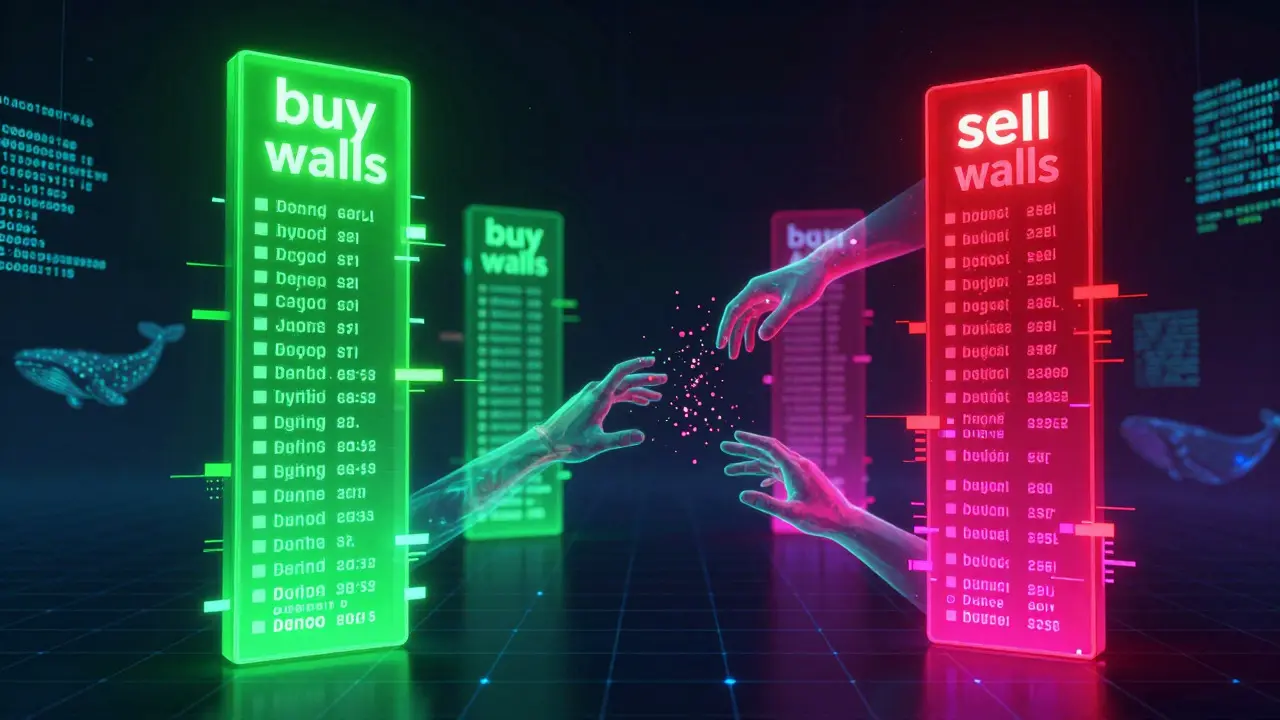
- Buy Walls and Sell Walls: A whale places a massive limit order far from the current price. A huge buy wall makes it look like demand is high, encouraging others to buy and push the price up so the whale can sell higher. Conversely, a sell wall suppresses the price, allowing the whale to accumulate cheap coins before pulling the wall and letting the price recover.
- Spoofing: This is a form of deception. A whale places a large order to create panic or FOMO (Fear Of Missing Out) but cancels it right before it executes. CoinLedger documented this in 2023 as a common tactic to trigger stop-loss orders from smaller traders.
- Wash Trading: Here, a whale buys and sells an asset to themselves or through affiliated accounts. This artificially inflates trading volume, making the coin look popular and liquid. It tricks algorithms and retail investors into thinking there is organic interest.
- FUD Campaigns: False, Uncertain, and Doubtful information spread via social media can drive prices down. Whales often coordinate these narratives to dump their holdings at lower prices while retail traders panic-sell.
These techniques exploit the thin liquidity found in many crypto markets. When a whale executes a large market order, they consume the available orders on the book. If the book is shallow, the price crashes instantly. This can trigger cascading stop-losses, amplifying the drop far beyond the initial trade.
The Real-World Impact: Case Studies
Theory is one thing; seeing the money move is another. Let's look at concrete examples of how whale activity plays out in real time.
In August 2023, a prominent figure named Huang Licheng reduced his holdings of XPL tokens by 700,000 units. At the time, this was worth about $1 million. While that might sound small compared to Bitcoin's market cap, XPL is a smaller token. The result? The price swung wildly between $1.12 and $1.50 within minutes. Huang himself suffered an $8 million unrealized loss during the volatility, proving that even whales can get hurt by their own actions if the market reacts unpredictably.
Then there is the March 2020 COVID crash. Analysis by OneSafe showed that coordinated shorting by whales contributed significantly to the drop in Bitcoin and Ethereum prices. This wasn't just panic selling; it was strategic positioning that led to billions in liquidations across the market. On the flip side, some whales used those dips to stabilize prices temporarily, showing that whale activity is a double-edged sword.
| Market Type | Daily Volume Threshold | Vulnerability Level | Common Tactics |
|---|---|---|---|
| Bitcoin / Ethereum | $20 Billion+ | Low to Moderate | Futures positioning, Spot accumulation |
| Mid-Cap Altcoins | $50 Million - $200 Million | Moderate to High | Spoofing, Social media pumps |
| Small-Cap Tokens | < $50 Million | Very High | Rug pulls, Wash trading, Direct dumping |
As the table shows, context matters. A single transaction moving 5% of daily volume can shift a small-cap token's price by 10-15% in minutes. In Bitcoin, you need hundreds of millions in movement to see similar percentage changes.
Tracking Whales: Tools and Techniques
You cannot fight what you cannot see. Fortunately, blockchain technology is transparent. Every transaction is public, which means you can track whale movements using On-chain Analytics platforms. These tools analyze wallet addresses, classify them, and alert you to significant moves.
Leading platforms like Nansen and Glassnode offer deep insights. Nansen, for example, labels wallets as "Smart Money" if they have historically made profitable trades. By following these labeled wallets, you can see accumulation patterns before they hit the broader market. However, these premium services cost money-Nansen charges around $49 per month.
For those on a budget, free alternatives exist. Whale Alert, a popular Telegram channel, broadcasts large transactions in real-time. It has a 4.2/5 rating on Trustpilot based on user feedback. But beware: 43% of alerts from free services are false positives, often representing routine exchange operations rather than actual investor activity. You need to verify the context. Is the money moving to an exchange (likely selling) or to a cold wallet (likely holding)?
Another method is reading the order book yourself. Look for sudden appearances of large walls. If a $10 million buy wall appears and then disappears, it was likely spoofing. If it stays and gets eaten, genuine demand is present.

Protecting Your Portfolio from Whale Volatility
Knowing about whales is useless if you still lose money to them. Here is how to defend yourself.
- Use Stop-Loss Orders Strategically: Don't set them too tight. In volatile altcoin markets, a 20-30% swing from a single whale dump is possible. Place stops below key support levels, not just a fixed percentage below entry.
- Diversify Beyond Small Caps: Smaller tokens are easier for whales to manipulate. Stick to assets with high daily volumes ($100M+) where individual whales have less relative impact.
- Verify Before You Buy: If a coin pumps 50% in an hour, check the on-chain data. Was it a wash trade? Did a known whale dump? Don't chase green candles blindly.
- Learn to Read Context: A whale selling isn't always bad news. Sometimes it is profit-taking after a long bull run. Sometimes it is fear-mongering. Combine price action with on-chain data for a clearer picture.
Expert advice from CoinLedger suggests setting realistic investment goals that account for this inherent volatility. Expect swings. Plan for them. And never invest more than you can afford to lose in a market where a few thousand wallets control half the supply.
The Future of Whale Activity
Is the era of unchecked whale power coming to an end? Regulatory bodies like the U.S. Commodity Futures Trading Commission (CFTC) are stepping up. Since Q2 2022, they have increased scrutiny on derivatives markets, leading to enforcement actions against spoofing and wash trading. The SEC's 2023 charges against Binance for artificial volume generation signal a tougher stance.
At the same time, market structure is evolving. As institutional participation grows, liquidity deepens. Nansen predicts that by 2025, whales controlling less than 0.5% of a token's supply will have minimal impact on assets with over $100 million in daily volume. However, new risks emerge in Decentralized Finance (DeFi). In 2022 alone, $230 million was lost to "rug pulls" involving whale-like token concentration, a 187% increase from the previous year.
So, while regulation may curb the worst abuses in centralized exchanges, DeFi offers new hunting grounds for manipulators. The game changes, but the predators remain. Staying informed and using the right tools is your best defense.
What defines a crypto whale?
A crypto whale is an individual or entity holding a significant amount of cryptocurrency, typically enough to influence market prices through their buying or selling activities. There is no strict dollar amount, but generally, anyone holding millions of dollars in a single asset can be considered a whale.
How can I track whale activity for free?
You can use free tools like the Blockchain.com Explorer or follow Telegram channels like Whale Alert. Additionally, many decentralized exchanges provide public transaction histories. However, free tools often lack context, so you must learn to distinguish between exchange transfers and actual investor moves.
Are all whale activities manipulative?
No. Many whales are legitimate long-term holders or institutional investors rebalancing portfolios. Legitimate behavior often shows consistent accumulation over time, whereas manipulative behavior involves rapid spikes, spoofing, or coordinated social media campaigns.
Why are small-cap tokens more vulnerable to whales?
Small-cap tokens have lower liquidity and trading volumes. A single large transaction can represent a significant percentage of the daily volume, causing drastic price swings. In contrast, Bitcoin's high volume absorbs large trades with minimal price impact.
What is a buy wall in cryptocurrency trading?
A buy wall is a large limit order placed below the current market price. It signals strong demand, potentially encouraging other traders to buy and push the price up. Whales often use buy walls to create a false sense of security before selling their holdings at higher prices.
Comments
16 Comments
Aryan MISHRA
The fundamental flaw in retail trading is the inability to comprehend order book dynamics. Whales exploit liquidity voids with surgical precision. You are merely providing exit liquidity for their accumulation phases. Stop chasing green candles; start analyzing delta divergence. The market does not care about your feelings. It cares about volume profile and support/resistance levels. If you cannot read the tape, you are prey.
Ryan Robinson
hey man i totally get what ur saying but its kinda scary tbh lol. like how do we even know if a whale is buying or just messing with us? feels like gambling sometimes.
Earl Kott65
Oh, the horror! 😱 Imagine not knowing who's pulling the strings! But seriously, Ryan, it's all about pattern recognition. 🕵️♂️ When you see a massive buy wall vanish, that's spoofing. When you see consistent accumulation on dips, that's smart money. Don't panic, just observe! 📉➡️📈
Ethan Yuwono
It is interesting to consider the ethical implications of such manipulation. Are these whales truly malicious or simply participants in a free market? Perhaps the volatility is a feature not a bug allowing for efficient price discovery through extreme variance.
Jack Delasquez
man i love this stuff!! crypto is so exciting when big players move things around. makes me feel like im part of something huge even if i only have $50. lets goooo!!!
Harman Singh
why is everyone so happy?? my portfolio is bleeding red because some whale decided to dump his bags on us poor souls. it sucks being a lemming. i hate this game.
Qolbina Islami
This is exactly why America needs stricter regulations!!! These foreign entities are manipulating our markets. We need to protect American investors from these globalist sharks!!! Patriotism should be required for trading!!!
SUBHAM CHOUDHURY
Hey Qolbina, try to stay calm. The market is global by nature. Maybe we can learn from each other instead of blaming countries. Let's focus on education and staying positive about our investments together!
Joy Kwant
You people are so naive. It's not about patriotism or education. It's about greed. Pure, unadulterated greed. These whales are vampires sucking the life out of the little guy. And you're cheering them on. Disgusting.
amy miranda
Let’s be honest, the entire concept of 'whale watching' is just a way for the elite to justify their hoarding. They sit in their ivory towers, moving billions while we stress over pennies. It’s morally bankrupt. The system is rigged, plain and simple. Why bother trying to beat them when the game is designed for you to lose?
Pernelia Wahkan
I find the mechanics fascinating. It’s like a high-stakes poker game where everyone can see the cards except for the ones in the dealer’s hand. The key is to watch the tells-the order book spikes, the sudden silence on social media. It’s a dance, really. A dangerous, volatile dance.
Subhash Kashyap Dm
its all a psyop. the fed uses crypto whales to track dissenters. they want you thinking its random manipulation so you dont notice the real agenda. wake up sheeple. blockchain is transparent but the narrative is controlled by deep state algorithms.
Marcia Albert
I just watch the charts go up and down like a rollercoaster. Honestly, I don’t care who owns the ride as long as it doesn’t crash. Some people make it way too complicated. I just buy low, sell high, and ignore the noise. Simple is best.
Emma Smith
you think its simple? no. its complex psychological warfare. the whale is inside your head. he knows what you fear. he feeds on your anxiety. to understand the market you must first understand your own soul. are you ready to face the void?
Ed Mitchell
It is evident that the current regulatory framework is woefully inadequate. The sheer audacity of these entities to manipulate assets without consequence is an affront to justice. We must demand immediate action from the SEC. This is not speculation; it is theft on a grand scale. The public deserves transparency and accountability now.
Michael Mostyn
One might argue that the concentration of wealth is an inevitable outcome of network effects. However, the question remains: at what point does efficiency become oppression? The philosophical underpinnings of decentralized finance suggest equality, yet the reality mirrors traditional hierarchies. This paradox warrants deeper contemplation.
Write a comment