

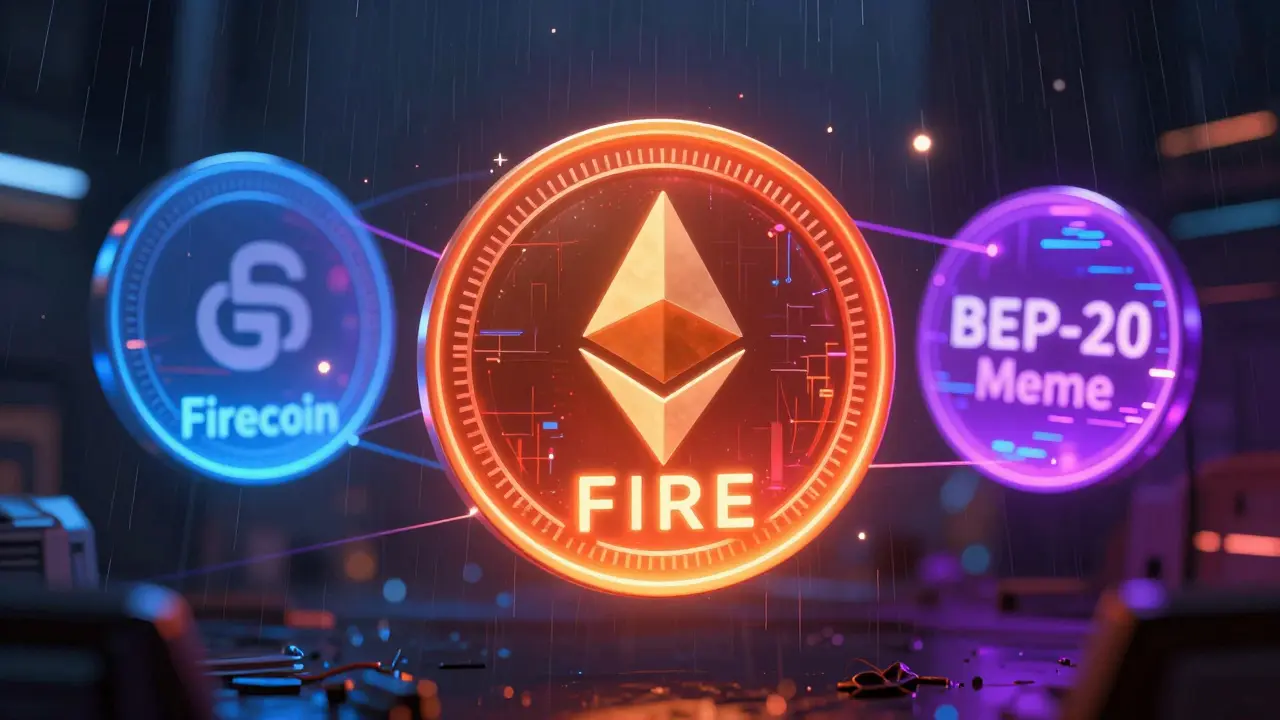
Have you ever stumbled upon a cryptocurrency with a name that sounds familiar but feels... off? Maybe you saw "Fire" and thought of the popular exchange, or maybe you just spotted the ticker FIRE on a chart and wondered what it actually does. In the messy world of crypto, names collide constantly. Today, we are cutting through the noise to look at Fire Protocol, specifically its governance token known as FIRE. This isn't the Firecoin from the centralized exchange, nor is it the random BEP-20 meme token floating around BNB Chain. This is an Ethereum-based decentralized finance (DeFi) project launched back in 2020.
If you are holding FIRE or thinking about buying some because the price looks "cheap," you need to know exactly what you are getting into. The short answer? It’s a micro-cap governance token for a lending and borrowing platform that struggles with visibility and liquidity. Let’s break down the mechanics, the market reality, and the red flags you shouldn’t ignore.
The Core Identity: What Actually Is Fire Protocol?
To understand the coin, you have to understand the machine it powers. Fire Protocol is a decentralized finance platform that integrates trading, lending, and borrowing into a single ecosystem. Think of it like a digital bank where you can deposit assets to earn interest, borrow against those deposits, and trade assets without leaving the app. The goal, according to its listing on Polkastarter, was to create tighter coupling between these functions. For example, if someone’s loan gets liquidated, the protocol aims to execute that sale against ample liquidity within its own pools to minimize slippage.
The FIRE token itself doesn’t act as a currency for buying coffee. Instead, it serves two main purposes:
- Governance: Holders vote on proposals. This includes decisions on interest rate models, which new assets get listed as collateral, and how incentives are distributed.
- Incentives: The protocol uses FIRE to reward users who provide liquidity. For instance, their official X (formerly Twitter) account has advertised monthly rewards totaling $30,000 worth of FIRE tokens for liquidity providers. This is a classic "liquidity mining" strategy designed to bootstrap network activity.
Technically, FIRE is an ERC-20 token deployed on the Ethereum blockchain. You can verify its contract address (0xF921ae2DAC5fa128DC0F6168Bf153ea0943d2D43) on Etherscan. The code is verified, which is a basic security step, meaning anyone can read the source code. However, verification alone doesn’t guarantee safety-it just means the code matches what’s running on the chain.
The Confusion Trap: Not All "FIRE" Tokens Are Equal
This is where most beginners trip up. The ticker "FIRE" is not unique. If you buy the wrong one, you’re buying nothing of value to this specific protocol. Here is how to tell them apart:
| Asset Name | Network | Primary Use Case | Relation to Fire Protocol |
|---|---|---|---|
| Fire Protocol (FIRE) | Ethereum (ERC-20) | DeFi Governance & Lending Rewards | This is the subject of this article. |
| Firecoin (FIRE) | Multiple / Native | Centralized Exchange Utility | Unrelated. Associated with a different exchange brand. |
| Fire Token (FIRE) | BNB Smart Chain (BEP-20) | Generic Utility / Meme | Unrelated. Launched separately in 2021. |
Always check the contract address before swapping. The Fire Protocol token lives exclusively on Ethereum. If you see a FIRE token on Solana, Polygon, or BSC, it is likely a different project entirely unless there is a confirmed bridge wrapper (which, based on current data, is not a prominent feature here).
Market Reality Check: Liquidity and Volume in 2026
Let’s talk numbers, because they tell a stark story. As of mid-2026, Fire Protocol is what traders call a "micro-cap" asset. But even that might be generous. Here is the snapshot from major aggregators like CoinMarketCap, Binance, and Crypto.com:
- Price Range: Trading consistently between $0.0020 and $0.0024 USD.
- Daily Volume: Often below $2,100 USD. On quiet days, it dips under $150.
- Market Cap: Listed as $0 USD on many platforms.
Why is the market cap zero? Because data providers cannot find reliable circulating supply figures. Yahoo Finance lists a total supply of 100,000,000 FIRE but reports zero tokens in circulation. This suggests either that all tokens are locked, vesting, or simply not being reported correctly by the team. Without knowing how many coins are actually tradable, you cannot calculate a true market capitalization or fully diluted valuation (FDV).
This lack of transparency creates a massive risk. When volume is this thin-say, $200 in a day-a single person selling $500 worth of FIRE could crash the price by 20% or more. There is no deep order book to absorb large trades. If you buy in, getting out might be painful due to high slippage.
Technical Footprint and Activity Levels
You can gauge a project’s health by looking at its on-chain activity. Etherscan provides a clear window into this. Since its deployment on December 22, 2020, the FIRE token contract has processed approximately 9,988 transactions. Let that sink in. Over five and a half years, that averages to roughly 5 transactions per day.
Compare this to major DeFi governance tokens like UNI (Uniswap) or AAVE, which process thousands of interactions daily. Low transaction counts usually mean low user engagement. It suggests that very few people are actively using the governance features or moving their rewards frequently. While the protocol may still be functioning in the background for lending/borrowing, the token itself sees minimal movement.
Who Is Behind Fire Protocol?
In crypto, trust is often tied to reputation. Unfortunately, Fire Protocol operates with significant anonymity. There are no named founders publicly attributed to the project in major databases. No registered corporate entity is linked to the token issuance. No whitepaper with detailed technical architecture is easily surfaced in standard search results.
This "ghost team" approach is common in early-stage DeFi experiments, but it raises serious due diligence questions. If something goes wrong-if the smart contracts have a bug or the liquidity dries up completely-who do you hold accountable? The absence of audit reports from firms like CertiK or OpenZeppelin further complicates the risk profile. You are interacting with code written by unknown developers, relying solely on the fact that the contract is verified on Etherscan.

How to Buy FIRE (And Why You Might Want to Wait)
If you are determined to acquire FIRE, you will likely need to use a centralized exchange (CEX) that supports it, as direct DeFi swaps on Ethereum might carry prohibitive gas fees relative to the token's tiny value. Platforms like Bitget, AscendEX, Binance, and Coinbase have listed the pair. The process is standard:
- Create an account and complete KYC (Know Your Customer) verification.
- Deposit fiat (USD, EUR) or stablecoins (USDT, USDC).
- Search for the FIRE/USD or FIRE/USDT trading pair.
- Execute a limit order to avoid slippage on the thin order books.
However, consider the utility. Are you buying FIRE to vote on governance? With only ~5 daily transactions, your vote might be one of the only ones cast. Are you buying it for yield? The $30,000 monthly reward pool sounds nice, but if the token price drops faster than the rewards accumulate, you lose money. This is a speculative play on a niche asset with opaque metrics.
Risks and Red Flags Summary
Before adding FIRE to your portfolio, weigh these specific risks:
- Liquidity Risk: Daily volumes under $2k mean you could get stuck holding the bag if you try to sell a moderate amount.
- Data Opacity: Zero circulating supply data makes valuation impossible. You don’t know the true size of the market.
- Anonymity: No public team or audits reduces accountability.
- Low Activity: Minimal on-chain transfers suggest a dormant or extremely niche user base.
- Name Collision: High risk of accidental purchase of unrelated "FIRE" tokens.
Fire Protocol represents an interesting experiment in integrated DeFi, but as of 2026, it remains on the fringes of the ecosystem. It lacks the traction, transparency, and liquidity required for mainstream adoption. Treat it as a high-risk, experimental position rather than a core investment.
Is Fire Protocol (FIRE) the same as Firecoin?
No. Fire Protocol (FIRE) is an Ethereum-based DeFi governance token. Firecoin is associated with a centralized exchange and is a completely different project. Always check the contract address to ensure you are buying the correct asset.
What is the market cap of Fire Protocol?
Most major trackers like Binance and CoinMarketCap list the market cap as $0 USD because the circulating supply is not reliably reported. Yahoo Finance lists a total supply of 100 million but 0 in circulation, making accurate valuation impossible.
Can I stake FIRE tokens for rewards?
The protocol offers incentives for liquidity providers, advertising monthly rewards of up to $30,000 in FIRE tokens. However, staking mechanisms are tied to providing liquidity in the protocol’s pools, not necessarily simple staking wallets.
Is Fire Protocol safe to use?
Safety is uncertain. While the smart contract is verified on Etherscan, there are no public audit reports from reputable security firms. Additionally, the anonymous development team and low liquidity increase the risk of exploitation or loss.
Where can I buy FIRE tokens?
FIRE is listed on several centralized exchanges including Bitget, AscendEX, Binance, and Coinbase. You can also find it on decentralized exchanges via its Ethereum contract address, though gas fees may exceed the value of small trades.
Comments
20 Comments
Robert Hundley
Man, this article is a total wake-up call. I always thought FIRE was just another coin with a cool name, but seeing the transaction numbers... wow. Like, 5 transactions a day? That’s basically a ghost town out there. 😂 I guess that’s why it’s called Fire Protocol, because it’s burning through your attention span and leaving you with nothing. Thanks for breaking it down so clearly, really helps cut through the hype.
Melissa L
i saw this token on some random chart last week and was like oh look at me im smart buying cheap coins lol. glad i read this before i did anything stupid. the part about the market cap being zero is kinda scary tbh. how do u even value something if nobody knows how many are out there?? feels like a scam to me honestly. thanks for the heads up tho :)
Rob Morton
It makes me wonder about the nature of value in decentralized systems. If a protocol has no users and no liquidity, does it truly exist as an economic entity? The anonymity of the team suggests a lack of accountability, which is concerning when dealing with financial assets. Perhaps we should view such projects not as investments, but as experiments in community engagement that have failed to engage anyone. It is a philosophical question about trust in code versus trust in people.
John Curry
Oh my god, the sheer audacity of launching a DeFi platform with ZERO transparency! 🎭 It’s like they’re playing a game of hide and seek with our money, and let me tell you, we are losing badly. The idea that you can’t even find a whitepaper or a single named founder is absolutely dramatic in its negligence. I feel like I’m watching a tragedy unfold in slow motion, where the protagonist is a ghost and the audience is us, holding worthless tokens. What a spectacle!
Trent Erman1
Hey everyone! 👋 Just wanted to chime in and say that while this looks risky, sometimes these micro-caps are diamonds in the rough! 💎 But seriously, do your homework. The contract address is key here. Don't buy the wrong one! I’ve seen too many people get burned by name collisions. Stay safe out there and keep learning! 🚀📈
Sajjad Ghorbani Moghaddam
Look, I get it, crypto is confusing. But this specific project seems like a bad bet right now. If you're new to this, maybe stick to bigger names until you understand how liquidity works. It's not about being elitist, it's about not losing your shirt. There's plenty of good info here, just take it slow and don't rush into things you don't fully grasp.
Rebecca Shoniker
The liquidity profile is abysmal; frankly, it is pathetic.;; A daily volume under $2,100 indicates a complete lack of market interest, which is a red flag for any serious investor.;; Furthermore, the absence of circulating supply data is not just opaque, it is negligent.;; One must ask: who is auditing these contracts?;; Without third-party verification from firms like CertiK, the risk of exploitation is exponentially higher.;; Proceed with extreme caution, if at all.;;
Jay Sharma
They want you to think it's just a failed startup, but look closer. Zero circulating supply? That means they hold all the bags. It's a classic pump and dump setup controlled by insiders who know exactly when to pull the plug. The 'anonymous team' isn't just lazy, it's a shield for their illegal activities. Wake up sheeple, this is how they steal from you.
Mélanie Boulay
I have been following the development of decentralized finance protocols for quite some time, and what strikes me most about this particular case is the profound disconnect between the ambitious marketing claims and the stark reality of the on-chain metrics, which clearly demonstrate a lack of sustained user engagement and liquidity depth that would be necessary for any long-term viability in such a competitive market environment.
Maurice Flynn
I suppose there's a lesson here about patience. Most of these projects die quietly. No big crash, just... fading away. Five transactions a day is basically silence. It’s sad, really. All that code, all that effort, and nobody cares. Maybe in ten years someone will dig it up as a curiosity, but right now, it’s just digital dust. Let it be.
nancy jarecki
Pathetic. Absolutely pathetic. Anyone with half a brain cell knows that a market cap of zero is not an investment opportunity, it’s a charity case for idiots. The fact that this is even listed on major exchanges is a testament to how low the barrier to entry has become. Do yourself a favor and delete your wallet app before you lose everything.
Routh Middaugh
Well, well, well!! Look at all these red flags waving around!! 🚩🚩🚩 I mean, come on people!! Who signs up for a project with NO TEAM?! No audits?! No liquidity?! It’s like walking into a casino where the house doesn’t even show you the cards!! But hey, if you wanna gamble, go ahead!! Just don’t cry when you’re left holding the bag!! 😂😂😂
Ryan Peters
This is what happens when you let unregulated tech bro scams run wild. No accountability, no oversight, just pure greed. I hope this project gets shut down by regulators soon. We need stricter laws to protect American investors from this garbage. Until then, stay far away from these foreign-coded messes.
ross harris
Oh, the sweet, sweet rot of a dead project. It smells like burnt silicon and broken promises. You can almost hear the servers humming in the void, waiting for a transaction that will never come. It’s a beautiful tragedy, really. A monument to hubris. Go ahead, buy some. Add your name to the wall of shame. It’s free real estate.
Carl Belgrave
Listen up! This is trash! Pure trash! If you’re American, you should be ashamed of supporting these weak, anonymous projects. They’re hiding because they’re guilty. Buy gold, buy stocks, buy real assets. Don’t throw your money into this black hole. Stand strong and demand better standards!
Carl Hanzel
You’re all missing the point. It’s not risky, it’s genius. Think about it. Zero volume means no slippage for the whales. Anonymous team means no leaks. They’re building a fortress of solitude for their own profits. While you argue here, they’re laughing all the way to the bank. Enjoy the narrative, it’s cute.
Daniel J. Cox
Haha, this reminds me of the early days of internet forums where everyone had a pet project that nobody used. 😄 It’s funny how we treat crypto like it’s different. It’s just code. If nobody uses it, it’s useless. Thanks for the laugh though, reading about the 5 transactions a day cracked me up. Keep it real folks! ✌️
Emma Rémond
How utterly quaint. The notion that one might derive utility from a token with negligible liquidity is laughable. It is evident that the creators lack any fundamental understanding of market dynamics. To suggest otherwise is to insult the intelligence of anyone with basic financial literacy. Avoid this subpar asset at all costs.
ELNORA JEFFERSON
Boring. So boring. Another dead coin story. Can we talk about something interesting? I’m tired of reading about failures. Move along, nothing to see here except a bunch of zeros.
Carol @minaszilda
Take a deep breath. It’s okay to make mistakes. Learning from these examples is valuable. Don’t let fear stop you from exploring, but always prioritize safety. Knowledge is power. Stay positive and keep growing.
Write a comment