




Most of us have felt the sting of freelance platforms taking a massive chunk of our hard-earned money. Whether it's a site like Upwork or Fiverr, it's not uncommon for intermediaries to swallow 30% to 40% of a contract's value in fees. This creates a frustrating gap where the person doing the work gets paid less and the person hiring pays more, all to support a corporate middleman. Work X is a decentralized job economy platform designed to kill off these intermediaries and create a zero-marginal-cost economy for work contracts. By moving the hiring process to the blockchain, it aims to return that lost value to the actual workers and employers.
How Work X Flips the Employment Model
Traditional job boards are essentially toll booths. They control the data and charge a premium for the privilege of connecting two people. Work X changes this by using a Decentralized Autonomous Organization (or DAO), which is essentially a community-led entity that operates without a central CEO or board of directors. Because it functions as a non-profit, the goal isn't to maximize shareholder profit, but to keep the platform running and improving for its users.
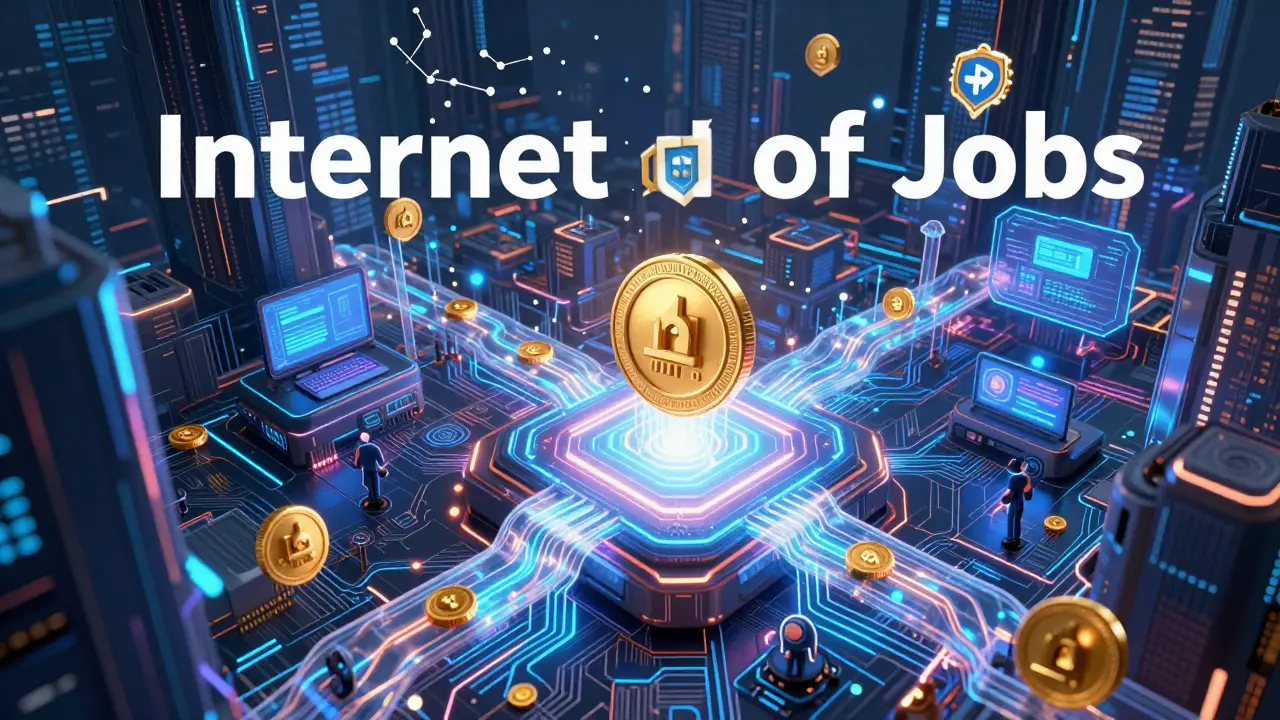
The platform creates what they call "The Internet of Jobs." Imagine a world where you don't need a corporate account to prove you're a qualified developer or designer. Instead, you use decentralized identity tools to own your career data. No more worrying about a platform deleting your account and erasing years of client reviews; your reputation is anchored to the blockchain, not a private company's database.
The Role of the WORK Token
WORK is the utility token that powers the entire ecosystem. You can't really interact with the platform's advanced features without it. Think of it as the fuel for the engine: you use it to create job postings, access the generative AI assistant, or take part in skill assessments.
One of the clever parts of the system is how it handles money. Most people aren't ready to pay for a job in a random crypto token, so Work X allows fiat currency transactions. However, behind the scenes, the platform converts these payments into WORK tokens. This creates a constant demand for the token as more people join the platform, potentially driving value for those who hold it.
| Feature | Purpose | Requirement |
|---|---|---|
| Job Postings | Connecting employers with talent | WORK Token |
| AI Assistant | Profile and resume optimization | WORK Token |
| Governance | Voting on platform updates | Staked WORK Tokens |
| Verification | Proving skills via blockchain | WORK Token |
Smart Tech: AI and Verified Skillsets
Matching a job seeker to a role is usually a guessing game based on a PDF resume that anyone could have written. Work X tries to fix this with a few high-tech additions. First, there's a generative AI assistant that helps users build high-quality profiles instantly, removing the "blank page' struggle.
More importantly, they use Work Performance Indicators. Instead of relying on a subjective interview or a fancy degree, the platform matches candidates based on verified work experience and actual performance data. This is paired with Self-Sovereign Identity (SSI) wallets, which let you store your own credentials and only share what is necessary with a potential employer.
They've also introduced "learn-to-earn" NFT achievements. This means as you gain new skills or complete difficult projects, you earn a digital badge that serves as an immutable proof of competence. It turns your career path into a verifiable map that an employer can trust without needing to call five previous bosses for references.

The Technical Backbone: BEP20 and Proof of Work
Under the hood, Work X uses Proof of Work (PoW) to secure its transactions. This is the same fundamental logic that secures Bitcoin, requiring computational effort to validate blocks and keep the network honest.
To make the token accessible, Work X utilizes the BEP20 network, which is the standard for the Binance Smart Chain (BSC). This is a strategic move because BSC is one of the most liquid and fastest ecosystems in crypto, making it much easier for users to deposit, withdraw, and trade their WORK tokens without paying the insane gas fees associated with the main Ethereum network.
Market Performance and Where to Trade
If you're looking at the price charts, you'll see that the WORK token has had a wild ride. It hit an all-time high of $0.74, but like many early-stage Web3 projects, it has faced significant volatility. Recent data shows it trading much lower, often around $0.01, which is a common pattern for tokens that launch with hype before the full utility of the platform is realized by the mass market.
Finding the token is easier than it used to be. While it started exclusively on Gate.io, it expanded significantly when KuCoin listed it in December 2023. You can also find pricing data and availability on Coinbase. The primary trading pair is WORK/USDT, making it simple for most traders to enter or exit their positions.
What's Next for the Ecosystem?
Work X isn't just trying to be a better Upwork; they want to own the entire human capital pipeline. Their roadmap includes the WorkPi dApp, which acts as a hub for users to enrich their profiles through educational courses and assessments.
The long-term goal is to move into a full-scale marketplace for education and development. This means the platform would not only help you find a job but also tell you which skills you're missing and provide the tools to learn them-all verified on the blockchain. It shifts the focus from "finding work" to "managing a career" in a decentralized way.
Does Work X actually eliminate all fees?
The platform aims for a zero-marginal-cost economy by removing the 30-40% commercial commissions typical of traditional marketplaces. While it uses a dynamic fee model to cover basic operational costs, these are designed to scale down as the platform grows, ensuring the bulk of the money stays with the worker.
How is the WORK token different from a regular stock?
Unlike a stock, the WORK token is a utility token. Holding it gives you access to platform services (like the AI assistant) and governance rights via the DAO. You can vote on how the platform is developed, which is a level of control you don't get with traditional corporate shares.
What is the BEP20 network and why does it matter for WORK?
BEP20 is the token standard for the Binance Smart Chain. For the WORK token, this means faster transaction speeds and significantly lower fees than if it were on Ethereum, making it practical for small-scale payments between freelancers and employers.
Can I use Work X if I don't know how to use crypto?
Yes. The platform allows for fiat currency transactions to lower the barrier to entry. The system handles the conversion to WORK tokens internally, so you can experience the decentralized benefits without needing to manage a complex crypto wallet for every single payment.
What are Work Performance Indicators?
They are unbiased metrics used to match candidates with employers based on actual demonstrated skills and completed work rather than a subjective resume. These indicators are verified on the blockchain to prevent fraud.
Troubleshooting and Getting Started
If you're looking to get involved with Work X, your first step is setting up a compatible wallet (like MetaMask or Trust Wallet) that supports the Binance Smart Chain. Since WORK is a BEP20 token, sending it to an Ethereum address will result in a permanent loss of funds-always double-check your network settings.
For freelancers, the best way to gain traction is to start utilizing the WorkPi dApp. By taking assessments and earning NFT achievements, you build a "trust score" that makes you more visible to employers who are tired of filtering through hundreds of unverified resumes. If you're an employer, start by exploring the DAO governance proposals to see how the platform's matching logic is evolving to better suit your industry's needs.
Comments
21 Comments
Tyler Webb
This sounds like a much more equitable way to handle freelance work. It is really heartbreaking how much the big platforms take from creators just for providing a basic connection :)
Tracie and Matthew Hartley
lol a decoenteralized job market? sounds like another way for people to lose money on a fancy coin that goes to zero. just use linkedin like normal people do
Adam Auksel
Actually, the idea of owning your own career data is a game changer! 🚀 Imagine not being at the mercy of a corporate account ban after years of building a reputation. This is the way forward! ✨
william manes
Only idiots trust these coins 🤡🇺🇸
Kieran Smith
i laov the idea of learn-to-earn nft's! it makes the whole grind feel like a game and actualy proves you know your stuff without a boring old resume
Lela Singh
Pure magic! This is a dazzling leap for freelancers. Let's crush those parasitic fees! ⚡
daniella davis
Um, please. Calling this a "future" is such an overstatement. It's just a basic DAO wrap on a job board. I've seen a dozen of these fail since 2017 and the math on the WORK token is basically a joke lol
Terrance Hausmann
I can see how this helps people. However, the volatility of the token might be scary for someone just trying to make a living, but if the fiat bridge works well, it could really bridge the gap for a lot of global talent who are currently shut out of the high-paying markets by ridiculous corporate gatekeepers.
Surender Kumar
looks pretty cool actually. hope it works out for everyone who is tired of those huge fees
Amanda Faust
the bep20 choice is just for cheap gas its not some strategic revolution
Rebecca Violette
i tried to set up my wallet and it's just so confusing i feel like i'm gonna lose everything and i can't even sleep tonight because of this stress
Jonathan Chamma
It is quite a refreshing concept to prioritize verified performance over a piece of paper. This could truly democratize access to opportunity for talented individuals regardless of their background.
Scott Fenton
The implementation of Self-Sovereign Identity is the most critical component here. By ensuring the user retains control of their credentials, the platform mitigates the risk of centralized censorship and data silos.
Lane Montgomery
What's your wallet address?
logan bates
Keep the jobs in the US. This blockchain stuff just lets more overseas cheap labor undercut everyone.
Omotola Balogun
Actually, the Proof of Work aspect is a bit redundant for a job platform's internal logic but fine for the chain security. Most people confuse utility with governance anyway, which is a common mistke in these whitepapers.
EDOZIEM MICHAEL
the soul of work is changing and we are just witnesses to the digital shift of human effort
Akshay Gorad
I appreciate the effort to lower fees for the workers. It is a fair approach.
jennelle williams
everyone deserves a fair chance to earn
Will Dixon
this sounds like a good way to help new peple get started in the gig economy without getting ripped off by the big sites
Artavius Edmond
I'm down with this. Definitely beats arguing with an Upwork support bot for three days just to get a payment released.
Write a comment