

Have you ever wondered if your favorite painting could live on the blockchain? That’s the promise behind Public Masterpiece Token, also known as PMT. It is a cryptocurrency designed to bridge the gap between physical art and digital ownership. But is it just another meme coin with a fancy name, or does it have real utility?
As of June 2026, PMT sits in a unique spot in the crypto market. It claims to be part of the growing Real World Asset (RWA) tokenization trend, yet its branding often leans into "meme" culture. If you are looking to buy, hold, or simply understand what PMT actually does, you need to look past the hype and check the numbers.
Key Takeaways
- PMT connects physical art to blockchain: The project aims to issue digital certificates for real-world artworks.
- Price volatility is high: As of early June 2026, PMT trades around $0.10, but prices vary significantly across exchanges.
- Supply dilution risk exists: Only about 5% of the maximum 2 billion tokens are currently circulating.
- Limited technical transparency: There is no public whitepaper or GitHub repository linked from major exchange pages.
- Trading access varies: You can trade PMT on Bybit and LBank, but not directly on Binance's central order book.
What Exactly Is Public Masterpiece Token (PMT)?
At its core, Public Masterpiece Token is a fungible cryptocurrency. This means each PMT token is identical to every other PMT token, unlike NFTs which are unique. However, the project uses these tokens to support an ecosystem that includes non-fungible elements.
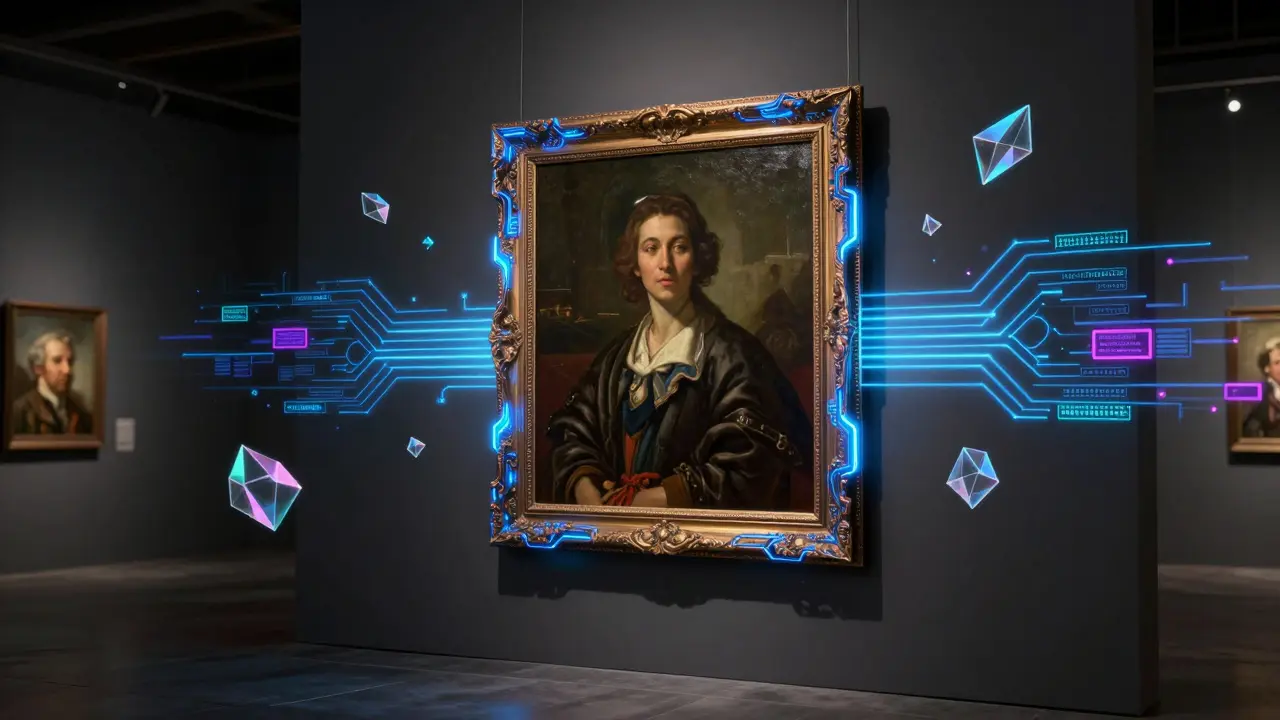
The main idea is simple: link physical art pieces to the blockchain. When you buy a physical painting through their platform, you might receive a digital certificate or an NFT that proves ownership or authenticity. This falls under the broader category of Real World Assets (RWAs), where tangible items like real estate or art are represented digitally on a ledger.
But here is the twist. CoinGecko lists PMT as "Public Meme Token." This creates a confusing identity crisis. Is it a serious infrastructure play for art provenance, or is it a community-driven meme coin? The official website emphasizes the "art meets blockchain" angle, while social media presence often highlights the "meme" aspect. For investors, this duality means the price action might be driven more by social sentiment than by actual adoption by galleries.
PMT Tokenomics: Supply and Dilution
Understanding the supply structure is critical because it affects future price potential. Here is the breakdown based on data from Coinbase and Bybit as of June 2026:
| Metric | Value | Implication |
|---|---|---|
| Maximum Supply | 2,000,000,000 | Fixed cap; no infinite printing. |
| Circulating Supply | ~103.5 Million | Only ~5% of max supply is in hands. |
| Total Supply | ~281 Million | Tokens issued but potentially locked/unreleased. |
| Fully Diluted Valuation (FDV) | ~$189 Million | High FDV relative to current market cap suggests future selling pressure if all tokens unlock. |
The big red flag here is the low circulating supply. With only about 103 million tokens out of 2 billion available, the current market cap of roughly $9.8 million looks small. However, the Fully Diluted Valuation (FDV) is nearly $190 million. If the team releases more tokens into the market later, the price could drop significantly unless demand increases proportionally. Always watch for vesting schedules or unlock events, though specific dates are not clearly published in standard listings.
How Does PMT Work? Utility and Ecosystem
If you hold PMT, what can you actually do with it? The project outlines three main utilities:
- Staking Loyalty NFTs: Users can stake loyalty NFTs associated with artists or brands to earn PMT rewards. This incentivizes long-term holding rather than quick flips.
- Art Provenance: Galleries or artists may use the platform to create immutable records of artwork ownership. This helps combat forgery and simplifies resale tracking.
- Community Engagement: As a "meme-adjacent" token, PMT relies heavily on influencer engagement and community voting or participation features.
However, there is a lack of technical documentation. Unlike established projects like Ethereum or Solana, PMT does not prominently feature a GitHub repository or a detailed technical whitepaper on its main landing page. This makes it hard for developers to verify the security of the smart contracts or understand the underlying architecture. Are they built on Ethereum? BNB Chain? Polygon? The sources don't explicitly state the base chain, though most Web3 wallets support ERC-20 or BEP-20 standards.
Current Price and Market Performance (June 2026)
Cryptocurrency prices change by the second, and smaller tokens like PMT often show different prices on different exchanges due to lower liquidity. Here is how PMT was performing in early June 2026:
- Bybit: Traded around $0.107 with a 24-hour volume of over $265,000.
- Coinbase: Listed near $0.10 with a market cap of ~$9.8 million.
- Crypto.com: Showed a price of $0.1073 with similar volume metrics.
- All-Time High (ATH): Reached $0.0951 back in July 2025. Note that recent prices are slightly above this ATH, indicating some growth since mid-2025.
The trading volume is modest. A daily volume of $250k-$300k means you can buy or sell small amounts easily, but large institutional orders would likely cause significant slippage. This confirms PMT is still a micro-cap asset, suitable only for speculative portfolios.
Where Can You Buy PMT?
Accessing PMT requires knowing which platforms list it. Not every exchange carries this token.
Centralized Exchanges (CEX): Bybit offers direct spot trading pairs for PMT. You can deposit USDT or other major cryptos and swap them for PMT instantly. LBank also provides guidance on acquiring PMT, suggesting it is listed there as well.
Decentralized Access: Binance explicitly states that PMT is not listed on its central exchange for trading. However, they provide a guide on using the Binance Web3 Wallet to interact with decentralized liquidity pools. This means you can find PMT if you know how to connect a wallet to a DEX (Decentralized Exchange), but you cannot just click "Buy" on the main Binance app interface.
Wallet Compatibility: Since PMT is a fungible token, it should work with any standard Web3 wallet that supports the relevant blockchain network (likely Ethereum or BSC). Ensure you have the correct contract address before transferring funds to avoid losing your assets.
Risks and Red Flags to Watch
Before investing, consider these risks specific to PMT:
- Transparency Gap: No named founders or team members are publicly highlighted on major aggregator sites. Anonymous teams carry higher risk.
- Dilution Potential: With 95% of tokens not yet circulating, future unlocks could crash the price.
- Niche Market: The intersection of "meme coins" and "high-end art" is unproven. Will serious collectors use this, or just speculators?
- Liquidity Risk: Low trading volume means it might be hard to exit large positions quickly.
Is PMT a Good Investment?
There is no simple yes or no. If you believe in the long-term narrative of tokenizing physical assets (RWAs), PMT is an early-stage experiment worth watching. Its connection to artists and influencers gives it a marketing edge that pure tech tokens lack.
However, if you are looking for stability or transparent governance, PMT might not fit. The lack of a clear roadmap, missing technical docs, and anonymous leadership mean you are betting on the brand and community hype rather than fundamental utility. Treat it as a high-risk speculative asset, not a savings account.
What blockchain is Public Masterpiece Token (PMT) built on?
While not explicitly stated in all public listings, PMT functions as a fungible token compatible with standard Web3 wallets. Most tokens of this type operate on Ethereum (ERC-20) or BNB Smart Chain (BEP-20). Check the contract address on Bybit or CoinGecko to confirm the specific network before transferring.
Can I buy PMT on Binance?
You cannot buy PMT on the main Binance centralized exchange. However, Binance provides a guide to purchasing PMT using the Binance Web3 Wallet, which allows you to swap tokens via decentralized protocols.
Who founded Public Masterpiece Token?
The specific names of the founders or core team members are not publicly listed on major data aggregators like CoinGecko or Coinbase. The project is referred to as a "collective," which often implies a decentralized or anonymous development group.
What is the difference between PMT and an NFT?
PMT is a fungible token, meaning each unit is the same and can be traded for equal value. NFTs (Non-Fungible Tokens) are unique. In the PMT ecosystem, you might use PMT to buy or stake loyalty NFTs that represent ownership or access to physical art.
Is PMT considered a Real World Asset (RWA)?
PMT itself is a utility token, but the project facilitates RWAs. It aims to tokenize physical art by linking digital certificates to real paintings, thereby bringing traditional art assets onto the blockchain.
Comments
24 Comments
Sylvia Mossman
Let's be real for a second, this whole "art meets blockchain" thing is just a fancy way to say "we need more liquidity." The FDV is nearly $190 million while the market cap is barely double digits. That isn't an investment opportunity; that is a dilution trap waiting to happen. Who exactly are these anonymous founders? Are they in a bunker laughing at us? I don't trust projects that hide their team behind a "collective" label. It screams rug pull or at least massive insider selling when those unlocks hit. Stay away unless you enjoy watching your portfolio evaporate.
Alexander DeVries
I see where you are coming from with the skepticism, but we have to look at the potential here too. The RWA narrative is huge right now and PMT is positioning itself early. Sure, the tokenomics are risky with that low circulating supply, but if they actually get galleries on board, the utility could drive demand up before the big unlocks. It is about timing the entry correctly rather than just avoiding it entirely. You have to believe in the vision of digitizing provenance to make this work long term.
Lee Paige
This entire concept is a foreign imposition on traditional art markets. Why do we need blockchain verification for paintings? The system works fine without crypto interference. These digital certificates are just another layer of complexity designed to confuse investors and siphon money into offshore wallets. I suspect there is a larger agenda here to undermine local cultural institutions by replacing them with decentralized nonsense. We should protect our heritage from these digital parasites.
JEVON HALL
Hey guys, just wanted to add some value here since everyone is focused on the negatives 😅
The key thing people miss is the Binance Web3 Wallet integration. Even though it is not on the central exchange, being able to swap via DEXs on Binance is a huge plus for accessibility. Most small caps struggle with liquidity access, but having that bridge helps. Also, check the contract address carefully before you buy because there are always fake tokens out there. It is all about doing your own due diligence on the smart contract security 🛡️
Karthikeyan S
lol ur all so naive 😂
the fact that u r even reading this post means u r already part of the problem
why would anyone care about physical art when u can just mint a jpeg?
this project is basically a scam wrapped in a shiny bow
the team is anon which means they will vanish faster than u can blink
do not waste ur time analyzing charts for garbage like this
just hodl btc and cry later 📉💀
Dinesh Pattigilli
It is pathetic how many people fall for this meme-adjacent marketing. Real connoisseurs of fine art do not trade through Bybit. They deal through Sotheby's and private auctions. This attempt to democratize high-end art ownership is an insult to the exclusivity that gives art its value. The lack of a whitepaper is not a feature; it is a glaring omission that reveals the incompetence of the developers. Only the intellectually lazy would consider putting capital into such a poorly documented venture. The grammar on their social media posts alone should disqualify them from serious consideration.
Madhu Menon
One must ponder the nature of value itself. If a painting exists only as a digital certificate, does it still hold the soul of the artist? Or has it become merely a number in a ledger? The intersection of meme culture and high art creates a paradox where seriousness is undermined by absurdity. Perhaps this is the next step in human evolution, or perhaps it is the final stage of cultural decay. We are witnessing the commodification of beauty in its purest, most hollow form. 🤔
Alexis Abster
I am trying to stay optimistic because the idea of staking loyalty NFTs to earn rewards sounds genuinely innovative! Imagine supporting your favorite local artist and getting rewarded for holding their digital certificate. It feels like we are building a new economy based on appreciation rather than just speculation. The community engagement aspect is what really excites me. If we can create a space where art lovers and crypto enthusiasts collaborate, we might just change the game. Let us support the dreamers!
Brad Ranks
Oh wow, look at us pretending we understand tokenomics. Meanwhile, the price is bouncing around $0.10 like a pinball machine in a casino. I bought in at $0.09 and now I am sweating every candle. Is it going to moon? Is it going to zero? Nobody knows except the insiders who are probably sipping margaritas on a yacht. This volatility is exhausting. My heart rate is higher than the FDV. Just send help.
Caitlin Donahue
i think ppl are overreacting a bit. sure the risks are there but isnt that true for almost all altcoins? the fact that it is listed on coinbase and bybit gives it some legitimacy. i mean, they dont just list anything. maybe the anon team is just privacy conscious? idk, im not gonna judge until i see more info. just keep ur expectations low and dont invest rent money lol
verna kennedy
You are all missing the forest for the trees. The real issue is the lack of technical transparency. No GitHub? No whitepaper? In the world of software development, this is unacceptable. It suggests that either the technology does not exist or it is so flawed that they cannot show it. I have seen dozens of projects fail because of poor documentation, and this one fits the pattern perfectly. Do not let the hype blind you to the basic principles of engineering rigor.
Matthew Malone
Seriously, why are we letting these globalist crypto schemes infiltrate our financial systems? This token is likely backed by entities that want to control the art market and manipulate prices. It is a classic example of how decentralized finance is actually centralized power disguised as freedom. We need to stick to assets that are tangible and regulated within our borders. This stuff is just gambling for the masses.
aaliyah zahid
I find it fascinating how different cultures perceive value. In some parts of the world, art is a status symbol, while here it is becoming a tradable asset class. The sarcasm in some of these comments is palpable, but maybe that is just the internet way of processing change. Whether you love it or hate it, the trend toward tokenization is happening. Ignoring it won't make it go away. Maybe we should embrace the chaos instead of fighting it?
Erik Kirana
It is truly embarrassing how little research most of you are doing. You call yourselves investors but you cannot even find the contract address. This is amateur hour. A proper analysis requires examining the vesting schedule, the team's background, and the underlying blockchain architecture. Since none of that is available, the only logical conclusion is that this is a dump-and-run scheme. Stop wasting your time and start learning how to read code. 📚
dan kaffeman
This is another example of weak-minded individuals chasing trends instead of building real wealth. The elite know that physical assets like land and gold are the only things that matter. Crypto is a distraction created to keep the working class busy with numbers on a screen. I feel sorry for those who lose their savings on this nonsense. Wake up and take back control of your finances from these digital overlords.
Meg Gran
Its ironic how everyone claims to be smart but falls for the same old tricks. The meme angle is clearly a bait to attract retail investors who dont know better. Once the hype dies down, the price will crash and burn. I bet my bottom dollar that the team has already sold their bags. Its just a matter of time before the rest of us get left holding the bag. Typical story, typical outcome.
Steven Jacobowitz
I am curious about the technical side of this. How does the platform ensure that the physical art matches the digital token? Is there an IoT component or just a trusted third party? The vagueness in the post is concerning. If the link between the physical and digital breaks, the whole value proposition collapses. I need more concrete details before I can even consider this seriously. Simple questions, complex answers needed.
Greg Lewis
you guys are worrying too much about the details when you should be focusing on the vibe. vibes are everything in crypto right now. if the community is strong the price goes up. if the community is weak the price goes down. simple as that. stop overthinking it and just join the discord. see you there or not your loss.
Dr Lynea LaVoy
As someone who has studied both art history and blockchain technology, I can tell you that this hybrid model has potential but also significant hurdles. The provenance tracking is valuable, but the execution needs to be flawless. Trust is the currency here, and currently, PMT is short on it. However, if they can partner with reputable auction houses, they might gain the credibility needed to survive the initial volatility. Patience and careful observation are key.
Kelly Tenney
I appreciate the detailed breakdown in the original post. It helps to have clear information about the risks. For those new to this, remember that diversification is important. Never put all your eggs in one basket, especially with high-risk assets like PMT. It is great to explore new opportunities, but always prioritize protecting your capital. Let us learn together and grow as a community.
Narendra Kulkarni
nice post man. thanks for sharing the info. i was thinking about buying some pmT but after reading this i think i will wait and watch. the risk seems too high for me right now. maybe later when things are clearer. good luck to everyone involved 👍
Caralee Robertson
i cant believe ppl are still falling for this. the writing is on the wall. no whitepaper no future. its just a meme coin with a pretentious name. save urself the headache and move on. there are better projects out there that actually have substance. dont be a sucker.
Mark Corpuz
It is interesting to observe the diverse perspectives here. While some see danger, others see opportunity. The truth likely lies somewhere in between. The project represents a novel approach to asset tokenization, but its success depends entirely on execution and transparency. Until then, caution is warranted. Let us continue to monitor developments and share insights respectfully.
Yogendra Dwivedi
I have been following the RWA trend closely and PMT is an intriguing case study. The question is whether the utility justifies the valuation. With only 5% circulating, the potential for growth is there, but so is the risk. I am keeping an eye on their social media activity to gauge community sentiment. If they can build a loyal base, they might surprise everyone. Time will tell.
Write a comment